Trump's tariffs could mean a softer freight environment and fewer Class 8 sales. Then there's the question of an emissions pre-buy.
Image: HDT Graphic
4 min to read
Heavy-duty truck orders and production have been dropping, and Trump administration actions may suppress that even further.
Chris Brady of Commercial Motor Vehicle Consulting said Class 8 production “faces significant downside risks” due to a number of factors:
Ad Loading...
Repercussions of a trade war on the freight environment.
The Trump administration possibly eliminating 2027 model year emission standards, which would eliminate the expected truck pre-buy in 2025 and 2026.
Tariffs on trucks and vehicle parts produced in Canada and Mexico.
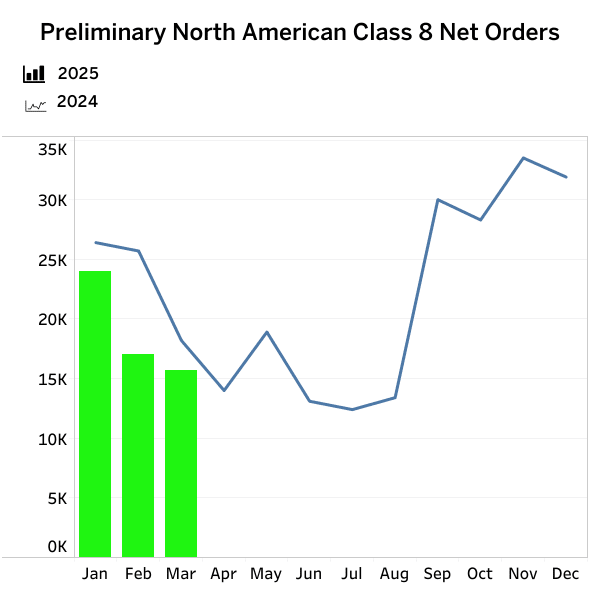
FTR and ACT Research reported that preliminaryNorth American Class 8 net orders in March were down significantly.
Medium-Duty Orders
ACT Research, which also tracks medium-duty order numbers, reported Class 5-7 orders for March were 18,600, down 33% year over year. Month over month, seasonally adjusted, Class 5-7 orders rose 6.2% to 16,800, a 201,000-unit annual rate.
FTR said 15,700 orders in March were down 14% month-over-month and 22% year-over-year. FTR analysts said this was significantly below the seven-year March average of 24,760 and was a slightly larger-than-expected seasonal drop month-over-month.
Ad Loading...
The vocational market accounted for the bulk of the month over month declines, although on-highway orders were predominantly weaker as well, according to FTR, which said Class 8 orders for the past 12 months totaled 277,927.
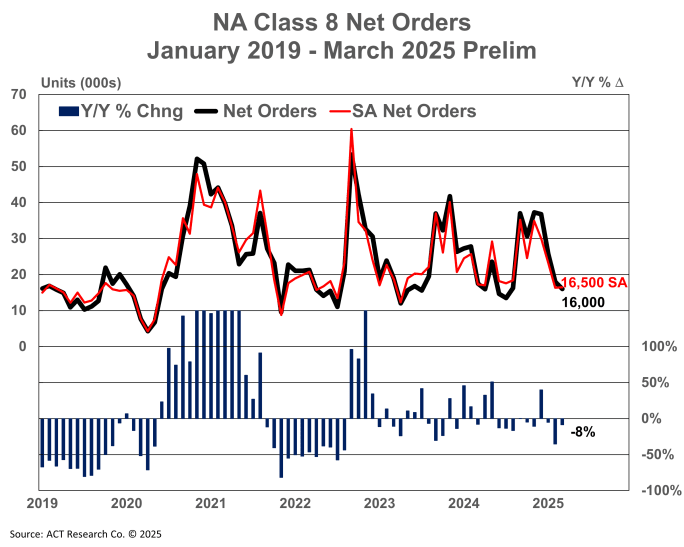
ACT Research’s March Class 8 net orders estimates for March were 16,000, down 8.3% year over year.
Word of the Day: Uncertainty
“Persistent uncertainty in tariffs, the economy, freight, and regulations could notably disrupt fleet replacement cycles,” said Dan Moyer, FTR’s senior analyst, commercial vehicles, “potentially prompting fleets to either accelerate purchases ahead of expected price hikes or, more likely, delay investments until market conditions stabilize.
“The latter scenario appears supported by the 25% year over year decline in net orders for 2025 to date. Cumulative net orders for the 2025 order season (September 2024 through March 2025) were down by 8% year over year as well.
ACT Research said March's seasonally adjusted annual order rate of 198,000 is one of the lowest one-month readings in almost three years.
Source: ACT Research
“New and pending U.S. tariffs and retaliatory tariffs are expected to significantly increase costs for North American Class 8 trucks, tractors, and related components. OEMs and suppliers may consider shifting production to mitigate tariff exposure, but such strategic adjustments are costly, complex, and time-consuming, further complicating industry planning.”
Similarly, ACT Research analyst Carter Vieth said, “The first quarter of 2025 has been defined by one word: uncertainty.
Ad Loading...
“Whether the slowdown in orders is a result of moderating economic activity, private fleets pausing expansion, or a response to trade and policy uncertainty is difficult to surmise and remains an open question.”
Seasonally adjusted, ACT said, March Class 8 orders were up slightly, increasing 1.1% from February to 16,500 units. That makes for a seasonally adjusted annual order rate of 198,000, “one of the lowest 1-month SAAR readings in almost three years.”
FTR's estimates of Class 8 truck orders for March show a decline year over year.
Source: FTR
The Trade War and the Freight Environment
Other countries are already responding to President Trump's April 2 announcement of "reciprocal" tariffs on U.S. trading partners with tariffs of their own.
This kind of trade war will have large implications on the freight environment, Brady said.
“In CMVC’s opinion, the trade war will do more harm than good to the U.S. economy, resulting in a soft freight environment,” he said.
Ad Loading...
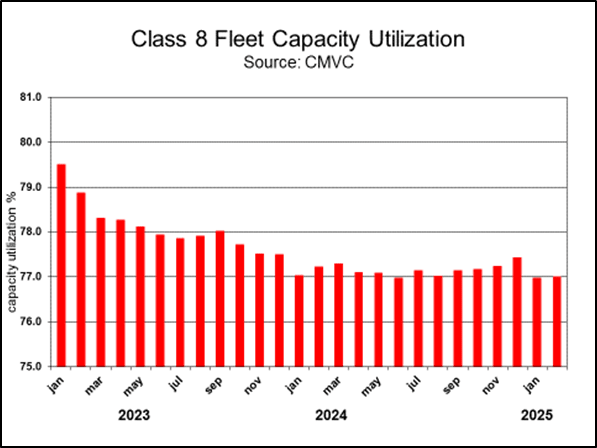
The continuing freight recession means fleets aren't under pressure to buy more trucks, and so far this year it doesn't look any better.
Source: Commercial Motor Vehicle Consulting
Tariffs on imports from other countries mean higher import prices, and that will slow consumer spending. Higher import prices also mean higher costs for businesses, and costs that can't be passed along to customers will reduce operating margins, slowing business profits. Slower business profits will prompt many businesses to also slow their investment spending.
Retaliatory tariffs from other nations will reduce the competitiveness of U.S. exports and a trade war will slow global growth. Retaliatory tariffs combined with slower global growth will slow or dampen U.S. output related to exports, again weighing on the freight environment, Brady explained.
A soft freight environment means fleets will be less likely to need to buy trucks to expand their capacity.
Brady reported that U.S. Class 8 retail sales in the first two months of 2025 were at a seasonally adjusted annual rate of 224,800 units. That’s down from 258,886 for the same time a year ago.
No Emissions Prebuy?
For several years, there have been predictions of a massive truck pre-buy as fleets try to get trucks before 2027 emissions standards kick in and raise truck prices.
RIght now, Brady said, Class 8 inventories were excessive in February, as dealers’ stocks represented 3.69 months of sales. If OEMs and dealers are planning on a Class 8 truck pre-buy to help bring stocks in equilibrium with sales, they may be disappointed, and it could lead to large decreases in Class 8 production.
Volvo’s updated D13 promises lower emissions without sacrificing performance or fuel economy. Take a closer look at what changed inside the engine in this HDT Spotlight video.
The Michelin X Multi Energy D2 is a regional haul drive tire engineered to help fleets improve fuel efficiency, durability and traction in demanding stop-and-go operations.
ZF is expanding its North American commercial-vehicle presence with new transmission applications, electrification, trailer technology and autonomous-driving systems.
Could Tesla’s camera-only autonomous driving technology work on an 80,000-pound Semi? In this commentary, HDT's Deborah Lockridge takes a look at Tesla, Cybercab, and how autonomous trucks see the road.
The U.S. Department of Transportation issued a new automated-vehicle strategy that outlines plans for driverless-truck regulations, cross-state freight corridors, and federal safety standards.
The Port Authority of New York and New Jersey announced millions in incentives for zero-emission drayage trucks, yard tractors, and new charging hubs near the port.
The National Highway Traffic Safety Administration says it lacks authority to regulate medium- and heavy-duty truck engines separately from complete vehicles, but the existing standards have not yet been eliminated.
Detroit isn’t starting from scratch to meet EPA 2027 diesel emissions standards. Its Gen 6 DD13 and DD15 engines keep much of today’s platform while updating the fuel and aftertreatment systems.