




How Truck Platooning Could Help Reduce Crashes
Following too closely is a factor in 5% of truck crashes. Deborah Lockridge says reaction to her coverage of Volvo's platooning test illustrates why this is a problem. Can platooning technology help? More in the All That's Trucking blog.

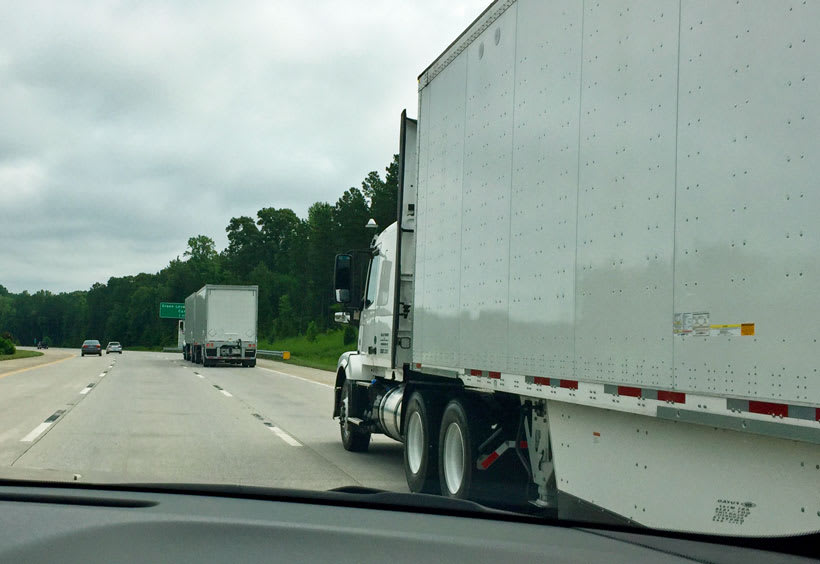
View from a car of the first two trucks in the Volvo platoon, as it prepares to cut in between them as part of the demonstration.
Photo by Deborah Lockridge
When I posted video of the Volvo Trucks North America truck platooning demonstration in North Carolina on social media, more than one person commented that the trucks didn’t look any closer than the rigs already run on highways every day without the benefit of this technology. And right there is an important thing to consider when it comes to truck safety.
The Volvo platoon was set up for a 1.5-second following distance, or about 132 feet at 60 mph. This is a larger gap than some other platooning demonstrations have highlighted and perhaps would not reap the same type of fuel economy that testing so far has shown for platoons where the following distance is more like 50 feet.
But Volvo, and FedEx Freight, which it’s collaborating with, emphasized that their primary goal with this project was safety.
The platooning system uses an extra radar sensor that’s programmed to recognize the platooning truck ahead, sophisticated software algorithms, and Dedicated Short-Range Communication (DSRC) radio for vehicle-to-vehicle communications. That V2V connection means the following trucks in the platoon can react much more quickly than relying just on radar (or a driver) detecting the slowing truck in front.
And that’s important, because The Large Truck Crash Causation Study reported that 5% of truck crashes occurred when the commercial motor vehicle driver was following the lead vehicle too closely.
The Federal Motor Carrier Safety Administration says for CMVs traveling below 40 mph, there should be at least one second of following distance for every 10 feet of vehicle length. For a typical tractor-trailer, this results in 4 seconds between you and the leading vehicle. For speeds over 40 mph, you should leave one additional second. That’s WAY more than the 1.5 seconds in the Volvo platooning test.
While the latest collision mitigation systems (like the Volvo Active Driver Assist that is standard equipment on new Volvo VNR and VNL series trucks), adaptive cruise control, and other technologies currently available can help prevent following-distance-related crashes, the vehicle-to-vehicle communication used in platooning could help even more.
Are your drivers following too close?
Related: Volvo Trucks, FedEx Demonstrate Truck Platooning in North Carolina
More Blog Posts

Beyond the Central Transport Settlement: Lessons on Hiring and Risk
The $5.5 million discrimination settlement raises broader questions about hiring practices, safety performance, and the hidden risks that can lurk in a fleet's recruiting process.
Read More →
Are Diesel Shortages Something to Worry About Again?
There’s a certain déjà vu when tensions flare in the Middle East and diesel price spikes can give you panic attacks. What parallels are there between the current situation and the 1970s energy crisis?
Read More →
NOx Isn’t Laughing Gas. Let’s Clear That Up.
A recent EPA reference mixed up NOx and nitrous oxide. It’s an easy mistake. Just not one you expect to see in emissions policy. Let’s look at the difference.
Read More →
TMC 2025 Takeaway 2: Buy... or Subscribe?
TaaS. Does that mean trucks as a service, trailers as a service, or tires as a service? HDT's Deborah Lockridge has another takeaway from the Technology & Maintenance Council meeting in her blog.
Read More →
TMC 2025 Takeaway: The Journey Toward Vertical Integration
HDT's Deborah Lockridge on how the trucking industry has moved toward "vertical integration" over the past 25 years.
Read More →
Trucks Are For Girls!
HDT Editor and Associate Publisher Deborah Lockridge is a longtime Girl Scout leader and loves to connect her passion for inspiring girls with her love of the trucking industry.
Read More →
Trucking Advocacy: Impact Beyond the 2024 Elections
No matter who wins the election, trucking continues to work to educate the people who pass the laws and make the rules that affect the industry. HDT's Deborah Lockridge shares insights from two major trucking associations in her All That's Trucking blog.
Read More →
Recharge Your Brain for Better Business
Skimping on vacation may be the worst thing you can do for your business, your career, and your mental health. In her All That's Trucking blog, Deborah Lockridge writes about the importance of giving your brain what it needs to be innovative.
Read More →
Trucker Pre-Trip Leads to Mission 'Im-paw-sible'
See what happened when a truck driver found an unexpected stowaway during his pre-trip inspection.
Read More →
HDT Editor: 2023's Most Important Trucking Topics
Read Deborah Lockridge's picks for the most significant stories we covered at HDT in 2023: freight recession, zero-emission trucks, drivers and marijuana, and more.
Read More →