




ZF Unveils its Latest Roadmap to Electric and Automated Trucks and More
German component manufacturer ZF Friedrichshafen AG showed off its vision of the future of trucking and logistics at the company's Technology Day, unveiling new electric and automated vehicle technologies.

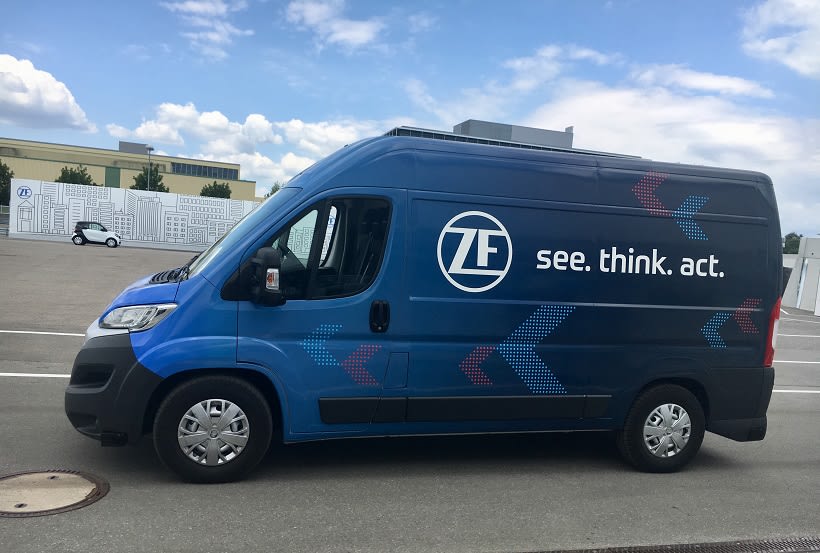
ZF's Innovation Van is a prototype electric and automated vehicle designed for last-mile delivery.
Photos: David Cullen
FRIEDRICHSHAFEN, GERMANY — A good place to envision where the future of trucking and logistics may be headed was at ZF Friedrichshafen AG’s Technology Day on June 27. And a packed day it was, full of live and full-on demonstrations of technology solutions in various stages of development.
On display, and in some cases available for taking a spin around a test track, was everything from a fully electric steering system for heavy-duty trucks and a hybrid electric drive for over-the-road commercial vehicles to an automated freight depot concept— including an automated truck and an automated yard jockey— as well as an autonomous electric van designed to neutralize last-mile delivery challenges.
Put it all together, and ZF pulled out what must have been all the stops to highlight the breadth and depth of its activities aimed at developing advanced products and systems that will, as the company puts it, “enable vehicles to see, think, and act.”
Already well known as a provider of driveline and chassis components as well as active and passive safety technology, ZF clearly has no plans to stay within the bounds of those product categories. The technology demonstrated fell into several “action areas,” said ZF CEO Wolf-Henning Scheider, including “full electrification”, automated driving, “digitization” [connectivity], and “integrated safety.”
Scheider said he expects autonomous drive to see “wider use in commercial vehicles much earlier than in passenger cars. We see autonomous technologies becoming standard in areas where they increase operational security and reduce operational costs.”
He said the future rollout of automated driving solutions will be determined by “business cases,” pointing out it’s easier to make a case for driverless vehicles in off-highway and transit bus applications first. “The most difficult solution to develop will be for urban traffic, so that I expect that to be last,” he said.
As for electric trucks, Scheider said the electrification of powertrains fits many applications. He said ZF will push this trend along with “pure” electric drive systems as well as with hybrid solutions and by electrifying components (such as automated manual transmissions) in integration schemes. Scheider noted that he expects that by 2025, all-electric drivetrains could reach 20% market penetration in medium- and heavy-duty trucks and score up to a 30% share of transit buses and delivery vans.
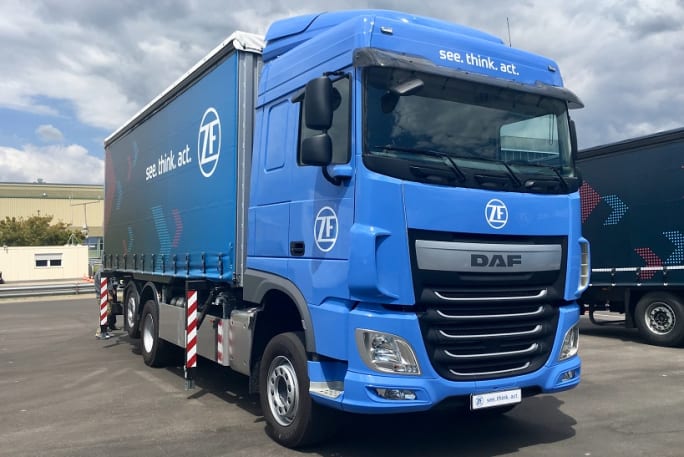
The ZF Innovation Truck was another concept vehicle with advanced technologies designed to show what direciton logistics could take at freight depots.
Here are short takes on just some of the new products and technology prototypes demonstrated by ZF:
ReAX EPS, according to ZF, is the world’s first prototype of a fully electric steering system for commercial vehicles that eliminates the need for hydraulics and associated peripheral components. In addition, the Electrically Powered Steering (EPS) system is designed to support steer-by-wire applications in the future. ZF said that fully electric steering is an important enabler for advanced driver assistance systems (ADAS) and automated drive functions that can help boost safety as well as driver comfort and improve logistics workflow. ZF noted ReAX EPS offers increased efficiency with reduced packaging space and weight, compared to traditional hydraulic steering systems. A ZF engineer told HDT the system may reach the market within four years.
cCab is a new active cab suspension system that balances the roll and pitch behavior of the vehicle as well as the upward and downward movement of the cab. ZF said it “creates outstanding work conditions for the drivers when the commercial vehicle is being driven manually.” As ZF sees it, cab suspensions are “usually passive systems that react to external influences, such as changes in road conditions, by absorbing and damping movements with springs.” In contrast, ZF’s electronically controlled active cCAB system can “actively adjust the cabin, anticipating undesired movements and preemptively working against them.”
TraXon modular automated transmission system will be equipped with an optional predictive maintenance function starting in 2019. ZF said this will monitor the condition of critical factors, such as transmission oil or clutch discs via the Cloud. That will mean maintenance can be planned proactively to reduce costs and downtime as well extend the transmission's service life.
Innovation Van is a prototype electrically driven and automated “last-mile delivery” solution. “[It] is an extensive solution tailored to the requirements of the delivery sector,” said Gerhardt Gumpoltsberger, head of Innovation Management at ZF. “In order to meet the wide range of challenges of inner-city deliveries, we called upon our entire range of competencies – from autonomous driving and electromobility right up to networking within a smart support system.”
Gumpoltsberger said the Innovation Van is equipped with Level 4 autonomous driving functions. The truck is designed to independently maneuver through urban surroundings, stay on course even if roads do not have lane markings, recognize both traffic lights and road signs, and react to sudden hazardous situations. In addition, it can recognize and avoid obstacles such as vehicles double parked. ZF noted that a tablet-based remote control is “particularly helpful for a courier: If two addresses are so close that the best delivery route is on foot, the Innovation Van follows the courier as if on a virtual leash. If there is no parking available outside an address, the courier can send the vehicle ahead to the next stop, where it will look for a parking space on its own.”
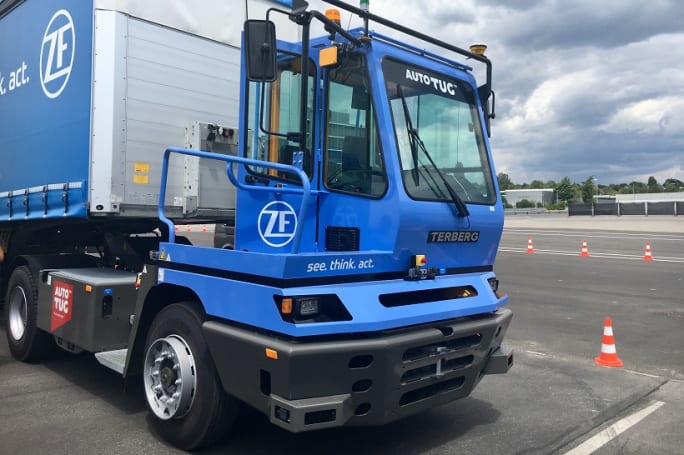
ZF said that in the future the Innovation Yard tractor could autonomously maneuver swap bodies or trailers to their respective destinations” to enable logistics operators to increase efficiency, speed, and environmental friendliness
Innovation Truck and Innovation Yard Tractor prototypes together show “what direction logistics could take at freight depots.” ZF said that the pair “in future could autonomously maneuver swap bodies or trailers to their respective destinations” to enable logistics operators to increase efficiency, speed, and environmental friendliness while reducing accidents and avoiding damage. Last but not least, driverless vehicles with the ability to maneuver help counter the ever growing shortage of skilled drivers.
"Autonomous vehicles that, thanks to our technologies, can see, think and act are turning the idea of consistent smart logistics into reality, at depots and other specified areas," said Fredrik Staedtler, head of ZF's Commercial Vehicle Technology Division. "These vehicles can prevent maneuvering damage and downtimes, which gives logistics companies a competitive advantage.”
Related: Quick Spin: ZF’s Reax Electronic Steering System
More Equipment

How Volvo Updated Its D13 for EPA 2027 [Watch]
Volvo’s updated D13 promises lower emissions without sacrificing performance or fuel economy. Take a closer look at what changed inside the engine in this HDT Spotlight video.
Read More →
Michelin Tire Improves Efficiency and Durability for Regional Fleets
The Michelin X Multi Energy D2 is a regional haul drive tire engineered to help fleets improve fuel efficiency, durability and traction in demanding stop-and-go operations.
Read More →
ZF Expands Commercial Vehicle Push in North America
ZF is expanding its North American commercial-vehicle presence with new transmission applications, electrification, trailer technology and autonomous-driving systems.
Read More →
Tesla Wants a Self-Driving Semi. Are Cameras Enough?
Could Tesla’s camera-only autonomous driving technology work on an 80,000-pound Semi? In this commentary, HDT's Deborah Lockridge takes a look at Tesla, Cybercab, and how autonomous trucks see the road.
Read More →
Kodiak: Driverless Long-Haul Truck Launch on Track for 2026
Kodiak AI says its driverless long-haul safety case is 93% complete and it remains on track to begin commercial operations by year-end 2026.
Read More →
What DOT’s Automated Vehicle Strategy Means for Trucking
The U.S. Department of Transportation issued a new automated-vehicle strategy that outlines plans for driverless-truck regulations, cross-state freight corridors, and federal safety standards.
Read More →
East Coast Port Launches $45M Electric Truck Push
The Port Authority of New York and New Jersey announced millions in incentives for zero-emission drayage trucks, yard tractors, and new charging hubs near the port.
Read More →
PlusAI Going Public to Fund Autonomous Truck Launch
A SPAC deal could provide PlusAI with up to $300 million as it works toward a 2027 commercial launch of factory-built autonomous trucks.
Read More →
NHTSA Moves to Rewrite Truck Fuel-Economy Rules
The National Highway Traffic Safety Administration says it lacks authority to regulate medium- and heavy-duty truck engines separately from complete vehicles, but the existing standards have not yet been eliminated.
Read More →
Detroit Opens Orders for EPA 2027 Engines
Detroit isn’t starting from scratch to meet EPA 2027 diesel emissions standards. Its Gen 6 DD13 and DD15 engines keep much of today’s platform while updating the fuel and aftertreatment systems.
Read More →