




Wide-Single Tires Need a Little More Care
Wide-base single tires have saved truck fleets millions of gallons of fuel over the 20-plus years they have been in service and facilitated the transport of thousands of additional tons of payload. Good maintenance improves the value proposition with wide-base singles.


Getting driver buy-in on regular tire inspections and pressure checks will prolong tire life and reduce costs. Photo: Michelin
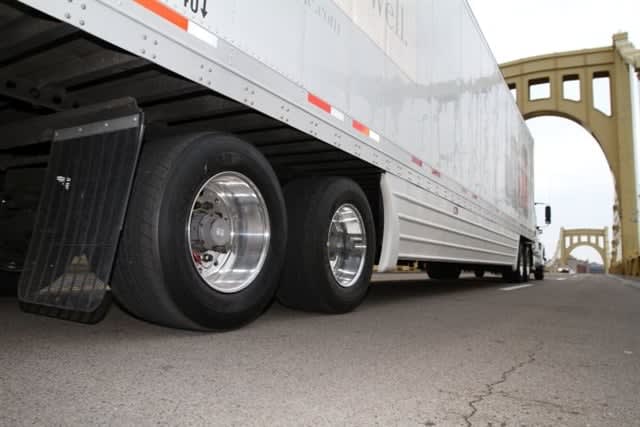
Trailers seldom get the maintenance they deserve, so it’s not surprising that tires don’t fare well.Photo: Goodyear
Wide-base single tires have saved truck fleets millions of gallons of fuel over the 20-plus years they have been in service and facilitated the transport of thousands of additional tons of payload. Both translate into fewer greenhouse gas emissions and ultimately lower fuel bills for fleets. But for all the good they do, they have certainly cost maintenance managers many sleepless nights.
Those maintenance managers have learned a few things about the wide-single tires over the years, and many have a better understanding today of what works and what doesn’t. In general, they’ve found:
Wide-single tires tend to run better and wear longer when loaded heavy rather than light.
Wide-single tires seem to prefer drive positions to trailing positions.
Wide-single tires seem more sensitive to mechanically induced wear, such as misalignment, improper inflation, bad camber settings and loose wheel bearings.
Fleets that run wide-base singles successfully probably didn’t start out that way. But after years of observation and some trial and error, they have ironed out most of the wrinkles.
Ryder, for example, found that axle width has an impact on shoulder wear, especially when using offset wheels to compensate for the narrower axles capable of mounting dual or wide-single tires.
“We saw irregular wear all but vanish after moving to wide-track axles with zero-offset wheels,” says Scott Perry, vice president of supply management with Ryder System. But he acknowledges there were consequences to that move. “If you wanted to put duals back on the axle you’d be more than 102 inches wide.”
Other users report reductions in irregular wear with zero-offset wheels. But many buying decisions are based not only on the intended application of the original buyer, but also with residual value in mind. So fleets hedge their bets with a narrower axle so they can sell it with dual tires at a better price. Unfortunately, they suffer through several years of bad tire wear in the interim.
“When spec’ing the vehicle upfront you may be setting up for optimal service life but you could find yourself in a poor position relative to resale value,” Perry says. “Full width axles are probably better for the tires, but they limit the second buyer’s choices if they do not want wide single tires.”
It’s believed that offset wheels can lead to a slightly negative camber for the tire, that is, the wheel leans top in, bottom out. Poorly adjusted wheel bearings can have the same consequence, says Todd Cotier, director of maintenance at Hartt Transportation in Bangor, Maine.
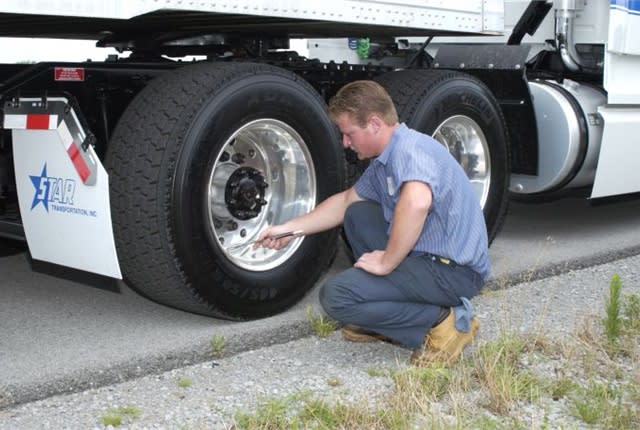
Getting driver buy-in on regular tire inspections and pressure checks will prolong tire life and reduce costs.Photo: Michelin
“We check tire pressure every time a truck comes into the shop, and we mark the pressure on the sidewall with a grease pencil for a reference,” he says. “We do a bearing end-play check on every wheel end at every PM interval, and we balance the tires and check vehicle alignment annually.”
“We are very careful with our bearing end-play and lateral wheel runout measurements,” he says. “It takes some extra time to get it right, but we have found that proper wheel bearing adjustment on the trailers made a big difference in the inner shoulder wear.”
It would be fair to say that any mechanical irregularity that causes tire scrub, such as misalignment, will have a greater impact on wide-base single tires than duals.
“Over time, a regular alignment program can reduce the occurrence of irregular wear,” says Brian Buckham, marketing manager, Goodyear Commercial Tire Systems. “Keep in mind that a traditional front-end alignment isn’t always enough for trucks. Drive axles should be aligned, too.”
And that brings us around inevitably to inflation pressure. Inflation pressure affects everything, and there’s mounting evidence that wide-single tires may be more susceptible to inflation-related wear.
“When engineers design a tire, they have a specific footprint in mind,” explains Rick Phillips, vice president of sales at Yokohama Tire. “It should be a certain size, so if you underinflate the tire, the footprint grows and the tire doesn’t flex the way we intended it to. If you overinflate it, the footprint shrinks and you have more pounds per square inch of tread hitting the pavement. It’s also more susceptible to blowouts and road hazards and that type of thing. The tire was designed to operate at a certain pressure for load carrying capacity as well as to maintain its shape for traction, resistance to damage and even wear.”
Phillips notes that maximum legal load of 17,000 pounds per axle calls for an inflation pressure of about 80-85 psi in most cases. He recommends adding 5-10 psi to compensate for pressure loss between airings because they are going to leak a little over time.
“You aren’t doing the tires any favors by running 100 psi or more. You really need only 80-85 psi, perhaps even less if you run lightly loaded,” he says.
The biggest risk related to inflation, of course, is a blowout. Underinflated tires are more prone to blowouts because they run hot, and that damages the casing. Blowouts with wide-base singles are costly.
“Frequently when we perform a road call for a wide-single tire, the tire is blown and not salvageable,” says Greg Frary, vice president of truck service at TravelCenters of America. “Many of those times the rim also needs to be replaced because when the tire blows, the rim contacts the road.”
When it comes to getting full value from a wide-single tire, retreading can be a limiting factor. While the process of retreading a wide-base single is no different than a standard dual tire, casing condition is more critical.
“Many fleets place exact specifications on the number of wide-single tire repairs they allow, since there is higher propensity for downtime with wide-single tires,” says Buckham.
As noted above, catastrophic wide-single failures tend to take the wheel out too, making the risk factor higher with retreads. For that reason, many fleets limit those tires to one retread only, versus two or perhaps three with a standard tire.
According to Paul Crehan, director of product marketing for Michelin Americas Truck Tires, the curious thing about tire wear is not that it occurs, but how fleets respond to it.
“Regardless of the type of wear, it’s often most obvious on fleets that have the best maintenance programs and good driver training programs,” he says. “But it’s rarely ever a major concern and it seldom leads to removal.”
Crehan says wear problems usually become worse on fleets with poor maintenance programs, but they often don’t have good records of how the tire performed over its life.
“We have studied this and found tires were being taken off with a considerable amount of tread still left in the crown area, but with nothing on the shoulder,” he says. “What they had were tires that looked worn out and scarred but with no mileage record. They have the visuals but they don’t have the records, and that’s where a lot of the dissatisfaction comes from.”
For the most part, wide-single tires remain niche products. However, they can be beneficial for some, particularly weight-sensitive fleets looking for ways to increase their payloads. With 1,000 to 1,200 pounds in weight saving on the table, it’s certainly worth considering wide-base singles, but you’ll have to be prepared to be a bit more diligent in your maintenance.
More Equipment

Kodiak Lines Up Fleets for Driverless Trucking
An agreement for 75 trucks, a new Texas freight lane, and progress on safety validation move Kodiak closer to its planned driverless highway launch.
Read More →
How GP Transco Builds Fuel Savings a Fraction at a Time
Aerodynamic specs, solar panels, and driver incentives help GP Transco turn small efficiency gains into savings it can reinvest in its people.
Read More →
More Trailer Data Through the Same Seven-Way [Video]
Can trucking’s standard seven-way connector handle more cameras and trailer data? Grote’s Adam Slade shows HDT how the company is using new technology with its 4See trailer system, not only to add a new backup camera but also to expand other capabilities — without adding another connection.
Read More →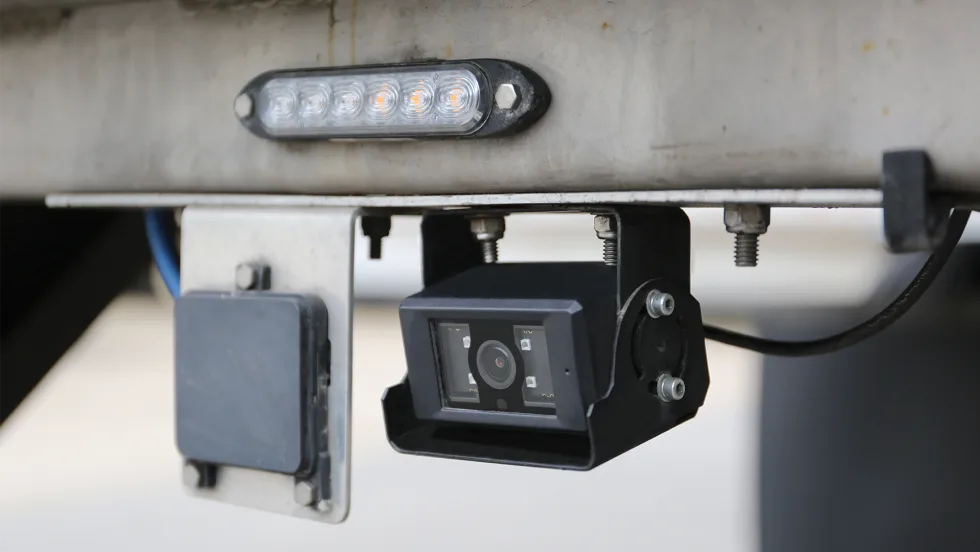
Grote: More Cameras, Same Seven-Way Connector
The next-generation 4See rear-view backup camera from Grote uses the standard seven-way connector and supports additional cameras and other trailer data.
Read More →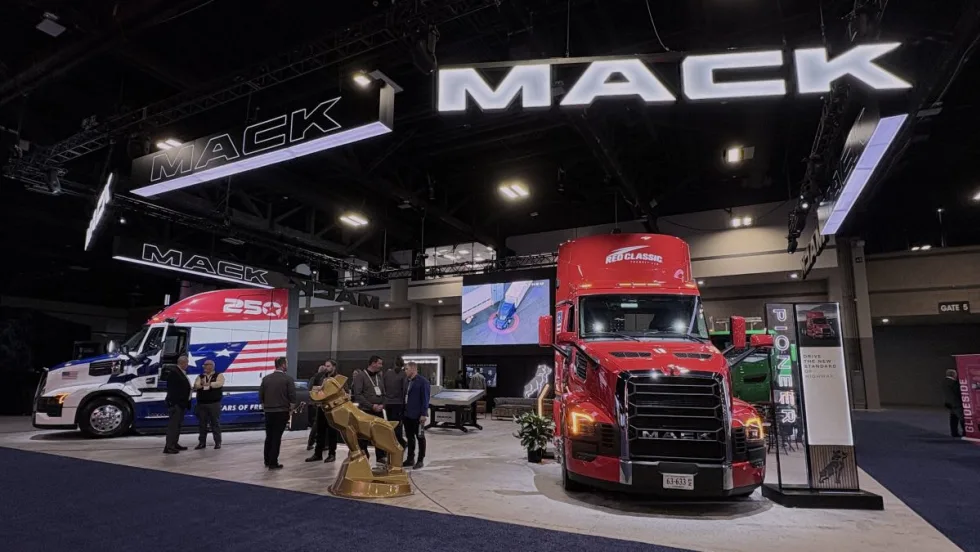
Trucks at ATA's 2026 MC&E in Charlotte, North Carolina [Photos]
From rigs decked out in patriotic America's 250 paint schemes to autonomous trucks and more, check out these photos from ATA's 2026 Management Conference & Exhibition.
Read More →
Help HDT Find Trucking’s Top Products
Have you come across a new product that could make a difference for trucking fleets? Nominate it for HDT’s 2027 Top 20 Products Awards by November 9.
Read More →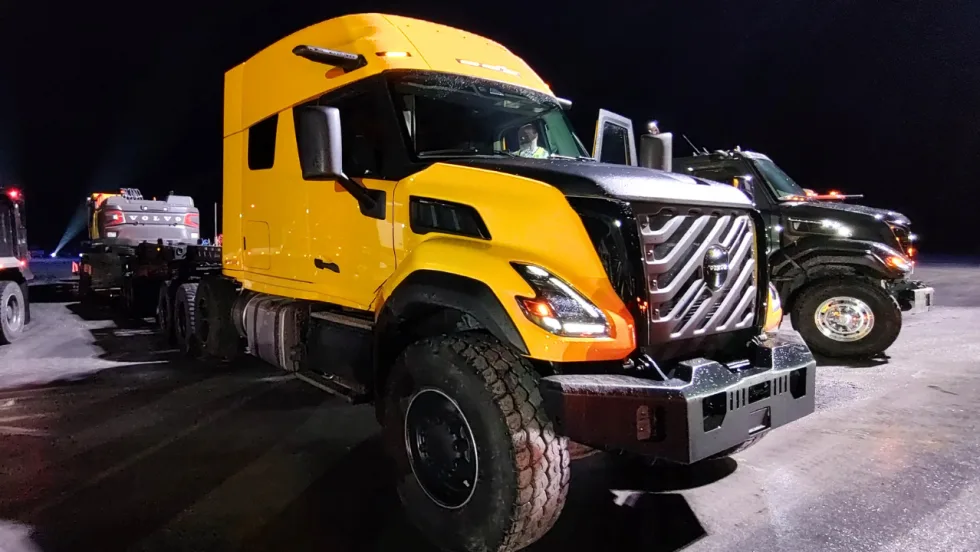
Volvo Unveils New VNX Heavy-Haul and Vocational Truck
Volvo Trucks has launched the VNX, a new vocational truck also available as a tractor in day cab and two sleeper configurations, with one heavy-haul model. The Volvo VNX is powered by Volvo's D13 platform, which delivers up to 540 horsepower and 1,950 pound-feet of torque and is EPA 2027-compliant.
Read More →
How GP Transco Cuts Trucking Fuel Costs, a Tenth of a Gallon at a Time
What’s another tenth of a mile per gallon worth? GP Transco shares how equipment upgrades and driver coaching turn small gains into meaningful fuel savings.
Read More →
Electric Yard Tractors Move Beyond Pilots
Operating-cost savings have overtaken sustainability goals as the leading reason surveyed fleets are adopting battery-electric terminal tractors, according to new NACFE research.
Read More →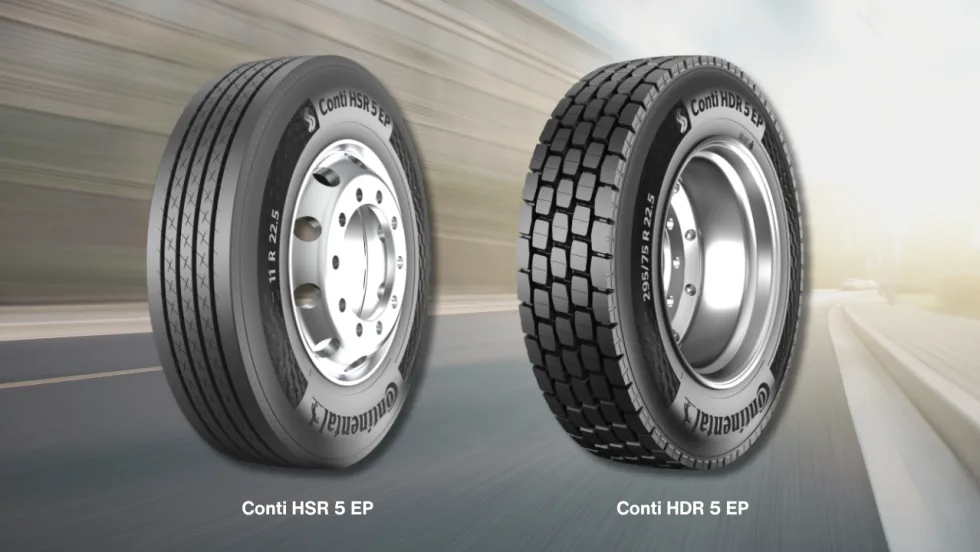
Continental Introduces New Regional Truck Tires
Continental says its new Generation 5 steer and drive tires for regional operations offer longer tread life, with estimated mileage gains of 22% and 19%, respectively.
Read More →