




Wide-Base Singles: What You Need to Know
Many who have switched from duals to wide-base single tires have an almost evangelical enthusiasm for the things. They report better fuel mileage, longer tread life, better handling and stability, higher payload potential, and reduced maintenance costs

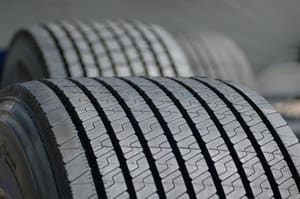
Their track record is firmly established and the efficiency gains are well documented, but they are not for every operation. Will they work for you? (Photo by Jim Park)
Many who have switched from duals to wide-base single tires have an almost evangelical enthusiasm for the things. They report better fuel mileage, longer tread life, better handling and stability, higher payload potential, and reduced maintenance costs.
But the enthusiasm is not universal. There are reported downsides, and frankly, there are applications that simply don't suit wide-base tires. Some users report poor tread life and irregular wear, and others aren't seeing the reported fuel economy benefits.
Let's look at the pros and cons of wide-base single tires, or WBS.
Shed pounds, save $$
The first, most obvious advantage to wide-base single tires is light weight. Switching from duals with steel wheels (worst-case scenario) to WBS tires on aluminum rims can save 1,400 pounds or more per tractor-trailer combo, according to Matt Brest, technology manager and head of engineering at Alcoa Commercial Vehicle Wheels.
"Our 14-inch, zero-offset wheel weighs 62 pounds," Brest says. "When you replace 16 steel wheels with eight aluminum wheels, and factor the weight difference between 16 standard tires vs. eight WBS tires, you're looking at a significant savings. If you're in the bulk or reefer business, that translates easily to additional revenue."
Bob Flynn, director of product management at Accuride Corp., puts the weight of a 14-inch steel, 2-inch- offset rim at 120 pounds, and 132 pounds for the zero-offset variety. His aluminum zero-offset wheel weighs 66 pounds, making the steel rims nearly twice as heavy as the aluminum.
"The 2-inch offset wheels are 90 percent of our volume right now, and the aluminum wheels are outselling the steel wheels by 10 to one," he says. "We feel that a large part of the shift to WBS tires is the result of the potential weight savings."
While the weight savings are compelling, fleets hauling high-cube loads might not see a tremendous advantage. However, it's known that every 1,000 pounds cut from the vehicle yields a roughly 1 percent reduction in fuel consumption. A truck that's 1,400 pounds lighter than it otherwise might be will save some small amount of fuel.
Tire life & tread wear
Opinions on tread wear and tire life among wide-base single users are generally favorable. Some users report increased irregular wear and shortened life-to-takeoff. However, tires of all descriptions often unfairly take the rap for improper chassis conditions and poor maintenance, and wide-base singles are no exception. The wider footprint of the tires could exaggerate wear problems you might not have noticed on duals.
"If wide-base singles are exposed to the same loads and conditions as duals, they will experience the same wear patterns," explains Rick Phillips, manager of commercial sales at Yokohama Tire Corp. Phillips says good maintenance such as proper inflation and alignment are always crucial to tire wear. "This is especially true for tires with such a wide tread surface."
Mike Beckett, owner of MD Alignment in Des Moines, Iowa, sees all kinds of badly worn tires at his shops. He claims there are no issues with WBS's that aren't manifest in duals as well.
That said, Beckett says there are certain practices users should observe to optimize tread life and minimize unnecessary wear, such as inner edge wear.
"You have to make sure you have heavy enough axle tubes to handle the flex caused by increased track width, especially when using a 2-inch offset," he says. "Loose wheel bearings are suspect in edge wear too, but if that can be ruled out, the next most obvious culprit with inner edge wear is axle flex."
Beckett has seen excessive inner edge wear on lightweight axles with 9-mm tubes, but says he doesn't see that on the heavier, 11-mm axles.
Axle flex results from the cantilever effect that occurs when the wheel centerline is moved further outboard from the spring.
The American Trucking Associations' Technology and Maintenance Council is developing a recommended practice on this issue, and is also coming out with recommended axle capacity de-rates based on track width. What Beckett has seen of that project so far suggests using 2-inch offset rims could force axle capacity derates of as much as 3,000 pounds.
Beckett also suggests wide singles could be susceptible to shoulder wear if they are run at sustained high speeds. Michelin rates the X One at 75 mph, but Beckett cautions that centrifugal forces experienced at speeds over 65 mph can distort the center of the tread face, essentially altering the tire's centerline circumference relative to the shoulder ribs.
"High speed distorts the ribs in the center of the tire, but since the shoulder ribs cannot stretch, they wind up scuffing along the road because the circumference at the center of the tire is larger than at the shoulders. That scuffing causes the edges to wear faster," Beckett says.
Another issue is related to engine output. "The contact patch on a wide single is about 25 percent smaller than that of a set of duals. With the same engine power transmitted through the smaller patch, we get more 'micro-slippage' between the tread block and the pavement, and therefore a faster wear rate," he suggests.
None of these problems are related directly to the tires. The situations described above can affect the tires, but they can be mitigated, too.
One fleet's story
Bruce Stockton, vice president of maintenance and asset management at Con-way Truckload in Joplin, Mo., is an unabashed supporter of wide-single tires, but not without good reason. He takes little for granted and runs his numbers diligently.
"When we were running all duals on our trailer fleet, our tire costs were just over 2 cents per mile. In our wide-base world today, the costs are about 1.8 cents," says Stockton. "The savings over 2,600 trucks running 130,000 miles per year is $700,000. Add the fuel economy benefit, and wide singles become a no-brainer."
Stockton has seen his share of irregular wear, but he attributes much of it to chassis problems unique to each truck. Alignment is a big factor, he says, as it is with duals.
"The wear patterns caused by a certain problem will manifest themselves in the same way on standard or wide-base single tires, such as river wear. The problems, the causes, and the solutions are the same," he notes.
One of the more common concerns Stockton hears from the non-converted is the potential cost of ruining a WBS tire, versus the cost of killing a standard tire.
"I can understand that argument, but why would you let any tire go to ruin before addressing a chassis problem, or ruin a tire by running it flat or underinflated when it could be easily saved by stopping and having it repaired?" he asks.
It's common to hear fleets say that if one wide-base single goes down, the truck is effectively sidelined until it's repaired, whereas you have a second tire to limp-in on with duals. That theory holds little water with Stockton.
"To begin with, it's against the law to run with a flat tire. Some still do it, and you risk wrecking the second tire as well, running it overloaded," he says. "Now you're back to the same argument. You kill one wide-single, or two duals. What's the difference?"
Michelin says there are more than 1,500 outlets nationwide now stocking wide-base tires in the most common sizes. They also say most tire service calls are still completed in two hours or less. If that's accurate, it more or less puts to bed the availability and downtime argument.
Still, there can be problems associated with using 2-inch offset wheels to meet minimum track width requirements. Stockton says Con-way Truckload has not experienced any such problems, and some of its power units are up to 800,000 miles on the original axles and bearings.
"I've heard about the complaints, but we've seen no bearing issues at all. We run the 2-inch offset wheels and we did not change our be
More Equipment

How Volvo Updated Its D13 for EPA 2027 [Watch]
Volvo’s updated D13 promises lower emissions without sacrificing performance or fuel economy. Take a closer look at what changed inside the engine in this HDT Spotlight video.
Read More →
Michelin Tire Improves Efficiency and Durability for Regional Fleets
The Michelin X Multi Energy D2 is a regional haul drive tire engineered to help fleets improve fuel efficiency, durability and traction in demanding stop-and-go operations.
Read More →
ZF Expands Commercial Vehicle Push in North America
ZF is expanding its North American commercial-vehicle presence with new transmission applications, electrification, trailer technology and autonomous-driving systems.
Read More →
Tesla Wants a Self-Driving Semi. Are Cameras Enough?
Could Tesla’s camera-only autonomous driving technology work on an 80,000-pound Semi? In this commentary, HDT's Deborah Lockridge takes a look at Tesla, Cybercab, and how autonomous trucks see the road.
Read More →
Kodiak: Driverless Long-Haul Truck Launch on Track for 2026
Kodiak AI says its driverless long-haul safety case is 93% complete and it remains on track to begin commercial operations by year-end 2026.
Read More →
What DOT’s Automated Vehicle Strategy Means for Trucking
The U.S. Department of Transportation issued a new automated-vehicle strategy that outlines plans for driverless-truck regulations, cross-state freight corridors, and federal safety standards.
Read More →
East Coast Port Launches $45M Electric Truck Push
The Port Authority of New York and New Jersey announced millions in incentives for zero-emission drayage trucks, yard tractors, and new charging hubs near the port.
Read More →
PlusAI Going Public to Fund Autonomous Truck Launch
A SPAC deal could provide PlusAI with up to $300 million as it works toward a 2027 commercial launch of factory-built autonomous trucks.
Read More →
NHTSA Moves to Rewrite Truck Fuel-Economy Rules
The National Highway Traffic Safety Administration says it lacks authority to regulate medium- and heavy-duty truck engines separately from complete vehicles, but the existing standards have not yet been eliminated.
Read More →
Detroit Opens Orders for EPA 2027 Engines
Detroit isn’t starting from scratch to meet EPA 2027 diesel emissions standards. Its Gen 6 DD13 and DD15 engines keep much of today’s platform while updating the fuel and aftertreatment systems.
Read More →