





Dig Deeper: Do Your Drivers Understand Their Brakes?
Why do Brake Defects Put so Many Trucks Out of Service?
The Commercial Vehicle Safety Alliance conducts two major brake inspection initiatives each year. Year over year, the brake defect out-of-service rate remains about the same. Why aren’t we making progress in bringing those numbers down?
September 1, 2022
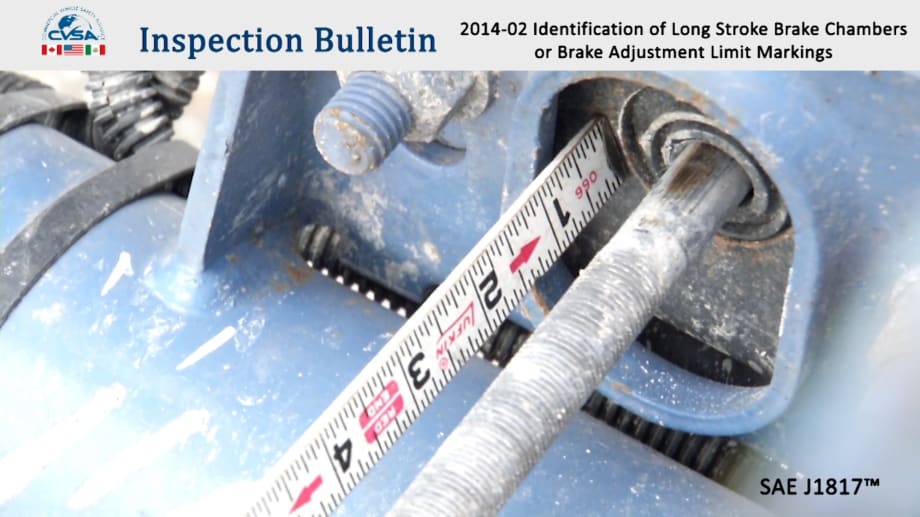
While there is still some braking capability left at the end of the legal stroke length, it’s outside the safety margin built into CVSA brake-stroke measurements.
Source: CVSA
7 min to read
Brake safety is a big deal and always has been — but it’s probably safe to say we take our brake systems largely for granted these days. And why not? They are robust and reliable, and with automatic brake adjusters and now air disc brakes, we don’t really need to pay a lot of attention to them.... Or do we?
The Commercial Vehicle Safety Alliance conducts two major brake inspection initiatives each year. Year over year, the brake defect out-of-service rate remains about the same. The puzzling question is, why aren’t we making progress in bringing those numbers down?
Will Schaefer, CVSA's director of safety programs, has some thoughts on why the OOS rate isn’t improving. It’s got little to do with the brakes themselves, he says.
I posed that question to Schaefer for a recent HDT Talks Trucking video and audio podcast interview. Here are the highlights:
HDT: Each time CVSA organizes a brake inspection event, inspectors focus on some part of the brake system. What criteria do you use to pick that focus area? Is it some trend or pattern of violations that have shown up in previous inspections?
Schaefer: We have a committee that meets twice a year to look at and discuss the results of past inspection campaigns. One of the things we look at are the top violation categories in, for example, our International Roadcheck campaign. We look at the top out-of-service violation categories for vehicle components, and consistently we see that about 40% to 50% of the out-of-service violations are brake-related. For the past two years, we've been looking at brake hoses.
HDT: Results from previous years of Roadcheck, Brake Safety Week and various unannounced brake inspection blitzes show the out-of-service rate hovers consistently around 20-30%. What conclusions can you draw from that? Do you think that's a "normal" failure rate for brake system components, or does it suggest that some fleets just aren't paying close enough attention to their brakes?
Schaefer: I think there's a combination of things that’s leading to the prevalence of brake violations. One is that some percentage of carriers is not checking their trucks’ brakes, and not doing the required maintenance on a more regular basis. And there's another category of carrier that is trying to do the right thing, but they may not be getting the best service, whether it's in-house or from a third party, because there's a shortage of quality technicians and mechanics out there.
In some cases, I think technicians may not be familiar with the regulatory environment surrounding brakes, and they may not be looking for the same things our inspectors are looking for. They might check to see that the brake is functioning, but they may not be measuring brake stroke, for example.
The regulations don’t tell us how to do brake maintenance, but they provide tell-tale signs that if you have such-and-such a violation, you probably have a problem. That usually indicates some shortcoming in the maintenance process. And in the final analysis, I think it’s just a lack of education among technicians and drivers.
HDT: You have been speaking mostly about technicians, but what about drivers? If your inspectors can see the problems during a roadside inspection, why do you think drivers aren't catching them before they get into an inspection?
Schaefer: If you gave drivers the same sort of training on vehicle inspections that our inspectors get, I’m sure they’d be able to spot all the violations that our inspectors do. If drivers did their pre-trip inspections armed with that kind of training, they would notice the telltale signs of brakes being out of adjustment, or brakes not applying, like seeing old rust on the inside surface of a brake drum or a brake rotor.
In other cases, I think they're not even looking. I think that some pre-trip inspections might be, let's say, a little cursory.
HDT: So, what can drivers do to up their inspection game? Should they be going through an airbrake refresher course once in a while or getting some training from their fleets on how to do brake inspections? Would additional training start driving the out-of-service numbers down?
Schaefer: I think that's part of it. The way that our regulations work, the driver is responsible for the condition of the vehicle they're driving. There are some exceptions to that where certain violations would be applied directly to the carrier, but most vehicle violations that a roadside inspector who doesn't use tools and doesn't remove components are things that for the most part a driver could potentially see.
I know that many companies don't allow their drivers to crawl under the vehicle. That becomes an OSHA concern or liability concern or just a training issue. Some drivers aren't trained to do things under the vehicle. Some drivers do. Before we had automatic slack adjusters. more people went under their trucks to adjust their brakes. They don’t do that much anymore.
One of the things we often see missing when we do a carrier safety audit is a kind of “chain-of-repair command.” A driver might spot something during a vehicle inspection and note it on the DVIR, but we don’t always know if the carrier followed through on the repair. You want to document any issues that come up on a vehicle. That's just a process or procedure that helps keep the vehicle in good working order.
HDT: Given that 1 in 5 trucks inspected during these special events are taken out of service, do crash statistics show that brakes or brake-related defects are contributing factors in a similar percentage of crashes?
Schaefer: Strictly speaking, the answer to that one is no. The percentage of cases where brakes were a causal factor in a crash is not 20% of all crashes. If it was, I think we’d have brake manufacturers going out of business or changing their designs. It’s pretty well established that the majority of crashes are the result of driver error. That said, if you look at vehicle-related causal factors, brakes are one of the few that can be identifiably connected to the causal factors.
There are other factors more represented statistically, such as tire condition or blow-outs. Certainly, we see examples of brakes heating up on long grades. Sometimes that’s an adjustment issue, sometimes it’s a brake condition issue, and sometimes it’s poor driving technique. There’s a safety margin built into our brake-stroke measurements. While there is still some braking capability left at the end of the legal stroke length, it’s outside that margin. Really, that’s why we have standards, and any vehicle that doesn’t meet those standards is in inadequate condition to be on the road.
HDT: Automatic slack adjusters have been around since the mid-90s, and yet we still have people manually adjusting them. They're not supposed to be manually adjusted except when they're installed. If they're going out of adjustment, that's generally an indication of some other underlying condition, not the adjuster itself. And yet at roadside, when you catch a truck with brakes out of adjustment ... the driver is allowed to readjust the brakes and continue the trip. Is that really solving the problem or is it just putting it off for another day?
Schaefer: A common scenario would be the driver calls roadside repair service to “fix” the brakes, but the mechanic simply readjusts them. I would say that that's one of those cases where we have technicians that maybe aren't as well educated about how brakes work as they should be. Simply adjusting the slack adjusters so that for one brake application, they appear to be within adjustment, hasn't addressed the underlying problem.
When an inspector goes to look at those brakes — after the repair — and they are in adjustment, there's no violation anymore. We know those brakes could go 10 miles down the road and they've readjusted to being out of adjustment. Inspectors may tell the driver, "Hey, you know, having these adjusted is not fixing your problem. I can't stop you because you've fixed the out-of-adjustment condition that I can identify, but you really need to tell your company to get the brakes in for service."
Subscribe to Our Newsletter
More Safety & Compliance

FMCSA Pauses Biennial-Update Enforcement Amid Motus Transition
Carriers whose updates were due on or after June 1 have more time, while FMCSA works to stabilize its new registration system and warns of phishing sites impersonating its new carrier registration system, Motus.
Read More →
ZF Expands Commercial Vehicle Push in North America
ZF is expanding its North American commercial-vehicle presence with new transmission applications, electrification, trailer technology and autonomous-driving systems.
Read More →
Truck Drivers Need More Than Another Alert
Fleets have more visibility into truck health, safety events, and driver activity than ever. The next challenge is turning all that information into useful guidance for the person who has to decide what to do next.
Read More →
Tesla Wants a Self-Driving Semi. Are Cameras Enough?
Could Tesla’s camera-only autonomous driving technology work on an 80,000-pound Semi? In this commentary, HDT's Deborah Lockridge takes a look at Tesla, Cybercab, and how autonomous trucks see the road.
Read More →
What DOT’s Automated Vehicle Strategy Means for Trucking
The U.S. Department of Transportation issued a new automated-vehicle strategy that outlines plans for driverless-truck regulations, cross-state freight corridors, and federal safety standards.
Read More →
NYC Expands Speed, Pedestrian Safety Tech Across Fleet
New York City is expanding intelligent speed assistance and pedestrian-alert systems across its municipal fleet, moving the technologies from pilot programs into vehicle procurement and retrofit requirements.
Read More →
FMCSA Removes 110 Truck Driver Training Schools from Certified ELDT List
Federal regulators also are targeting more than 160 additional training providers and launching a nationwide audit of third-party CDL skills testers as part of a broader crackdown on trucking fraud.
Read More →
Beyond DOT Compliance: What Makes a Trucking Fleet Truly Safe?
A trucking fleet can follow every rule and still make unsafe decisions. The real test comes when safety conflicts with freight, productivity, or cost.
Read More →
Hours of Service Pilot Programs: FMCSA Readies for 2027 Rollout
Two pilot programs could eventually reshape hours-of-service rules, giving truck drivers options to pause their 14-hour clock or use longer split sleeper rest periods.
Read More →
New Guide Offers Pet Safety Tips for Truck Drivers
Hundreds of thousands of pets travel in truck cabs. A new safety guide from Volvo Trucks and the Center for Pet Safety offers practical advice for truck drivers who bring dogs and cats along for the ride.
Read More →