





Private Fleets Continue to Outpace Trucking in Driver Employment
Why Aren’t Local Delivery Jobs in Sync With Consumers’ Nonstore Spending?
Why have local delivery jobs stalled while nonstore retail keeps growing? This column from FTR's Avery Vise breaks down the surprising disconnect and what it reveals about e-commerce and labor trends.
July 9, 2025

FTR's Avery Vise looks behind the numbers for retail sales and delivery jobs.
Image: HDT Graphic
3 min to read
May represented something of a milestone for nonstore retail sales. The sector’s share of total retail and food service spending hit 17.5% – the highest percentage ever (except for 18.8% in April 2020, which most decidedly is an outlier that likely will not be matched for years to come).
Part of May’s achievement was the combination of steady growth in nonstore retail sales as all other major retail categories saw either declines or no growth, but it counts.
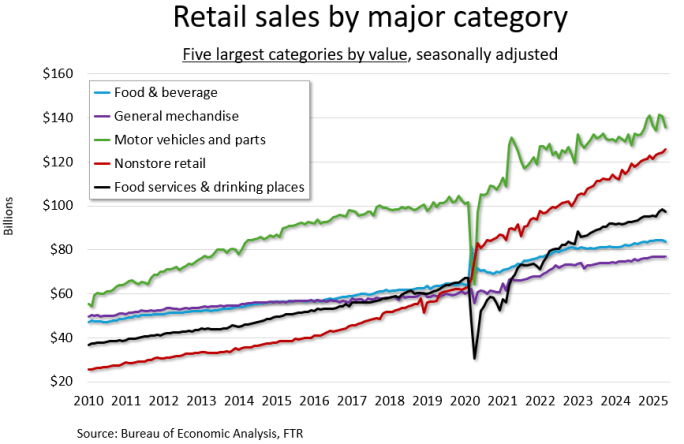
Nonstore sales are now the second-largest retail sales category.
Source: FTR
Nonstore Retail’s Steady Climb Since the Pandemic
For obvious reasons, the Covid-19 pandemic supercharged nonstore retail sales. As recently as January 2020, they accounted for only 12.3% of total sales. At the beginning of 2019, nonstore retail was the fifth-largest retail category in dollar-denominated sales.
By the end of lockdowns, it ranked second and has steadily gained on the motor vehicles and parts retail category. If trends continue, it’s conceivable that nonstore retail sales could exceed sales of vehicles and parts within a couple of years.
The pandemic also fueled big growth in payroll employment for parcel and local delivery, what the government somewhat quaintly calls “couriers and messengers.” During a time when most of the economy suffered from major employment deficits relative to the pre-pandemic economy, parcel and local delivery jobs soared.
The connection between local delivery jobs and nonstore retail sales is obvious, and for many years, they were closely correlated.
By the first quarter of 2022, however, payroll employment in local delivery had peaked — but nonstore retail sales kept rising. Why didn’t parcel and local delivery employment continue to rise, too?
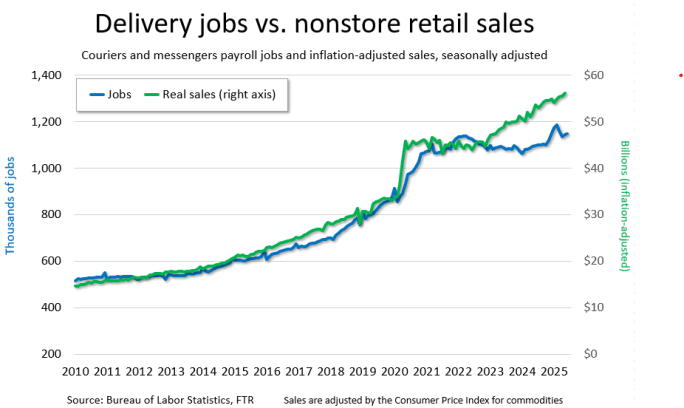
One factor in the disconnect is inflation.
Source: FTR
What Explains the Disconnect Between Sales and Delivery Jobs?
Several factors explain the disconnect.
First is inflation. The Census Bureau reports retail sales in current dollars, so soaring inflation in 2021 and 2022 artificially inflated sales, distorting the implied unit volume.
Adjusted for inflation using the Consumer Price Index for commodities, nonstore retail hit an all-time high in March 2021 and did not surpass that level again until the beginning of 2023. So, one reason parcel and local delivery employment stalled is that the volume of goods to be delivered did so as well.
Inflation does not fully explain the disconnect, however. Real (inflation-adjusted) nonstore retail sales began rising again in 2023. But local delivery employment was stagnant until very late in 2024.
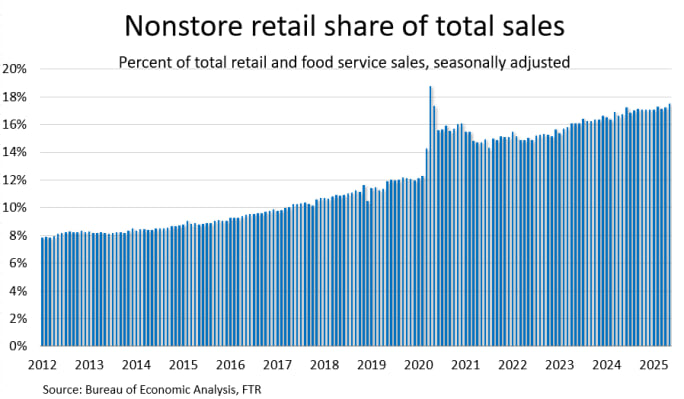
Nonstore sales have continued to get a greater share of retail.
Source: FTR
Omnichannel Distribution’s Growing Role
This is where distribution channels come into the mix.
We tend to think of nonstore retail broadly as delivery of goods to homes or workplaces rather than goods purchased at brick-and-mortar stores, but the reality is more complicated. Goods purchased online but picked up curbside or even in-store apparently are treated in the data as nonstore retail, at least in many cases.
Retailers were playing around with this omnichannel distribution model even before the pandemic, which probably is one reason nonstore sales began to outpace delivery jobs slightly as early as 2016. The pandemic obviously accelerated curbside pickup and similar “delivery” options.
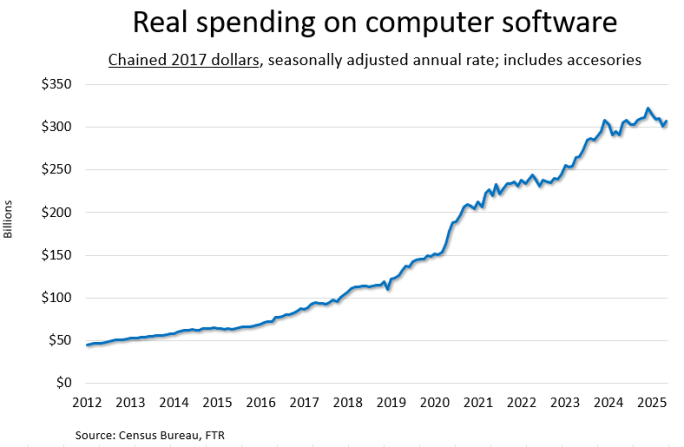
Some retail sales aren't delivered by trucks, or even in a box.
Source: FTR
Digital Goods and the Invisible Delivery Economy
Another factor, potentially an even larger one than omnichannel distribution, is the fact that not all nonstore retail purchases must be delivered to the buyer — at least not in a physical sense. Purchases of digital downloads, such as computer software, music, movies, etc., have significantly accelerated since 2020.
Real spending on computer software and accessories stabilized in 2021-2022 but took off again in early 2023. Coincidentally or not, the beginning of 2023 is when local delivery employment and real nonstore retail sales diverged. Sales rose strongly, while jobs were basically flat until the end of 2024.
In the end, maybe it’s not that delivery jobs are out of sync with nonstore sales — it’s that our assumptions about what counts as “delivery” haven’t kept up with the digital world’s tendency to redefine everything.
Subscribe to Our Newsletter
More Fleet Management

Nominations Open for HDT Emerging Leaders
Heavy Duty Trucking is looking for accomplished trucking fleet professionals under 40 who are making an impact and helping lead the industry forward.
Read More →
Why Private Fleets Are Taking More Freight
Private fleets are putting their own trucks on demanding customers and high-cost lanes as companies seek greater control over service, costs, and capacity.
Read More →
Sponsored•September 16, 2026
Color Match Smarter: Tools That Restore & Perform
For fleet managers and collision repair professionals keeping heavy-duty trucks on the road, getting the color right the first time isn't just about appearance — it's about efficiency, turnaround time, and bottom-line results. Discover how today's digital color tools are transforming the repair process from guesswork to precision.
Read More →


FMCSA Pauses Biennial-Update Enforcement Amid Motus Transition
Carriers whose updates were due on or after June 1 have more time, while FMCSA works to stabilize its new registration system and warns of phishing sites impersonating its new carrier registration system, Motus.
Read More →
Sponsored•September 14, 2026
2026 Blueprint for Countering Smarter Supply Chain Theft
Cargo theft is no longer just the cost of doing business. It's a multi-billion-dollar criminal enterprise exploiting vulnerabilities across your fleet, drivers, and supply chain.
Read More →
Sponsored•September 1, 2026
How Telematics Improves Visibility, Control, and Performance in Refrigerated Fleets
Explore how telematics help refrigerated fleets improve visibility, uptime, efficiency, compliance, and cargo protection across connected cold chain operations.
Read More →
What the U.S.-Canada Trade War Means for Trucking
Escalating U.S.-Canada tariffs could disrupt cross-border freight, reduce truck volumes, raise costs, and create new uncertainty for carriers on both sides of the border.
Read More →
What Are Trucking’s Top Concerns for 2026?
The American Transportation Research Institute wants to know what's worrying trucking fleet managers, drivers, and other stakeholders in its annual Industry Issues survey.
Read More →
American Trucking Associations Looks for a New Leader
ATA President and CEO Chris Spear abruptly left his job at the association on August 21, at a pivotal time for the trucking industry.
Read More →
Public Wi-Fi Cybersecurity Risks: How Truck Drivers and Fleets Can Protect Their Data
Public Wi-Fi can expose truck drivers and fleets to credential theft, malware, and other cyber threats. Here’s how to reduce the risk on the road.
Read More →