




Why A. Duie Pyle is Adding Electric Trucks to its Last-Mile Delivery Fleet
A. Duie Pyle is one of the first motor carriers in the U.S. to add all-electric Fuso eCanter medium-duty trucks to its fleet. HDT talked to the Northeast LTL about why these trucks are a great fit for its Bronx Service Center.

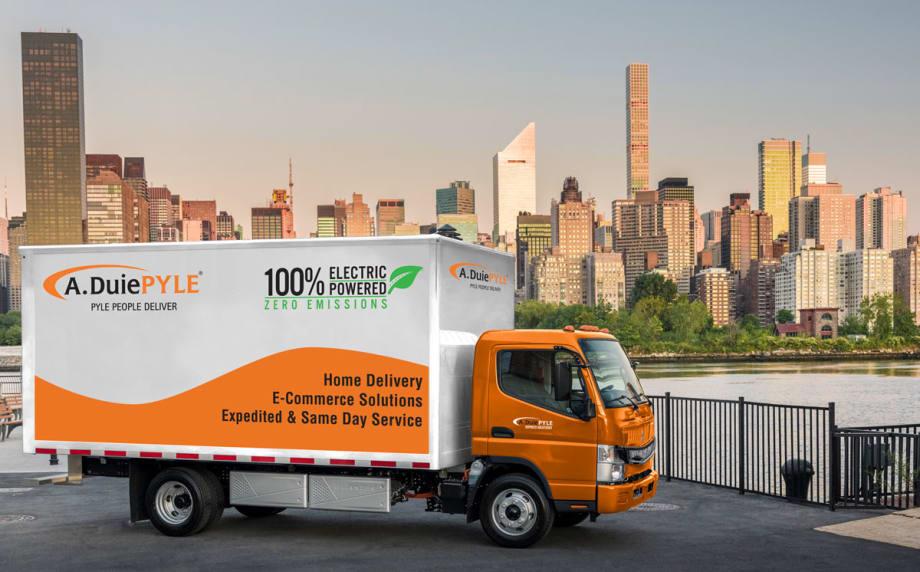
A. Duie Pyle is leasing two battery-electric Fuso eCanters for use in its last-mile delivery fleet.
Photo courtesy A. Duie Pyle
A. Duie Pyle is one of the first motor carriers in the U.S. to add all-electric Fuso eCanter medium-duty trucks to its fleet – a great fit for its Bronx Service Center, where it joins a fleet of electric hybrid straight trucks used for urban business-to-business and business-to-consumer deliveries in the New York metro area.
The company, which offers less-than-truckload, asset and non-asset based transportation and supply chain solutions in the Northeast, is adding two of the Fuso eCanters, which Daimler says is the first series-produced fully electric-powered medium-duty truck.
Why Electric?
Electric power for trucks “definitely seems to be picking up steam and it’s something we believe will be sustainable in the future,” explained Dan Carrano, VP of fleet maintenance, in an interview. “We wanted to dip our toe in the water and give it a try on a small scale. The Fusos don’t require much infrastructure and they’re a good stepping-tone toward a full electric-powered tractor.”
John Luciani, COO of LTL Services, told HDT that the company already has a number of green initiatives, making this a natural step. Through its ECO (Environmentally Conscious Operation) Program, Pyle has incorporated a number of green and sustainable practices throughout its fleet, facilities and operations, such as a solar-powered warehouse in Parkesburg, Pennsylvania, paperless dock management and handheld systems, and electric forklifts.
“We currently run 10 hybrid diesel trucks in the Bronx service center, and this was an excellent segue from the hybrid diesel to a fully electric freight truck,” Luciani said.
While Pyle has investigated natural gas, it decided it was not a good fit for the company. “We’ve been doing our research, following the industry as far as electric vehicles,” Carrano says. “We are part of the Daimler electric vehicle council, and as we accumulated information we believe this is the direction as far as alternative-powered vehicles. As technology catches up with the concept, we truly believe it is the future.”
Right truck, right application
With a permanent synchronous e-motor, the eCanter delivers 185 kW, completely silent and emission-free, making it ideal for urban delivery and green application needs.
“The two electric trucks, while limited in range – 60 to 80 miles between charges – they work well in that urban environment,” explained Luciani. “There’s heavy congestion, and relatively short delivery routes. The driver can go 25 or 30 miles away and come back. It’s the right application.”
The Fusos are a smaller unit than the larger Hinos that Pyle is running in its Express Solutions last-mile delivery fleet, with a 16-foot box and a liftgate on the back.
The trucks are on a full-service lease for two years, after which they will go back to Fuso for evaluation of the batter and electric components. So it was a good way for Pyle to “stick its toe in the water,” Luciani said.
The full-service lease also means there’s no maintenance to worry about – although the technicians at the Bronx service center are already familiar with working on electric-vehicle components because of the 10 hybrid trucks Pyle runs from that facility.
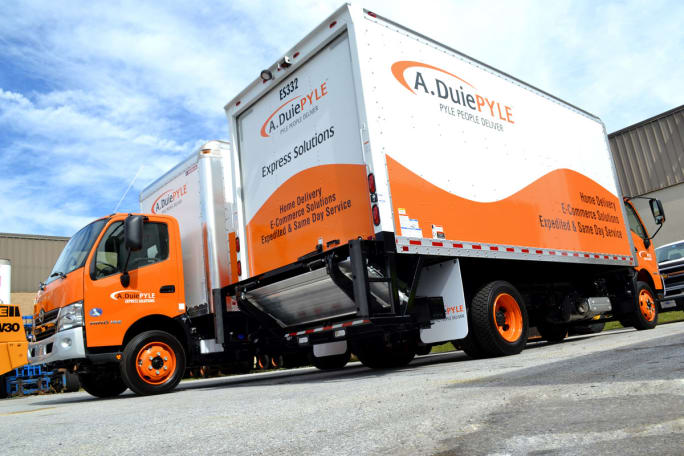
The two new electric trucks join A. Duie Pyle's fleet of Express Solutions medium-duty trucks spec'ed for last-mile delivery.
Photo courtesy A. Duie Pyle
In the Bronx
Strategically located on the East River in Hunts Point, A. Duie Pyle’s service center opened in the Bronx in early 2018.
The Bronx service center includes 77 doors for loading and unloading, 6,846 square feet of office space (located above the docks), and a three-deck parking garage with the maintenance shop integrated into the garage. It includes 100% stand-by power generation, on-site snow removal capabilities, heated dock operations, secure fencing and a 24/7 monitoring system.
“We felt like if we wanted to be a Northeast premier service provider, we needed to be right next to where our customers are,” Luciani said. “We deliver about 1,000 bills a day from that service center in the boroughs and Long Island. It was a good place to be, the first major trucking investment on that side of the East River in the last 50 years.”
“Having a terminal right in one of the five boroughs is an optimal location” for testing out the electric delivery trucks, Carrano explained. “We’re peddling freight right from there, versus getting on the highway and using a lot of the battery power.”
The eCanters are charged overnight using a 230-volt slow charge system – similar to a household dryer, he adds. It takes about eight hours. The two charging stations required minimal infrastructure investment; just some wiring to get the electrical outlets where the trucks were being parked at night.
The two electric trucks join 15 other Express Solutions trucks running out of that facility; tractor-trailer combinations make up the rest of the fleet. About 65 drivers operate out of the Bronx facility.
Express Solutions
Pyle’s Express Solutions fleet was designed to do two things: address the growing demand for last-mile delivery of package that don’t work well either in Pyle’s traditional LTL operations or in a traditional package-delivery system; and as a way to transition dock workers and other employees into full-fledged truck drivers.
The Express Solutions fleet totals 90 trucks that don’t require commercial drivers licenses. Non-driving employees can get behind the wheel without having to go to school to get a CDL. After a year in the smaller trucks, if they’re at least 23 years old, these employees can go through Pyle’s truck driving academy.
“We were looking to grow some of our residential delivery business and having these 18-foot box Class 5 Hino trucks, taking those [loads] off the tractor trailer combinations and putting them on the right truck in the right application was an important part of our initiative. We have expanded our residential delivery service – not to the extent we want to and will in the future – but we were serving two masters by putting those small trucks into the fleet,” Luciani said.
Meanwhile, Carrano and Luciani don’t rule out trying out Freightliner’s eM2 medium-duty electric truck and eCascadia tractor, both currently in fleet testing. While emphasizing they won’t be “on the bleeding adge,” Luciani said, “Putting our toe in the water does essentially give us first right of refusal of the next iteration. It keeps us engaged. That’s where we want to be.”
More Fuel Smarts

How Volvo Updated Its D13 for EPA 2027 [Watch]
Volvo’s updated D13 promises lower emissions without sacrificing performance or fuel economy. Take a closer look at what changed inside the engine in this HDT Spotlight video.
Read More →
Diesel Price Spike Shortens Payback for Natural Gas Trucks, Report Says
Energy Vision estimates fleets could recover the higher purchase price of an RNG-fueled Class 8 tractor in 1.3 to 2.8 years under current fuel-price scenarios.
Read More →
Calstart Becomes Catalyst Mobility, Reflecting Broader Focus
Calstart is now Catalyst Mobility, reflecting the nonprofit’s growing national role in clean transportation, including zero-emission trucks, infrastructure and incentive programs.
Read More →

Record Diesel Prices Squeeze Trucking Fleets
Average U.S. diesel prices have climbed to nearly $6 a gallon, surpassing the 2022 record as tight refinery capacity and Middle East disruptions keep fuel costs elevated.
Read More →
How Fuel Delivery Shapes Engine Performance
Fuel delivery depends on more than what happens at the injector. For fleet, maintenance and technical professionals, looking at the full path from pump to injector can provide useful context for understanding engine performance.
Read More →
East Coast Port Launches $45M Electric Truck Push
The Port Authority of New York and New Jersey announced millions in incentives for zero-emission drayage trucks, yard tractors, and new charging hubs near the port.
Read More →
California Bill Could Shed Light on Electric Truck Prices
Why do battery-electric Class 8 trucks remain so expensive? A California bill headed to Gov. Gavin Newsom would give fleets and state agencies more visibility into what manufacturers charge.
Read More →
Detroit Opens Orders for EPA 2027 Engines
Detroit isn’t starting from scratch to meet EPA 2027 diesel emissions standards. Its Gen 6 DD13 and DD15 engines keep much of today’s platform while updating the fuel and aftertreatment systems.
Read More →
Zero-Emission Truck Corridor Planned for West Coast
California, Oregon, Washington, British Columbia and Baja California are coordinating plans for truck charging and hydrogen fueling from Canada to Mexico.
Read More →
A Closer Look at Kenworth’s Electric T880E Vocational Truck [Video]
Learn more about Kenworth's T880E battery-electric vocational truck at the Paccar Technical Center, including its range, applications, upfitting considerations, and PTO options, in this HDT Spotlight video.
Read More →