





Dig Deeper: Is Trucking Pulling Out of the Post-Pandemic Doldrums?
When Consumer Spending on Goods Produces No Freight
Real consumer spending on goods remains at a near-record level. Why isn't that filling up truck trailers?
August 27, 2024

FTR's Avery Vise shares his insights each month for Heavy Duty Trucking.
Image: HDT Graphic
3 min to read
The resilience of American consumers – especially in their spending on goods – has been surprising. Sure, households received vast sums in stimulus and other government support during 2020 and 2021, and they had limited ability to spend that money for things other than goods for some time. That money is gone, though. What does that mean for trucking?
According to a San Francisco Federal Reserve staff analysis, excess savings – savings that were above what households would have accumulated absent the pandemic – were depleted by March of this year. Since then, consumers have tapped their “regular” savings to the tune of $372 billion, according to the analysis.
Consumers’ spending mix also has changed as “real,” or inflation-adjusted, spending on services has recovered, driven most notably by health care. That additional spending has exerted further stress on consumers’ spending on goods.
And yet, real spending on goods remains at a near-record level. June’s real spending on goods was second only to December 2023, at least on a seasonally adjusted basis, according to preliminary data from the Bureau of Economic Analysis.
However, growth in spending has cooled greatly over the past couple of years.
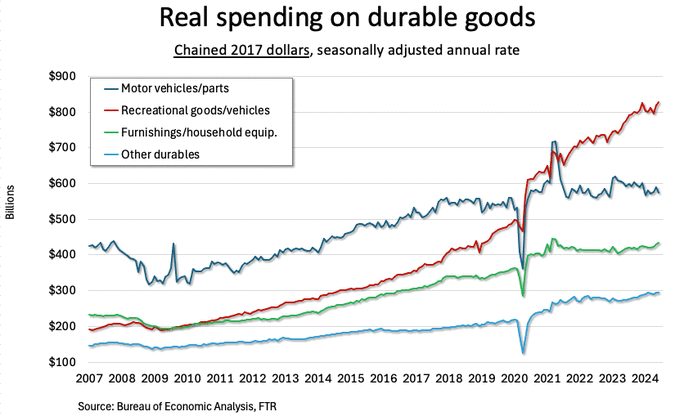
Aside from a couple of months in early 2021, recreational goods and vehicles has been the largest category of spending on durable goods.
Source: FTR
The Spending Splurge and the Trucking Hangover
During the decade between the end of the Great Recession and the pandemic, real spending on goods rose at an average annual rate of 3.5%. Growth during 2020 was 4.9% as the stimulus-fueled rebound more than offset the sharp – but very brief – plunge in spending during lockdowns.
Then came 2021, which was all upside and no downside. Spending surged 11.3% year over year.
Not surprisingly, that 2020-2021 splurge created a hangover. Real spending on goods ticked up a mere 0.3% in 2022 and was up just 2.0% year over year in 2023. The run-rate through June puts 2024 spending at less than 1% higher than 2023.
Lack of growth, therefore, is a major challenge for trucking operations that had worked hard to build operations to handle 2021 demand.
The profile of goods being purchased also has much to do with freight sluggishness, however.
Spending That Doesn’t Fill Truck Trailers
Since late 2021, the strongest growth in real consumer spending among broad categories that BEA tracks has been in “recreational goods and vehicles.” Before the pandemic, motor vehicles and parts was by far the largest spending category for durable goods in inflation-adjusted dollar value. Aside from a couple of months in early 2021, recreational goods and vehicles has been the largest category of spending on durable goods, and its share of spending has been growing steadily.
What falls under recreational goods and vehicles? Not surprisingly, items like motorcycles, bicycles, boats, and sporting goods are a big part. So are televisions and audio equipment.
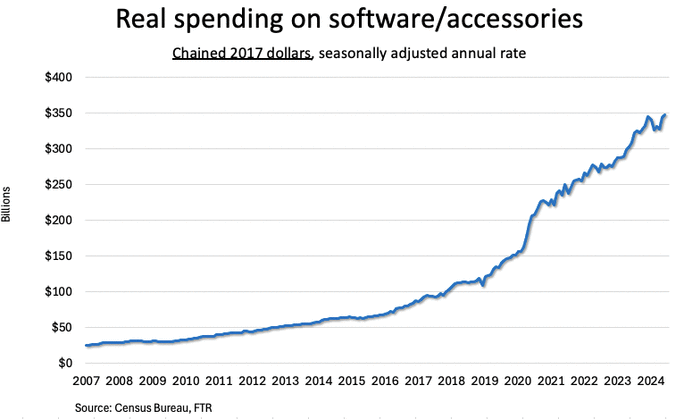
Spending on “information processing equipment" doesn't result in much freight.
Source: FTR
And then there’s “information processing equipment,” which includes items like computers, tablets, monitors, printers, etc. Those are products with high values to cube/weight density and, thus, do not produce all that much freight volume. On the other hand, it is a segment that is growing.
However, a far larger piece of the information processing equipment category is “computer software and accessories.” Whatever those accessories are probably do not account for much freight, but software itself produces no freight whatsoever.
One of the largest drivers of growth in consumer spending on goods does not need a truck to move. It just needs an internet connection.
The FTR Transportation Conference, scheduled for September 9-12 in Indianapolis, will, among other things, explore economic underpinnings behind the outlook for truck freight in the coming year. For more information, visit www.ftrconference.com.
Subscribe to Our Newsletter
More Fleet Management

Kodiak Lines Up Fleets for Driverless Trucking
An agreement for 75 trucks, a new Texas freight lane, and progress on safety validation move Kodiak closer to its planned driverless highway launch.
Read More →
ITS Logistics Settles Religious Harassment Case
The Nevada-based logistics firm agreed to pay more than $396,000 to settle a religious harassment charge involving an employee's Jewish identity.
Read More →
Your Trucks Are Busy. That Doesn’t Mean They’re Winning.
High utilization doesn’t always mean strong margins. Looking beyond the current load can help fleets make better dispatch decisions and get more value from each truck’s time.
Read More →
Why This Trucking Recovery Is Different
Freight demand remains sluggish, but rising costs and tougher enforcement have taken enough capacity out of the market to change the outlook for motor carriers.
Read More →
Platform Science Adds Dispatch and Safety Tools
Four additions to PS Fleet help fleets monitor loads, manage driver coaching, share truck locations and adjust video system settings.
Read More →
PrePass Intelligence Mines Fleet Bypass, Toll and Safety Data
PrePass Intelligence helps fleets measure bypass savings, flag potential toll overcharges, and spot suspicious transactions by combining data from separate systems.
Read More →
Motive Adds AI Agents for Fleet Operations
New tools automate follow-up on fleet data, from maintenance work orders to driver alerts, with two-way voice conversations planned for later this year.
Read More →
Can You Beat Our Trucking Trivia Challenge?
Test your truck knowledge with 19 trivia questions from Heavy Duty Trucking Exchange. Can you keep up with the fleet pros?
Read More →
BeyondTrucks Adds Rules Checks to Dispatch
New Compatibility Engine checks driver qualifications, equipment requirements and fleet policies before loads are dispatched.
Read More →
Diesel Prices Hijack Trucking’s Worry List
ATRI’s annual survey finds cautious optimism about freight, but diesel costs, litigation, and insurance continue to squeeze fleets. Drivers have different priorities on several issues.
Read More →