




Volvo's SuperTruck Demonstrates the Art of the Possible
Volvo Group’s SuperTruck demonstrates where energy-saving technology could take us – and in some cases, already has.

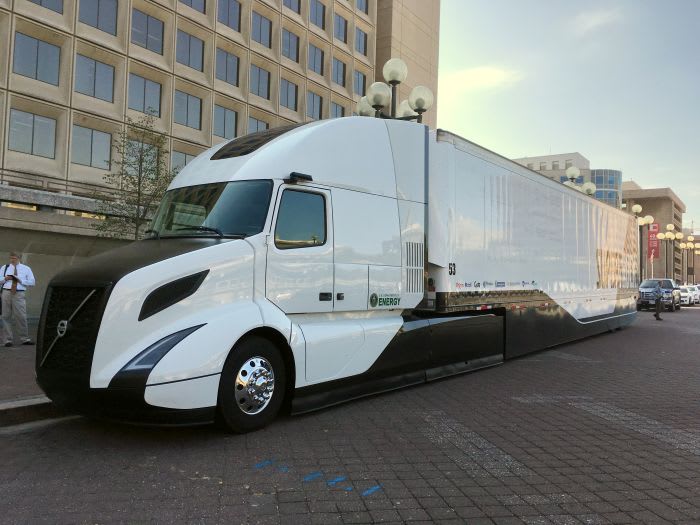
Volvo Trucks North America’s SuperTruck project boasts a freight efficiency improvement of 88%, a 40% reduction in aerodynamic drag and 12-13 mpg. Photo: Jim Park
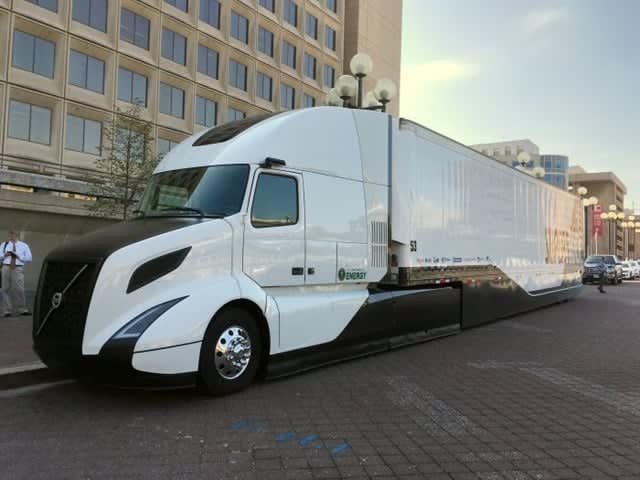
Volvo Trucks North America’s SuperTruck project boasts a freight efficiency improvement of 88%, a 40% reduction in aerodynamic drag and 12-13 mpg.Photo: Jim Park
It’s amazing what $40 million will buy you these days. If that seems like a lot to spend on just one truck, consider what truck makers typically spend on R&D for a new model, or even just a significant upgrade. The $40 million Volvo Trucks spent on its SuperTruck project was an investment in near- and distant-future truck technology that will begin paying dividends for the truck maker and its customers as early as 2017.
That figure, by the way, represents a joint investment by the U.S. Department of Energy and Volvo Trucks North America. Volvo matched the DOE funding grant dollar for dollar. The goal of the entire SuperTruck project is to build vehicle prototypes that push the boundaries of both fuel and freight efficiency to levels beyond where today’s normal OEM R&D budgets would normally take them. These are concept vehicles, science projects if you will, that pull forward ideas and technologies that in the normal course of vehicle development might languish on bottom shelves and on computer hard drives because the immediate payback just isn’t there.
Like the two SuperTruck projects that were revealed in previous years from other OE-led teams, the Volvo team managed some astonishing gains:
a freight efficiency improvement of 88% (the initial target was 50%),
a 70% improvement in fuel economy (12-13 mpg) over a base model 2009 Volvo VNL 670 (7 mpg)
a net weight reduction of 3,200 pounds after adding the new mechanical and aerodynamic technology,
a 40% reduction in aerodynamic drag, and
a 20% gain in powertrain thermal efficiency from 42 to 50%.
Göran Nyberg, president of Volvo Trucks North America, called the SuperTruck project a “knowledge accelerator.”
“We wanted to see what we could take from the project and get into our customers’ hands even before the project was complete,” he said when the vehicle was unveiled in Washington, D.C., in September. “We found some significant improvement that we could add to the existing VNL lineup.” Modifications already in production include:
a revised bumper design for all 2016 VNL models,
flared chassis fairings on 2016 VNL 630 and 670 models,
an updated roof profile on VNL 670 models, and
changes to the engine fan for improved airflow through the engine compartment.
Other enhancements will be featured in the 2017 engine lineup, which Volvo says will up fuel economy by 6.5%. They include:
a new piston design that improves combustion and reduces soot production,
common rail fuel injection, and
turbo compounding for the Volvo D13 engine to capture wasted energy from the exhaust stream and convert it to mechanical energy.
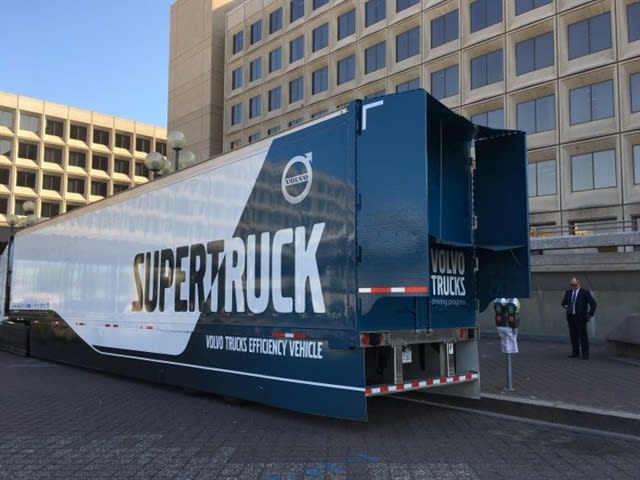
The hood, roof and body panels are made of lightweight, high-strength carbon fiber. While it’s still cost-prohibitive, knowledge gained in material science will be applied to future programs.Photo: Jim Park
So Volvo’s SuperTruck is already paying dividends for the customer. However, there’s a great deal more going on here that may or may not ever come to market. Some of the technologies on the truck are likely to remain wishful thinking for some time yet, such as carbon fiber body panels and the complex Rankine cycle waste-heat recovery system, which converts heat normally wasted in exhaust into torque, though a 2017 D3 model will use turbo compounding.
Pascal Amar, senior project manager, Volvo Group North America SuperTruck, told HDT that while the waste heat recovery system contributed significantly to the 20% gain in engine thermal efficiency, it’s nowhere near ready for market (a sentiment echoed earlier by both Cummins and Daimler after their SuperTruck projects.)
“The system on the truck today is a vast improvement over our first attempt,” he says. “The earlier version was optimized for peak power output, but we realized we had to make it work at cruise power instead. We have proven that it will work, but we have a long way to go in reducing the cost and complexity, and getting the cost/benefit numbers in line. We believe WHR can produce a 2-4% improvement in fuel economy.”
The project produced an interesting electrical climate control system using lithium-ion batteries, solar panels and energy harvested only when the truck was coasting and not under power. Amal says they used two small alternators rather than one larger one they could cycle in and out to produce a charge based on when the predictive cruise (Volvo calls it I-See) indicated the truck was coasting. They charged the LI batteries, along with the charge from the solar panels. The HVAC system uses electric compressors to avoid duplicate systems and to reduce the draw on the engine. Ultra capacitors are used for starting only, while the rest of the electrical demand comes from the LI batteries.
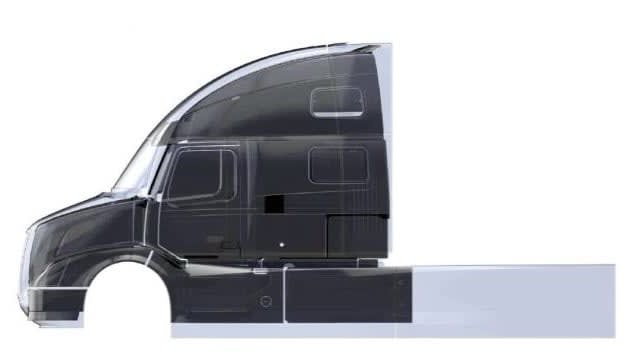
Compared to a 2009 VN cab, the SuperTruck cab (lightly shaded) is 3 inches taller, 8 inches longer and wider at the back than the front. The roof profile is changed too.Photo: Volvo
“We also used a dual-zone cooling system [driving area and sleeper compartment] to reduce demand on the system,” he says. “The batteries can store 12-14 kilowatt hours of electricity generated essentially free through kinetic energy and solar power, and the ultra-capacitor starter systems charges from them.”
The vast reduction in aerodynamic drag that came from a complete redesign of the cab (it’s 3 inches taller, 8 inches longer and wider at the back than the front) and the trailer aero trim allowed engineers to “right-size” the engine, thanks to a reduction in power required to keep it moving at highway speed. Amal says the truck requires 35% less horsepower (120 hp vs. 188) than the baseline truck, which permitted the use of an 11L, 425-hp D11 engine. The engine features common-rail fuel injection, a newly designed cooling package and fan shroud, low-viscosity oils and turbo-compounding.
To keep weight down, Volvo used the Meritor FueLite 6x2 drive axle and many lightweight components, including a frame made almost entirely of aluminum that saved more than 900 pounds. The roof, hood and side fairings are made of carbon fiber. While durable and light, like the frame, they are still too expensive for the current market.
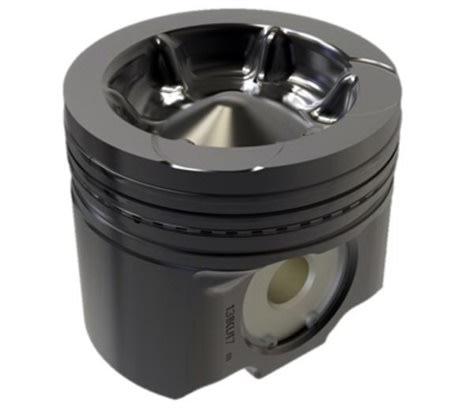
Volvo’s new “wave” piston bowl design directs atomized fuel from the injector back into the center of the burn, which increases energy yield while reducing soot production by 90%.Photo: Volvo
And of course it’s hard to ignore the overall aerodynamic look of the truck. Amal says the smooth sweeping shape produced a 40% reduction in aero drag, and not a corner of the cab was left untouched. Since this is a concept truck and not a practical model, even the cab entry steps were covered up and the mirrors replaced with cameras.
Volvo’s SuperTruck, like the others in the program, demonstrates what is possible if not practical. In time some of the concepts will eventually see real world service. Others will not. It depends on the cost of fuel versus the projected savings, and how the ROI calculations pencil out. The new GHG Phase 2 rules will push some of this technology into service, but just which bits will be called upon to serve remains to be seen.
The DOE recently selected the Volvo Group to participate in the SuperTruck II program, which will target a 100% improvement on a ton-mile-per-gallon basis, and a powertrain capable of 55% brake thermal efficiency.
Partners in Volvo’s SuperTruck project include Michelin Americas Research Company (tires), Wabash National (trailer), Metalsa (lightweight frame), Johnson-Matthey Inc. (exhaust aftertreatment system catalysts), Oak Ridge National Laboratory (exhaust aftertreatment system testing / analysis), Peloton Technology (connected vehicle / platooning), Pennsylvania State University (connected vehicle testing), Knight Transportation (long-haul fleet), and Wegmans Food Markets (regional-haul fleet).
More Fuel Smarts

Record Diesel Prices Squeeze Trucking Fleets
Average U.S. diesel prices have climbed to nearly $6 a gallon, surpassing the 2022 record as tight refinery capacity and Middle East disruptions keep fuel costs elevated.
Read More →
How Fuel Delivery Shapes Engine Performance
Fuel delivery depends on more than what happens at the injector. For fleet, maintenance and technical professionals, looking at the full path from pump to injector can provide useful context for understanding engine performance.
Read More →
East Coast Port Launches $45M Electric Truck Push
The Port Authority of New York and New Jersey announced millions in incentives for zero-emission drayage trucks, yard tractors, and new charging hubs near the port.
Read More →

California Bill Could Shed Light on Electric Truck Prices
Why do battery-electric Class 8 trucks remain so expensive? A California bill headed to Gov. Gavin Newsom would give fleets and state agencies more visibility into what manufacturers charge.
Read More →
Detroit Opens Orders for EPA 2027 Engines
Detroit isn’t starting from scratch to meet EPA 2027 diesel emissions standards. Its Gen 6 DD13 and DD15 engines keep much of today’s platform while updating the fuel and aftertreatment systems.
Read More →
Zero-Emission Truck Corridor Planned for West Coast
California, Oregon, Washington, British Columbia and Baja California are coordinating plans for truck charging and hydrogen fueling from Canada to Mexico.
Read More →
A Closer Look at Kenworth’s Electric T880E Vocational Truck [Video]
Learn more about Kenworth's T880E battery-electric vocational truck at the Paccar Technical Center, including its range, applications, upfitting considerations, and PTO options, in this HDT Spotlight video.
Read More →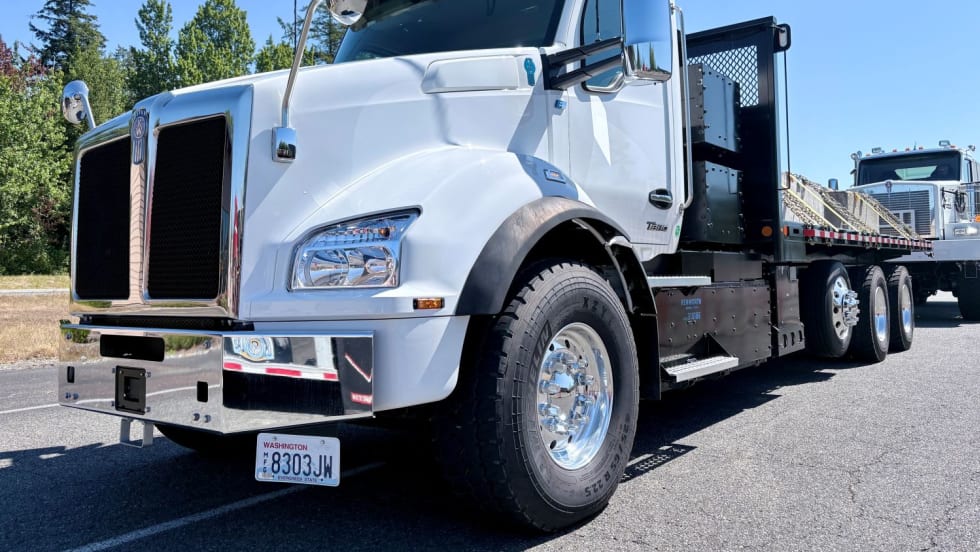
Kenworth T880E Brings EV Power to Vocational Trucks
A closer look at the Kenworth T880E’s range, charging, powertrain and upfit options — and where fleets are showing the most interest.
Read More →
Jennie Abarca Is Proving Electric Trucks Can Do the Job
HDT Truck Fleet Innovator Jennie Abarca is building confidence in fleet electrification one load at a time while openly sharing the challenges she encounters along the way as a small-fleet owner.
Read More →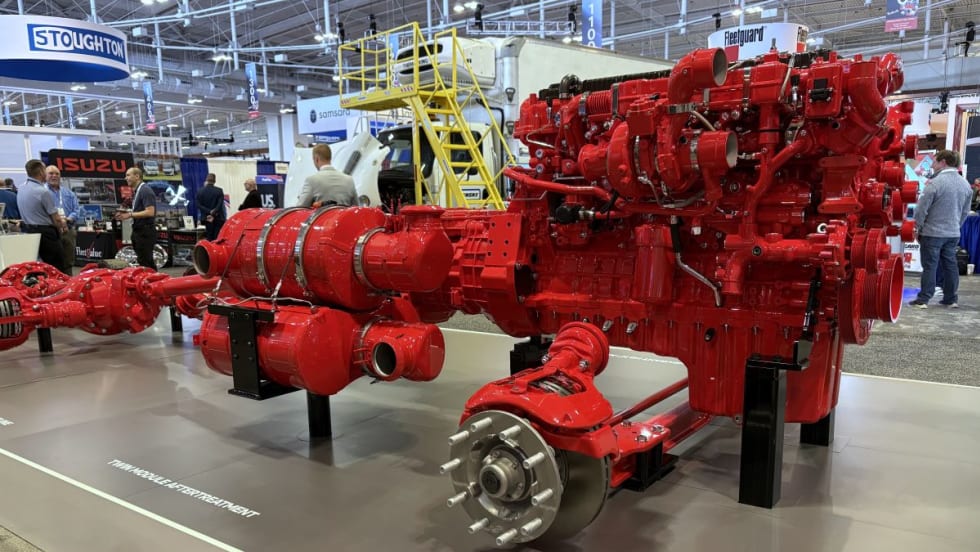
Cummins Adjusts 2027 Engine Rollout After EPA Proposal
The engine maker will gradually introduce its new Model Year 2027 diesel engines while continuing to offer current models during the transition, citing the EPA's proposed emissions rule changes.
Read More →