





Related: TPMS or ATIS… or Both?
Tougher Tires for Regional Trucks
Regional tires are designed to handle the rigors of city driving, curb strikes, and high-scrub environments.
February 22, 2019
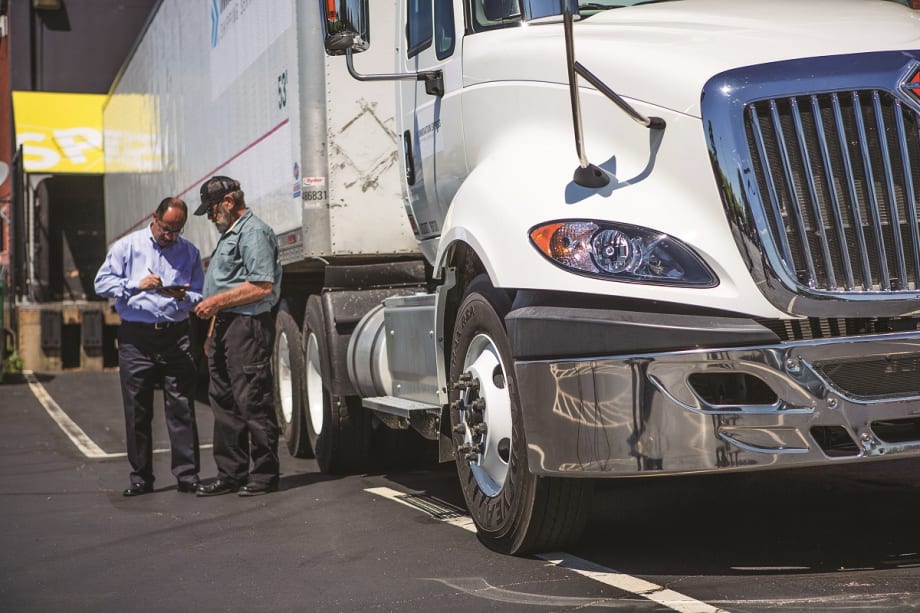
Twisting and turning into a loading dock a few dozen times a day eats on-highway tires, but regional tires are built to take that sort of punishment.
Photos: Jim Park
4 min to read
Many regional fleets are splitting more of their time these days between traditional highway driving and urban driving. A truck might start the day in suburban Cleveland, drive to Columbus with a few inner-city deliveries in the morning, then head up to Toledo for some afternoon drop-offs before shooting home at the end of the day. A fleet running that kind of route on a daily basis will want a high-fuel-efficiency tire, but also a tough, durable tire that can withstand the rigors of city driving. Long miles to removal would be as important an attribute as resistance to scrubbing and curb impacts.
Regional tires suffer all sorts of abuse that a typical highway tire hardly sees, such as tread scrubbing from tight turns. This can be particularly hard on steer tires, but drives and trailer tires get beat up as well while backing into docks and maneuvering in tight spots. Then you have the rough and uneven surfaces – often strewn with gravel – that also make unfavorable impressions on tire tread.
Frequent starts and stops are also hard on tires. There’s higher potential for tread wear, of course, especially with aggressive drivers. On top of that, the torque applied to the sidewalls during acceleration and braking is higher and more frequent than most on-highway tires are exposed to.
Tire makers combat these challenges with several design strategies, such as rubber compounding, as well as careful design of sidewalls, casings, tread and shoulders. Casing life can be extended with curb guards to protect the sidewalls from impacts and abrasions, while groove-bottom protectors guard against stone-drilling that can damage the casing, Michelin says.
“We offer a variety of both new tire and retread products that fall into this area,” says Paul Tatarchuk, B2B special services coordinator, Michelin North America. “When selecting a tire for regional applications, make sure that the tire is indeed designated for such use.” Michelin denotes the name for regional applications as “X Multi” and “X InCity” for urban applications. Its data books show the “winding road” graphic designation for tires with characteristics engineered for strenuous regional environments.
Curbs are the arch-enemies of trailer tires in city pickup-and-delivery work. Life expectancy for tires on the right side of the trailer is significantly lower than other tires because of curb strikes and sidewall damage. All trailer-tire sidewalls are at some risk, so investing in a tougher and more resilient sidewall is usually worth the money. Repositioned on-highway steer and drive tires won’t withstand such attacks as well as purpose-built regional tires will. The associated downtime from a curb strike is one thing, but the loss of a valuable casing is a double slap in the face.
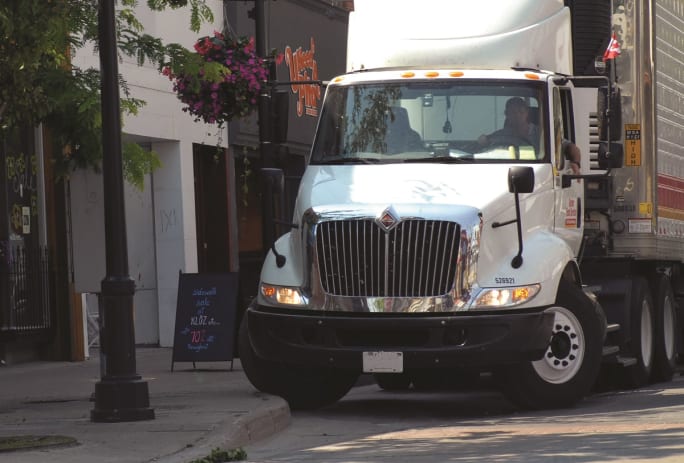
Curb strikes are inevitable in the close confines of a city. Guard against excessive damage with treads and sidewalls designed for the application.
Photo: Jim Park
“Regional trailer tires should be engineered to withstand high scrub conditions and be resistant to chips and cuts, so they can handle the rigors associated with spread-axle and drop-deck trailer applications,” notes Gary Schroeder, global director of Cooper Tire’s truck and bus tire business. “Regional tires can be retreaded, and the casing of all Cooper Pro and Work Series tires is designed and warrantied for multiple retreads.”
At the extreme end of the regional spectrum are the roll-off and waste haulers. These trucks get into some ugly areas and need all the help they can get from their tires. Such tires need to be tough and versatile, with the ability to withstand high-scrub conditions, Schroeder says. “They must manage severe turning and impact, so they need robust construction capable of carrying a heavy load and corresponding inflation pressure, plus deep, wide treads designed to deliver tread wear life.”
So how do you know which tire is right for you? Just like highway tires, different brands and different models can perform differently because of tread and casing design as well as the rubber compounding used in the tire.
“When selecting new tires, we strongly encourage regional fleets to consult with an experienced commercial tire dealer, who can assess the fleet’s tire needs and make appropriate recommendations,” says Mahesh Kavaturu, Goodyear marketing manager. “Dealers also can help develop a tire maintenance plan, including inflation management, that will help fleets drive down their operating costs.”
Maintaining proper inflation pressure levels, for example, is critical, and under-inflation, in particular, should be avoided. Under-inflation can lead to irregular wear and force truck engines to work harder, which leads to increased fuel consumption – just like with on-highway tires. In this way, regional tires are no different; they still need proper care and feeding.
“Fleets should check their tire inflation levels at least once a week, using a calibrated tire gauge, and more often, if possible,” Kavaturu says. “We cannot overstate the importance of tire inflation maintenance. This applies to truck tires for all vocations — not just regional.”
If your fleet is seeing an increase in regional work, you should consider looking at the appropriate tires for the job. The tires on your repurposed highway trucks may work, but they likely won’t last as long as you might expect. A few weeks in the inner city is like a few months out on the big road.
Subscribe to Our Newsletter
More Equipment

How Volvo Updated Its D13 for EPA 2027 [Watch]
Volvo’s updated D13 promises lower emissions without sacrificing performance or fuel economy. Take a closer look at what changed inside the engine in this HDT Spotlight video.
Read More →
Michelin Tire Improves Efficiency and Durability for Regional Fleets
The Michelin X Multi Energy D2 is a regional haul drive tire engineered to help fleets improve fuel efficiency, durability and traction in demanding stop-and-go operations.
Read More →
ZF Expands Commercial Vehicle Push in North America
ZF is expanding its North American commercial-vehicle presence with new transmission applications, electrification, trailer technology and autonomous-driving systems.
Read More →
Tesla Wants a Self-Driving Semi. Are Cameras Enough?
Could Tesla’s camera-only autonomous driving technology work on an 80,000-pound Semi? In this commentary, HDT's Deborah Lockridge takes a look at Tesla, Cybercab, and how autonomous trucks see the road.
Read More →
Kodiak: Driverless Long-Haul Truck Launch on Track for 2026
Kodiak AI says its driverless long-haul safety case is 93% complete and it remains on track to begin commercial operations by year-end 2026.
Read More →
What DOT’s Automated Vehicle Strategy Means for Trucking
The U.S. Department of Transportation issued a new automated-vehicle strategy that outlines plans for driverless-truck regulations, cross-state freight corridors, and federal safety standards.
Read More →
East Coast Port Launches $45M Electric Truck Push
The Port Authority of New York and New Jersey announced millions in incentives for zero-emission drayage trucks, yard tractors, and new charging hubs near the port.
Read More →
PlusAI Going Public to Fund Autonomous Truck Launch
A SPAC deal could provide PlusAI with up to $300 million as it works toward a 2027 commercial launch of factory-built autonomous trucks.
Read More →
NHTSA Moves to Rewrite Truck Fuel-Economy Rules
The National Highway Traffic Safety Administration says it lacks authority to regulate medium- and heavy-duty truck engines separately from complete vehicles, but the existing standards have not yet been eliminated.
Read More →
Detroit Opens Orders for EPA 2027 Engines
Detroit isn’t starting from scratch to meet EPA 2027 diesel emissions standards. Its Gen 6 DD13 and DD15 engines keep much of today’s platform while updating the fuel and aftertreatment systems.
Read More →