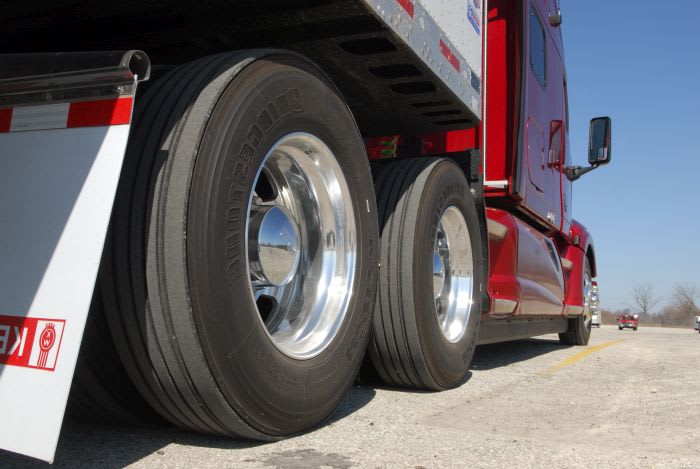
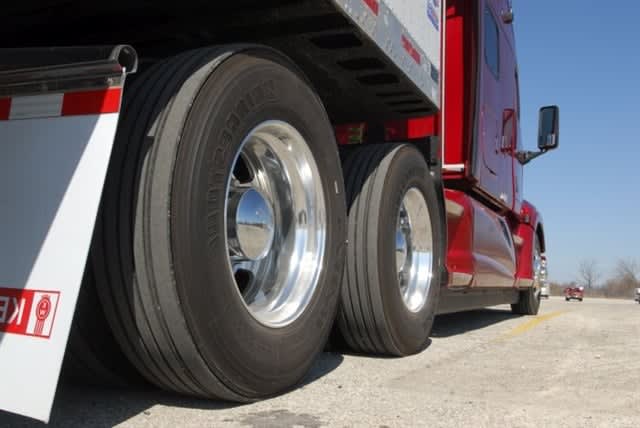
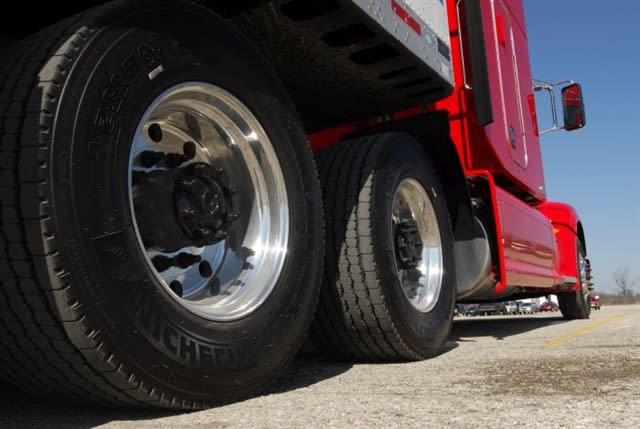
Fleets spec’ing wide single tires need to decide upfront whether to trade the vehicle as is or to spec axles and wheels for a later conversion to duals.
The greater axle track width used with dual wheels would make that same axle too wide when equipped with wide-single tires.Photos: Jim Park
5 min to read
The greater axle track width used with dual wheels would make that same axle too wide when equipped with wide-single tires.Photos: Jim Park
Photo: Jim Park
It’s easy enough to slap a wide-single wheel onto a hub where there used to be dual wheels. But there’s a little more to think about when replacing wide-singles with duals. In fact, any tire and wheel modifications from the original spec should be carefully thought through before the torque wrenches come out. There’s more at play here than meets the eye — especially the untrained eye.
Ad Loading...
In the aftermarket, where professional guidance might not be readily available, one could mistakenly create an overload scenario and reduce the fatigue-life of the wheel bearings, cautions Brandon Uzarek, technical service engineer, field engineering with Accuride Corp.
“It’s important for fleets to be mindful of how the whole wheel end system is integrated, from axle and wheel-end components to the wheel itself,” Uzarek says. “Some fleets are experiencing undue wheel bearing, hub and spindle wear due to the wheel-axle outset mismatch, usually in the aftermarket when replacement wheels are installed. Fleets don’t always contact the axle manufacturer to understand what’s necessary for their application. They could avoid the bearing wear problem if they were aware of its potential causes.”
Ad Loading...
Upfront, when the truck or trailer is new, owners usually don’t have to worry too much about the wheel-end spec. There are things to consider here, such as suspension and frame clearance and the width of the tires relative to the overall width of the vehicle, but the OEM and the axle/suspension suppliers usually take that into account when approving the spec.
“Historically, trailer suspensions (air or mechanical) were designed to accommodate most wheel offsets and tire combinations, as the suspension was a standalone purchase component,” explains Bill Hicks, director-product planning, Americas, for SAF-Holland. “With the advent of the integrated suspension system approach (axle, suspension, and wheel ends), and as the popularity of wide-base single tires has grown, the use of offset rims is now a very important consideration at the beginning of the suspension/axle system design. Therefore, the fleet will need to determine which axle track/offset rim combination works best for them.”
The wheel-end system is designed to place the centerline of the wheel load as close as possible to the center point between the inner and outer wheel bearings so both share the load equally. Moving the load in or out relative to that point could increase the load on one bearing or the other, says Charlie Allen, Meritor’s general manager for rear axles.
“There’s a load envelope there,” he says. “If you stay within that range you’ll get decent bearing life. But if you install wheels with the incorrect centerline relative to the bearings, like a 2-inch outset wheel, bearing life will diminish.”
For example, Allen cites some internal research that shows even the difference in thickness of the wheel flange between steel and aluminum wheels can make a difference. “When you look at the thickness of the mounting face, you can see where you’d be pushing that load more than an inch further out onto the outer bearing. That can decrease expected bearing life by nearly 40%.”
Ad Loading...
Meritor published a white paper on the subject in 2011 that explains this well. “Understanding the Impact of Wide-base Single Tires on Axle and Wheel-end Systems” should be required reading for any fleet planning to transition in mid-life from wide-singles to duals or vice versa.
The type of axle spindle matters, too. Tapered and parallel spindles are commonly available, but the tapered spindles do not respond well to the increased loads on the outer bearing when using a large-outset wheel.
“The increased load of the typical 2-inch wheel offset for wide-based single tires is not recommended for use with the HN (or tapered) spindles due to the reduction in service life of the spindle and outer wheel bearing,” cautions Jim Rushe Sr., program manager, trailer commercial vehicle systems at Hendrickson. “The 2-inch offset is permitted for use with the HP (or straight) spindles, but the maximum load capacity may be reduced.”
Spec’ing for the second owner
The ability to switch from offset single wheels to a dual wheel arrangement will depend on the nominal suspension axle track that is used. Dual wheel arrangements typically use a nominal 77.5-inch axle track so the outer tires do not exceed the U.S. maximum legal width of 102 inches. Depending on the wheel offset and the tires being specified, a wider track axle can be used that will move the tires outward in order to place them closer to that limit. But if a wider track axle is used, it cannot be converted to a dual wheel arrangement without exceeding the 102-inch width limit.
“When wide-based single tires are used, the typical 2-inch offset wheels place the tires at approximately the same width as dual wheels when used with a 77.5-inch track axle,” Rushe says. “This arrangement would allow subsequent owners to change to a dual wheel set-up and still meet the legal requirements.”
Ad Loading...
Less often, wide-based single tires are used with zero offset or a 1.25-inch offset wheel on a wider axle, commonly an 83.5-inch axle track. For this type of arrangement, subsequent trailer owners cannot convert back to dual wheel components.
“Fleets need to be spec’ing their wheels and wheel-end system for the day they sell the truck, or at least have in mind what the next buyer is going to want,” Allen advises. “That will help maximize the residual at resale time.”
Fortunately, with drive axles, fleets can usually spec either dual or wide-base wheels and change over later in life without having to worry about outset. Meritor’s DualTrac housing effectively repositions the loading on wheel bearings so it’s similar to dual tire configurations. The Spicer SelecTrac option from Dana also allows owners to switch from wide-based tires to a dual-tire configuration.
“Dual tires on a wider track axle will have a slightly different appearance since tire edges may extend beyond chassis fairings, but the configuration meets acceptable overall width limits,” says Steve Slesinski, director of product planning for the commercial vehicle market at Dana. “A standard track axle with 2-inch outset wheels will convert to a standard dual-tire configuration as well, without tires extending beyond chassis fairings or mud flaps.”
If you’re planning a switch from singles to duals or vice versa, Dave Walters, manager of field service at Arconic Wheel and Transportation Products (formerly known as Alcoa), suggests you do a little reading beforehand or seek some professional advice.
Ad Loading...
“TMC offers two RPs on the offset issue,” he says. “RP 661 is about offset wheels with wide-base tires, and RP 255 is a good description of the definition and suggestions on how to measure wheels. Or, consult your wheel, wheel-end, axle or suspension provider before buying anything.”
Inset, Outset, Offset and Back-Spacing
The four terms associated with wheels and the use of wide single tires on heavy trucks are often confused and used incorrectly in discussions, according to the American Trucking Associations’ Technology & Maintenance Council. TMC’s Recommended Practice 255 sets the record straight and helps in the understanding of these types of wheels.
First of all, the term “back-spacing” should not be used in such discussions. According to the RP, it’s an automotive term used to describe the distance from the mounting surface to the outer edge of the inboard rim flange on passenger cars and light truck wheels.
Instead, trucking uses the terms inset, outset and offset. But they are often used mistakenly, and there’s still some confusion as to their meaning. Chris Putz, principal engineer for commercial vehicle wheels at Maxion Wheels, sponsored TMC’s RP 255 to help improve understanding of the terms, and by extension the design and intended use of the different types of wheels. Here’s what they mean:
Offset: Applies only to disc wheels used in dual applications. Offset is the lateral distance from the rim centerline to the outboard disc mounting surface. As the offset measurement increases, the centerline of the rim moves further inward toward the vehicle.
Outset: Applies to wide-base single disc wheels used in drive and trailer axle positions. Outset is the lateral distance from the disc mounting surface to the rim centerline. With such wheels, the rim centerline is located outboard of the mounting surface on the wheel.
Inset: Applies to wide-base single disc wheels used in steer axle positions, such as on dump and refuse trucks. With inset disc wheels, the rim centerline is located inboard of the disc mounting surface, and the measurement applies to the distance between the rim centerline and the inside of the disc mounting face.
“In the RP we also provide some measurement techniques to determine what those dimensions are for your wheels,” Putz says.
Volvo’s updated D13 promises lower emissions without sacrificing performance or fuel economy. Take a closer look at what changed inside the engine in this HDT Spotlight video.
The Michelin X Multi Energy D2 is a regional haul drive tire engineered to help fleets improve fuel efficiency, durability and traction in demanding stop-and-go operations.
ZF is expanding its North American commercial-vehicle presence with new transmission applications, electrification, trailer technology and autonomous-driving systems.
Could Tesla’s camera-only autonomous driving technology work on an 80,000-pound Semi? In this commentary, HDT's Deborah Lockridge takes a look at Tesla, Cybercab, and how autonomous trucks see the road.
The U.S. Department of Transportation issued a new automated-vehicle strategy that outlines plans for driverless-truck regulations, cross-state freight corridors, and federal safety standards.
The Port Authority of New York and New Jersey announced millions in incentives for zero-emission drayage trucks, yard tractors, and new charging hubs near the port.
The National Highway Traffic Safety Administration says it lacks authority to regulate medium- and heavy-duty truck engines separately from complete vehicles, but the existing standards have not yet been eliminated.
Detroit isn’t starting from scratch to meet EPA 2027 diesel emissions standards. Its Gen 6 DD13 and DD15 engines keep much of today’s platform while updating the fuel and aftertreatment systems.