




Tires for GHG2: Increased Fuel Economy, Mileage
Tire makers say advancements in tire design and construction will produce safer and longer-lasting tires for the second round of greenhouse gas reduction rules.

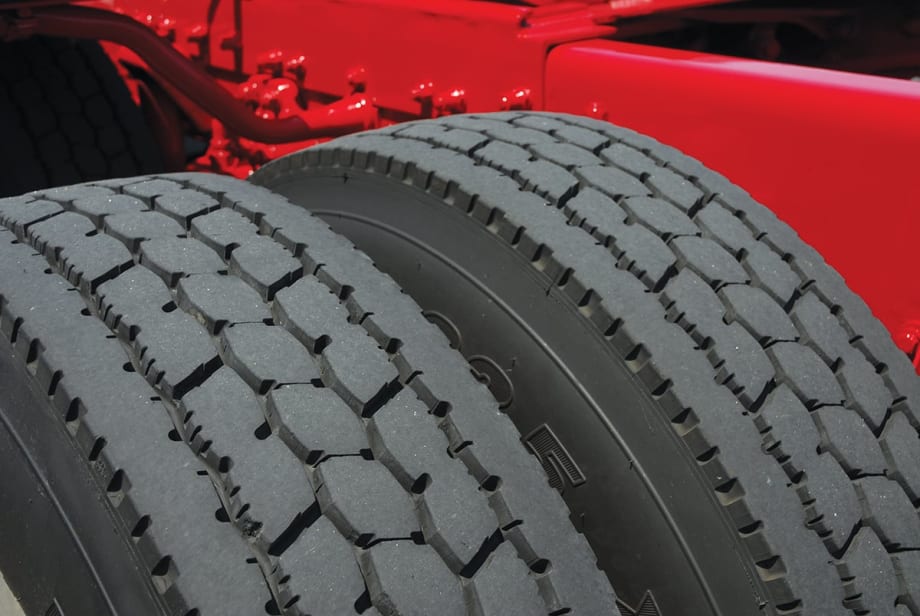
Shallower tread lowered rolling resistance, but fleets were not happy with the trade-off in tire life. More advanced tire design tools could change all that.
Photo: Jim Park
The next round of federal greenhouse gas emissions reduction mandates is slated to begin in 2021 for trucks and tractors. The stringency of the reductions will ramp up incrementally in 2024 and again in 2027. The Environmental Protection Agency claims these changes will result in a reduction of 1.1 billion tons of carbon emissions and $170 billion of fuel savings for commercial vehicle owners.
Tires will play a significant role in those plans.
Rolling resistance accounts for approximately a third of fuel costs. The lower the rolling resistance, the less fuel consumed. For example, a 3% reduction in rolling resistance translates into a 1% savings in fuel consumed, or an increase of 0.05 mpg. Consequently, ever-lower-rolling-resistance tires are seen as major contributors to the overall vehicle strategy for carbon emissions reductions.
Unlike the EPA’s Smartway initiative with its essentially voluntary compliance, the GHG Phase 2 rules require truck and possibly trailer manufacturers (see page 43) to meet prescribed emissions reduction thresholds. The manufacturers can choose their own pathway to compliance by building vehicles with certain components that contribute to those mandated reductions while accruing credits for compliant builds. At the risk of oversimplifying things, truck makers can load up a spec with certain engine parameters, such as idle shutdown timers and speed limiters, as well as certain components, such as aero fixtures, fuel-efficient drivetrains, tire pressure management systems, and low-rolling resistance tires.
Each component is assigned a numerical value that truck makers can plug into an algorithm, the Greenhouse Gas Emissions Model (GEM), which calculates the proposed reductions in carbon emissions for that truck.
“Truck manufacturers do not have to test every truck; they are not testing for actual greenhouse gas emissions,” noted Dennis Johnson, the technical director of the EPA’s climate division assessment center, speaking at American Trucking Associations’ Technology & Maintenance Council meeting in Raleigh, North Carolina, last fall. “Instead, they use certain inputs to the GEM model as a way to demonstrate compliance with the EPA standards.”
As far as the customer is concerned, there are no compliance requirements other than ensuring the vehicle remains in “as manufactured” condition. Certain compliance documentation is affixed to the vehicle to ensure compliance and for enforcement verification.
The upside for the end user is improved fuel efficiency, and as Johnson asked during his TMC presentation, “How many fleets would choose to burn 10% more fuel than they had to?”
Low-rolling-resistance tires can provide a significant fuel savings. “If the low-rolling-resistance tires were to provide a savings of 3%, that would be 450-600 gallons of fuel for a truck running 120,000 miles annually,” said Gary Schroeder, executive director of Cooper’s truck and bus tire business.
However, while fleets are almost always interested in fuel savings, many also factor other performance criteria into their tire spec. There needs to be some consideration for the operating environment and an understanding of how the tire can contribute to the overall success of the fleet, suggests Bill Walmsley, product category manager at Michelin North America.
“The tire’s performance must sync with the nature of their operations, to their drivers and their habits, driving locations, maintenance habits, budget and other priorities – such as fuel costs,” he said.
A New Age in Tires
Historically, this balancing of priorities has left fleets a little uncertain about their tire choices.
“When rubber compounds started changing back in the 1980s, we could demonstrate fuel savings of 3-5%, but those tires were about 15% more expensive and they ran about 30% fewer miles to removal,” said Patricia Meisenholder, Michelin’s product technical manager, at an S.2 Study Group session at the TMC fall meeting. “Anyone who had run those tires in wet weather probably called their dealers asking what had happened to wet traction.”
One of the hallmarks of the early-generation low-rolling-resistance tires was significantly thinner tread, perhaps 11/32 or 12/32 of tread depth versus 26/32 or 28/32. With simply less rubber to scrub off the tire over time, tires were pulled with fewer miles. Fleets had a hard time reconciling the fuel savings compared with the increases in tire costs – the LRR tires cost more but didn’t run as far.
Tire manufacturers work to optimize what’s known as the “performance triangle” of rolling resistance, traction and miles to removal. In the past, when one performance benefit was optimized, the remaining sides of the triangle sometimes took a back seat. That dynamic is much less prevalent these days, according to tire makers.
“We are constantly developing technologies and designs to minimize tire performance trade-offs, so fleets can enjoy optimal, all-around tire performance,” said Mahesh Kavaturu, Goodyear commercial technology director. “That said, as fuel efficiency regulations tighten, the need for new truck tires and even retreads that offer lower levels of rolling resistance will continue to grow, which is why we are investing even more resources to develop tires that help reduce fuel consumption while, at the same time, helping to ensure that our products provide the traction that fleets also require.”
The major tire companies are all concerned with traction to a certain degree, and many of the changes required to meet rolling resistance through tread rubber compounding have already been made. Now it’s more about design enhancements to the rest of the tire – the tread design, the sidewalls and the bead area.
“We have levers to pull today we didn’t have back in the’90s,” said Meisenholder. “We have tread-compounding to work with, even dual compounding. There’s tread sculpture optimization, tire architecture and wide-base single tires.”
She said there are lots more opportunities today to adjust and experiment with the 200 different chemicals and components inside a tire, including the elastomers and reinforcing agents in the rubber as well as the belts and structural components of the tire. Each one has some impact on rolling resistance.
“When fleets are choosing tires, they have to balance all their needs, from wet handling, wear and fuel efficiency,” she added. “The good news is, tire manufacturers are prepared to meet the GHG Phase 2 targets.”
More Fuel Smarts

How Volvo Updated Its D13 for EPA 2027 [Watch]
Volvo’s updated D13 promises lower emissions without sacrificing performance or fuel economy. Take a closer look at what changed inside the engine in this HDT Spotlight video.
Read More →
Diesel Price Spike Shortens Payback for Natural Gas Trucks, Report Says
Energy Vision estimates fleets could recover the higher purchase price of an RNG-fueled Class 8 tractor in 1.3 to 2.8 years under current fuel-price scenarios.
Read More →
Calstart Becomes Catalyst Mobility, Reflecting Broader Focus
Calstart is now Catalyst Mobility, reflecting the nonprofit’s growing national role in clean transportation, including zero-emission trucks, infrastructure and incentive programs.
Read More →

Record Diesel Prices Squeeze Trucking Fleets
Average U.S. diesel prices have climbed to nearly $6 a gallon, surpassing the 2022 record as tight refinery capacity and Middle East disruptions keep fuel costs elevated.
Read More →
How Fuel Delivery Shapes Engine Performance
Fuel delivery depends on more than what happens at the injector. For fleet, maintenance and technical professionals, looking at the full path from pump to injector can provide useful context for understanding engine performance.
Read More →
East Coast Port Launches $45M Electric Truck Push
The Port Authority of New York and New Jersey announced millions in incentives for zero-emission drayage trucks, yard tractors, and new charging hubs near the port.
Read More →
California Bill Could Shed Light on Electric Truck Prices
Why do battery-electric Class 8 trucks remain so expensive? A California bill headed to Gov. Gavin Newsom would give fleets and state agencies more visibility into what manufacturers charge.
Read More →
Detroit Opens Orders for EPA 2027 Engines
Detroit isn’t starting from scratch to meet EPA 2027 diesel emissions standards. Its Gen 6 DD13 and DD15 engines keep much of today’s platform while updating the fuel and aftertreatment systems.
Read More →
Zero-Emission Truck Corridor Planned for West Coast
California, Oregon, Washington, British Columbia and Baja California are coordinating plans for truck charging and hydrogen fueling from Canada to Mexico.
Read More →
A Closer Look at Kenworth’s Electric T880E Vocational Truck [Video]
Learn more about Kenworth's T880E battery-electric vocational truck at the Paccar Technical Center, including its range, applications, upfitting considerations, and PTO options, in this HDT Spotlight video.
Read More →