




Tips to Keep the Rubber on the Road
Good truck tire management can bedevil even the most dedicated fleets. Here’s how some of trucking’s sharpest maintenance minds make sure their tires are ready for the road.

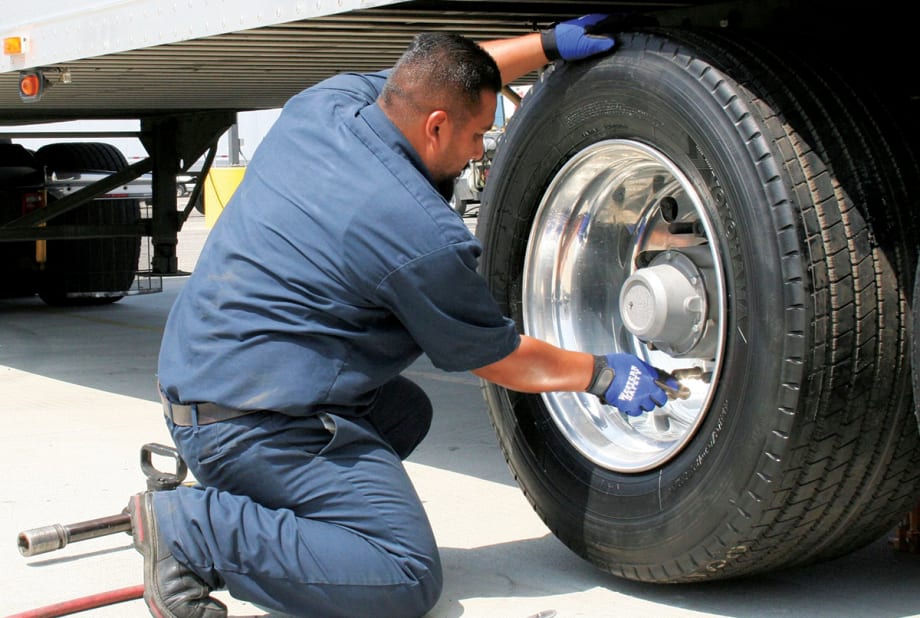
Getting your technicians to buy in to even a basic tire maintenance program can do wonders for reining in maintenance costs.
Photo: Jim Park
Good tire maintenance management can make or break a truck fleet. It’s taken for granted that drivers, fuel, and tires are a fleet’s top three operational expenses. No matter where tires land in that assessment, they are always the single highest cost item when it comes to fleet maintenance and repairs.
It’s an ongoing struggle for savvy fleet managers, and there are few hard-and-fast answers when it comes to tires. Each fleet has different operational and geographic demands to consider when focusing on tire maintenance — some of which can shift daily.
“Maintaining tires is a collective effort by drivers, managers, and our shop associates,” says Doug Lloyd, director of maintenance for Tennessee-based Averitt Express. “It’s our number one expense, no doubt, as far as maintenance. We’re engaging drivers to do a proper pre-trip and post-trip [inspection].
"I really stress the post-trip at the shop location, because they can get it to the shop and get it corrected before the next morning.”
There are other basic steps you can take to rein in tire costs and begin to collect data to fine-tune your spec’ing, purchasing and retreading programs.
Start with the Right Tire
“All best tire practices start with making the right tire choice, first and foremost,” stresses Gerry Mead, executive vice president, maintenance, The Hub Group.
In order to get a handle on tire maintenance and the associated benefits that go along with doing so — better application fit, longer life on the road, better casing life for multiple retreads, for example — you must select the correct size and type of tire for your operation, Mead says. It’s the first and most basic step.
“For a steer tire, understand if you need a regional or linehaul tire, and then select the correct load-rated tire based on your front axle rating,” Mead says.
It is also important to understand tread design and how it affects your operations, says Brett Wilkie, who as senior director of fleet services at Fleet Advantage travels to clients’ locations assessing their equipment and maintenance operations.
“There are specific reasons for which certain tread designs were engineered,” he notes.
Why Tire Pressure is Critical to Truck Tire Maintenance
“Air pressure is also critically important in tire maintenance," WIlkie says "A tire that is 10% below its required pressure operates at a temperature of 20 degrees warmer than a tire at the correct pressure. This can result in degradation of the casing.
"It is estimated that 95% of tire failures are due to low air pressure. Therefore, tire pressure audits must be conducted at least twice per week.”
Mead also cites tire air pressure as “vital in achieving optimal wear and extending the life of your tire,” as well as improving fuel economy.
“Some tire manufacturers have some specific psi they feel will help you extend the life of your tire. Work with your representative to set the pressure that carries the load as well as helps you extend the life of the tire. With a tire, every 32nd counts.”
Crunching the Numbers: How Data Helps in Truck Tire Maintenance
Perhaps the simplest — yet most effective — move fleet managers can make to get a better handle on fleet tire maintenance is to get their technicians to buy in to whatever maintenance plan is in play. The key to making that happen is to make sure they understand just how important tires are to a fleet’s overall economic health and prosperity.
“It is very important for technicians to understand the impact tires have on total fleet performance and total cost of ownership,” Wilkie says. “Many tire vendors are willing to help technicians to understand different failure modes and how to properly document each instance, resulting in improved data integrity.
"Technicians should consider looking into historical data regarding tire performance. Often-overlooked items such as alignments have a tremendous impact on tire life.”
For Lloyd, technicians are not just the tip of the spear when it comes to tires; they are the vital link that gets critical tire data off of vehicles and into the hands of the fleet’s maintenance managers.
“We have what we call a ‘tire champion’ at every shop,” he says. “Every tire removed is evaluated by a tire champion to make sure it was removed for the correct code, and we do a scrap analysis with our vendors.”
When it comes to data entry, Lloyd says he prefers to have that task in his technicians’ hands to ensure accuracy.
“We ask our technicians to stick tires two or three times and then average out those numbers,” he says. “That’s my way of taking the ‘human factor’ and the chance of error out of the equation. It’s a tough, thankless job. And there are drive-over systems we’ve looked at, but they are very expensive; we just don’t see the return on investment for them.”
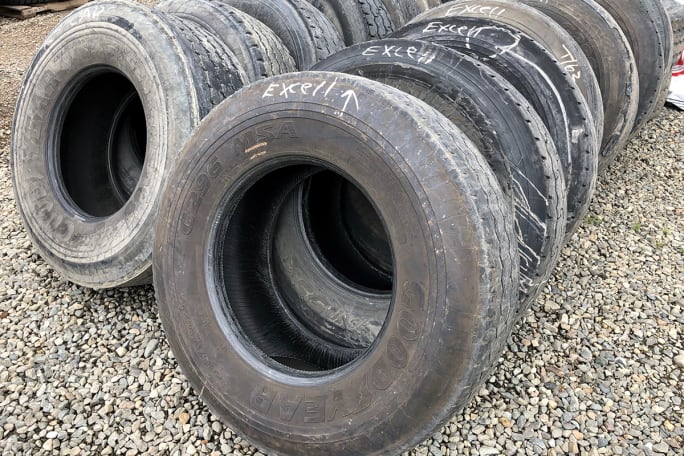
Tracking wear patterns and damage is an essential part of any basic tire management program.
Photo: Jack Roberts
Once the data has been collected, Lloyd says, it is transferred into Averitt’s own internal tire tracking program for analysis.
“Every time a tire is removed and replaced, we capture our meter and our tread depth,” he says. “So we can then run an internal report and know how many miles per 32nds for each part number we’re getting.”
The bonus here, Lloyd adds, is that if his maintenance team wants to test a specific brand or type of tire, the data allows them to break tires out according to those criteria and run validation trails.
“So if we want to do a test with Goodyear or Bridgestones” instead of their current Michelin tires, “we can put them in and compare them and determine which is the best fit for our application.”
Track each tire as an asset, Mead advises, and remember that tires have more than one life.
“That means that understanding and setting limits such as age, number of repairs, and number of retreads allowed will reduce your overall costs when tracking each tire through its lifespan,” he says. “But, as a bonus, tracking this data will also help you prevent costly failures while out on the road.”
Retreading Truck Tires Right
On top of that, Mead urges fleet managers to get intimately acquainted with their retread process.
“Know how your retread process functions and conduct regular audits on its performance,” he advises. “It is important to understand what is leading to your tire woes.
"Understand the retread process and show up and inspect your tires when they are in the process. Visit with the inspection station and ensure your specs are there and understood. Verify that repair-only tires go to the proper area and that highly valuable tread is not being buffed off at the buffer station. Ensure that the shearogrophy inspection process is occurring, as it will look for and detect unseen imperfections that will lead to early failures.
"Perform a scrap analysis and determine failure caused by poor process and make adjustments to prevent future occurrences.”
Tires can make or break your maintenance budget. A few basic management practices can make a huge difference in how much money you spend on tires, and how long you can expect to keep them making you money.
More Maintenance

Color Match Smarter: Tools That Restore & Perform
For fleet managers and collision repair professionals keeping heavy-duty trucks on the road, getting the color right the first time isn't just about appearance — it's about efficiency, turnaround time, and bottom-line results. Discover how today's digital color tools are transforming the repair process from guesswork to precision.
Read More →
Wrong Repair Prompts Recall of Freightliner, Western Star 4x2 Trucks
DTNA is recalling more than 2,400 trucks that received an incompatible software fix instead of the hardware repair required to address brake valve corrosion.
Read More →
Truck Drivers Need More Than Another Alert
Fleets have more visibility into truck health, safety events, and driver activity than ever. The next challenge is turning all that information into useful guidance for the person who has to decide what to do next.
Read More →
The Maintenance Checks Trucking Fleets Should Prioritize Before Fall Freight Picks Up
Making it through August isn’t the same as being ready for the next several months of operation. Find out what systems may have suffered from summer heat and need to be checked out before fall.
Read More →
What Three Fleets Are Doing Differently When Buying Truck Parts in 2026
With freight improving but costs still climbing, fleet maintenance executives explain how they're balancing price, quality, and supplier relationships.
Read More →
Paccar Recalls 2027 Trucks Built This Summer for Possible Electrical Problem
The nearly 6,000 Kenworth and Peterbilt trucks in the recall could potentially lose engine power, among other things.
Read More →
Will API PC-12 Oil Change Trucking Fleet Maintenance?
The new API PC-12 heavy-duty engine oil category reflects the changing demands of modern diesel engines. But fleets like Foodliner are looking to getting their own data before making decisions on adopting the new oils and questions such as extending oil drain intervals.
Read More →
Brake Safety Week to Focus on Drums and Rotors
Commercial vehicle inspectors are focusing on truck brakes during CVSA's Brake Safety Week, August 23-29.
Read More →Possible Battery-Cable Fires Prompt Recall of 15,000+ International MV and HV Trucks
On the recalled vehicles, manufacturing variations can cause the battery interconnect cable to contact the auxiliary stud and hold down the bracket.
Read More →
Rush, MCT Team Up to Grow Refrigeration Service Network
The joint venture will operate MCT's network of Carrier Transicold dealerships and mobile service locations, with the companies promising greater service capacity and uptime for refrigerated fleets.
Read More →