




Thor COO: Electric Trucks a 'Fantastic' Fit for Regional, Local Class 8 Applications
Thor Trucks COO Giordano Sordoni says electric trucks are a surprisingly good fit for the majority of Class 8 operations today.

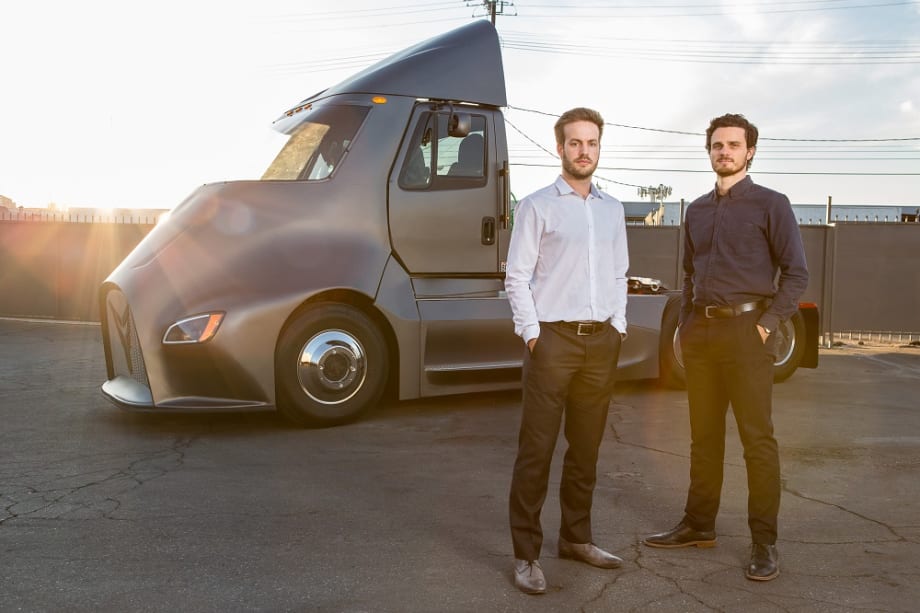
Thor Trucks isn’t looking to “reinvent” the trucking industry, says COO Giordano Sordoni, one of Thor's co-founders with Dakota Semler (both pictured here).
Photo courtesy Thor Trucks
Unlike some Silicon Valley startup companies, Thor Trucks says it isn’t on a massive ego trip compelling them to completely reinvent the trucking industry. That’s according to Thor Trucks co-founder and COO Giordano Sordoni, who answered questions on May 22 at the Freightwaves Transparency 18 summit in Atlanta about how his company differs from other electric commercial vehicle manufacturers today.
During a 15-minute discussion, Sordoni covered a wide range of topics detailing the efforts he and Thor co-founder Dakota Semler have made to design an electric truck that meets the needs of North American fleets.
“Dakota and I started out by ourselves six months before we even thought of assembling a team to design our dream truck – first in our heads, then on paper and then with models,” Sordoni explained. “And today, we head up a team of about 30 employees, 90% of whom are engineers.”
As it got deeper into the design process, the Thor team quickly realized that in some areas, they were going to have to be innovators. But in other areas, they’d be able to turn to established truck component suppliers to build their truck.
“We started out trying to buy battery packs off the shelf,” Sordoni recalled. “We went to over 100 different suppliers, and discovered that the vast majority of the battery packs on the market today are designed for passenger cars and have to be adapted for use in commercial vehicles.”
The defining design requirement for a passenger car battery, Sordoni noted, is the need to fit into very limited space on the vehicle chassis. From that starting point, the issue becomes how much usable energy can be crammed into that limited battery capacity. “But with electric trucks, we have the luxury of additional space,” Sordoni said. “And that allows us to focus on safety, cost and cooling in a battery pack – which essentially forced us to develop our own proprietary battery systems. And in hindsight, that was one of the best decisions we made during that time. Today, I feel we have the strongest battery technology on the market. And it’s purpose-built for commercial vehicles.”
At the same time, Sordoni said, his team realized that there are a whole host of reliable, knowledgeable industry suppliers Thor could partner with as they worked on their vehicle design. “We decided that it didn’t make a lot of sense for us to spend time, money, and energy reinventing various vehicle systems when there are any number of excellent suppliers building axles, wheel ends, suspensions, and other components we could use on our trucks,” he said.
Naysayers argue that electric trucks don’t make sense in some market segments today. And Sordoni absolutely agrees with that assessment. “I have drivers tell me they fuel up their trucks and run 2,400 miles before they have to find another pump,” he said. “And I tell them: 'Yes. And you’re not my potential customer for that reason.'"
Instead, Sordoni said Thor Trucks will focus on short daily hauls of around 300 miles made with fully laden Class 8 trucks. “Most people think of Class 8 trucks as long-haul tractor-trailers,” he said. “The reality is that the majority of Class 8 trucks work in local and regional routes and come to a home depot every night.”
Additionally, Sordoni noted, many Class 8 trucks spend an inordinate amount of time idling. “We know that drayage trucks can sit for as long as two hours waiting to get loaded,” he said. “And we know that many trucks in the Los Angeles area can spend up to six hours in a working day sitting in traffic, and only two hours actually moving at highway speeds. And all of these are fantastic applications for electric trucks.”
Related: Thor Trucks Takes Different Approach to Electric Trucks
More Fuel Smarts

Geotab Links Fleet Card to Vehicle Data
The new card combines fuel discounts with telematics-based purchase controls. Geotab’s analysis also points to potential savings from choosing lower-priced fuel stops.
Read More →
Fleet Economics Shape Electric Truck Outlook
ACT Research expects costs, charging infrastructure, and technology improvements to drive zero-emission commercial vehicle adoption as federal regulations and incentives retreat.
Read More →
Wex Adds Cardless Fuel Payments for Over-the-Road Customers
A new fuel card feature for Wex customers offers convenience and security.
Read More →

New California Law Could Shed Light on Electric Truck Prices
Why do battery-electric Class 8 trucks remain so expensive? A California bill signed by Gov. Gavin Newsom would give fleets and state agencies more visibility into what manufacturers charge.
Read More →
How Volvo Updated Its D13 for EPA 2027 [Watch]
Volvo’s updated D13 promises lower emissions without sacrificing performance or fuel economy. Take a closer look at what changed inside the engine in this HDT Spotlight video.
Read More →
Diesel Price Spike Shortens Payback for Natural Gas Trucks, Report Says
Energy Vision estimates fleets could recover the higher purchase price of an RNG-fueled Class 8 tractor in 1.3 to 2.8 years under current fuel-price scenarios.
Read More →
Calstart Becomes Catalyst Mobility, Reflecting Broader Focus
Calstart is now Catalyst Mobility, reflecting the nonprofit’s growing national role in clean transportation, including zero-emission trucks, infrastructure and incentive programs.
Read More →
Record Diesel Prices Squeeze Trucking Fleets
Average U.S. diesel prices have climbed to nearly $6 a gallon, surpassing the 2022 record as tight refinery capacity and Middle East disruptions keep fuel costs elevated.
Read More →
How Fuel Delivery Shapes Engine Performance
Fuel delivery depends on more than what happens at the injector. For fleet, maintenance and technical professionals, looking at the full path from pump to injector can provide useful context for understanding engine performance.
Read More →
East Coast Port Launches $45M Electric Truck Push
The Port Authority of New York and New Jersey announced millions in incentives for zero-emission drayage trucks, yard tractors, and new charging hubs near the port.
Read More →