




The Return of the Glider
Glider kits — new trucks and tractors that get rebuilt or remanufactured powertrain components — make up a small percentage of total new-truck purchases, partly because most truck operators know little about them.

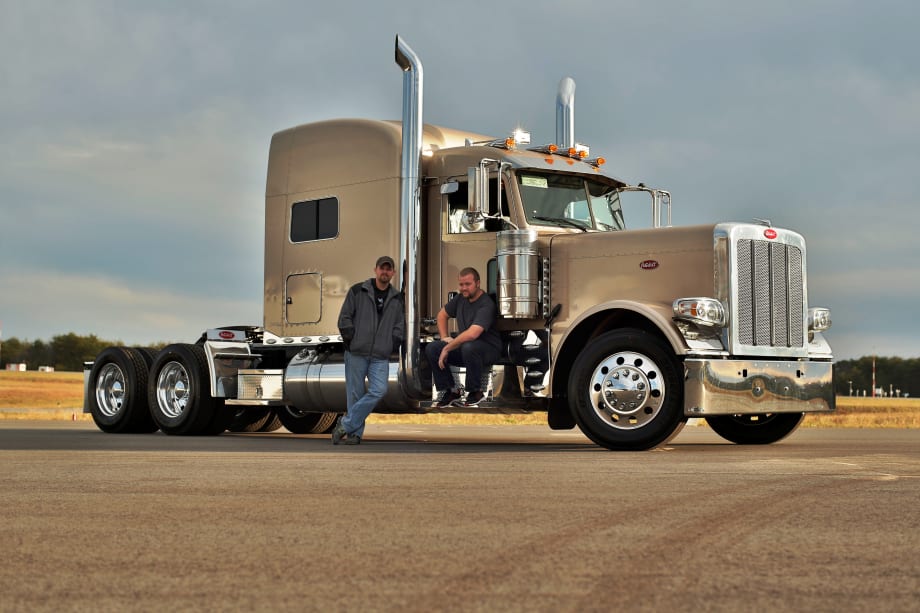
Brothers Robert Fitzgerald (standing) and Tommy Fitzgerald Jr. run the enterprise begun by their father, Tommy Sr. In addition to Freightliners and Western Stars, the specialty manufacturer also assembles Peterbilt gliders, like this Model 389, and will soon start on Kenworths.
Brothers Robert Fitzgerald (standing) and Tommy Fitzgerald Jr. run the enterprise begun by their father, Tommy Sr. In addition to Freightliners and Western Stars, the specialty manufacturer also assembles Peterbilt gliders, like this Model 389, and will soon start on Kenworths.
Glider kits — new trucks and tractors that get rebuilt or remanufactured powertrain components — make up a small percentage of total new-truck purchases, partly because most truck operators know little about them.
But word is spreading. The number of glider kits sold last year was about 3,900, double that of 2011.
Glider kits have been around for many years as a means to put wrecked trucks back on the road.
Damage too great for economical repairs was sidestepped by removing a still-good powertrain and placing its components, usually including rear axles and suspension, in an otherwise new vehicle. Today, some fleets are choosing them over buying new or used trucks for some economic and operating advantages.
A glider costs at least 25% less than a comparable new truck, is generally exempt from the 12% federal excise tax, and often gets better fuel economy than some modern engines that are saddled with expensive and sometimes troublesome exhaust emissions equipment, according to Lisa van Westing, marketing director at Tennessee-based Fitzgerald Gliders, the largest single assembler of gliders.
Tommy Fitzgerald Sr. started the enterprise as Fitzgerald Truck Parts and got into gliders more than 20 years ago. Last year, Fitzgerald produced 1,200 gliders and it expects to do 1,500 to 2,000 this year.
Glider kits also are built by various dealers and distributors, and some by user fleets.
“Truckers out there say the emissions systems on the new trucks still have bugs in them, and fuel economy is bad,” van Westing says. “They want trucks that have fewer problems and are cheaper to drive.”
Fleet managers continue to complain about problems with exhaust-gas recirculation, diesel particulate filters and selective catalytic reduction systems used since 2002, 2007 and 2010, respectively.
By contrast, 1999 to 2002-model diesels were known for reliability, longevity and good fuel mileage. Fitzgerald favors Detroit's 12.7-liter Series 60 from that era, but also installs pre-EGR 14-liter Cummins and 15-liter Caterpillar diesels. All are rebuilt, as are most transmissions and other parts.
The components and the completed trucks are covered by warranties that rival those on new trucks, van Westing says.
Not everyone is such a fan, however.
Glider kits are not part of Arrow Truck Sales’ business, says its president, Steve Clough. “I can't tell you the last time I saw a glider kit,” he says. “Part of it is the bodies and frames made today are so much better,” he says, compared to trucks from the ‘70s and ‘80s where the body would rust out but the engines and other parts could be rebuilt.
To Dale Tower, vice president of re-marketing for Ameriquest Used Truck Services, “the problem is residual values. If your plan is to run it into the ground, okay. But if you want to sell them, nobody wants them.”
Van Westing begs to differ.
“We take traded-in gliders if it's something we can sell,” she says. “We will absolutely take our own gliders. We have some larger fleets that want to always be under warranty, so they'll want to obtain new ones.”
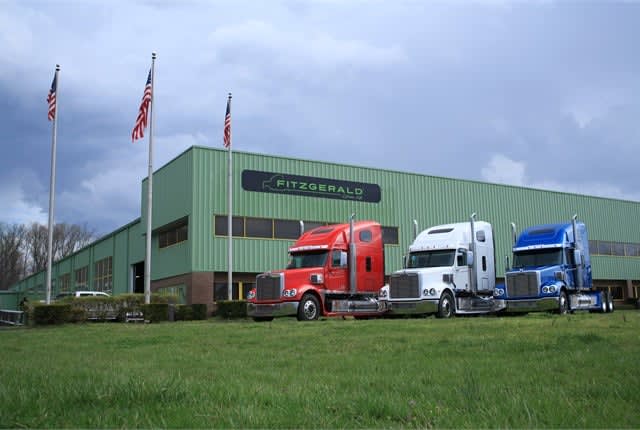
In its two factories in east Tennessee, Fitzgerald last year assembled about 1,200 gliders, most of them Freightliners. Many were sleeper-equipped Coronado tractors, early models that can take the popular 12.7-liter Detroit Series 60.
Who's making glider kits
Nearly all of Fitzgerald's gliders are Freightliners, which have been available since the 1980s. It also does Western Stars and Peterbilts, and plans to assemble Kenworths, which last fall resumed offering gliders due to customer demand.
Another major maker of gliders is the WheelTime Network, a federation of 18 distributors and repair shops. Half of them produce kits, and all supply parts to dealers and fleets whose shops do their own.
Members together assemble about 1,000 kits a year, according to Chris Craddock, director of the WheelTime Exchange, which supplies rebuilt Series 60 diesels used by Fitzgerald.
Soon WheelTime will locate an engine rebuilding line at Fitzgerald's Byrdstown, Tenn., plant, which it opened last year to keep up with demand.
Dealers are getting into the act, too.
Daimler Trucks North America produced about 3,800 gliders last year, said Don White, who manages the program. “Half of the 650 Freightliner and Western Star dealers and branches have assembled at least one. Each year it gains a little momentum.”
Economics behind glider kits
“Smaller fleets have always struggled to buy enough trucks, so they have been buyers of used trucks,” says Riley Asher, vice president of fleet services at Clarke Power Systems, a WheelTime member with locations in nine states. “They're into gliders, and are excited about them. I think we're going to see a steady stream of business, and a substantial number for quite some time if the economics don't change.”
“Fleets are desperately trying to stretch their capital,” Asher continues.
“Coming out of the recession, they've skipped a couple of trade cycles. Freight's coming on strong and they need to get newer equipment on the road. A glider is essentially a new truck, comfortable and very reliable, and costs substantially less than a new truck.”
Clarke assembled several hundred gliders for Schneider National in 2011 and 2012, says Rob Reich, the carrier's vice president of maintenance.
“We're done now. We had the pre-EGR Series 60 in tractors in our fleet. It's a very stable engine with good fuel efficiency. So we assessed that and the cost of a glider, and we decided it was a good financial decision.”
A&R Transport, a bulk hauler of plastic pellets in pneumatic tankers, went to gliders when DPFs in new trucks were plugging up during high-idle offloading of product, says Dan Umphress, vice president of maintenance and fleet services.
Glider kit tractors with non-DPF engines now make up two-thirds of the road fleet.
Glider kit rules
“There are still a lot of people who don't know what a glider kit is,” much less how to order or assemble one, says Daimler's White. “There are a lot of rules out there, but if you know them, it's not hard.”
Among them is the need for a “donor” truck, either wrecked or worn out. If a customer doesn't have one, the assembler locates it and literally yanks its components for rebuilding and installing in the kit, or has the vehicle information along with the engine.
Some states require a copy of the old truck's title and some don't. Assemblers and dealers that specialize in gliders, will know what the rules are.
There will be fewer kits built this year because customers and dealers have held back, waiting for an anticipated rules change from the Internal Revenue Service, White says.
The agency issued an “advice” letter in early February, but it basically changed nothing, so sales have been picking up again. The IRS closely watches glider transactions because it wants to collect the federal excise tax whenever possible.
Last year the American Truck Dealers division of the National Automobile Dealers Association asked the IRS to clarify several legal aspects regarding glider kits, but the agency's advice was disappointingly vague, ATD officials said.
One thing that remains clear, though, is that if there is any federal excise tax involved, the customer is responsible for paying it.
ATD has told its dealers to always place that responsibility with glider buyers. So although experienced glider assemblers can provide good guidance, so the FET is avoided, customers must be sure the work and transaction are handled correctly.
“You can use a glider kit to replace a truck if two or more major components of the original vehicle are used and the selling price is 75% or less of the actual transaction price of a comparable new truck,” explains Dave Hames, general manager of marketing and strategy at Daimler Trucks and Freightliner, whose past duties included glider kits.
Putting the glider kit together
Assembly time ranges from three days for a “powered” glider, which has a factory-installed remanufactured engine, to a week for a non-powered kit, Hames says.
Sometimes the tandem will be assembled and ready to mount, and the frame will be predrilled for a specified suspension, so work can go fast.
“There are lots of ways to screw up a glider kit,” Hames says. “Nothing is worse than giving the wrong serial number.”
Wiring harnesses are installed for the specified engine, and manufacturers often get the correct older designs from outside suppliers. The engine and harness, in turn, can dictate the truck model.
“For example, the current Coronado never had a Cat or a Series 60 engine,” Hames says. So Fitzgerald gets the old Coronado, designated CC-132, which has a different instrument panel, body pieces and other details. “We're now selling more of that model as gliders than we ever did new.”
Growth in gliders in recent years was due to the FET avoidance, poor fuel economy with EPA 2007-spec engines, and then the high cost of EPA 2010 emissions requirements, Hames says. “But that's beginning to go away. The market has digested the pricing on the EPA ‘10 engines, and the fuel economy is going in the right direction. So it might decline as a business.”
Even Tommy Fitzgerald Jr. acknowledges the possibility. “We're set up to make a profit at 300 a year,” he comments. “But I don't see it going to that.”
More Equipment

Used-Truck Remarketing Math Is Changing
Used-truck value is no longer just a concern at trade-in. Decisions made throughout a truck’s first life can influence what it’s worth years later.
Read More →
How Volvo Updated Its D13 for EPA 2027 [Watch]
Volvo’s updated D13 promises lower emissions without sacrificing performance or fuel economy. Take a closer look at what changed inside the engine in this HDT Spotlight video.
Read More →
Michelin Tire Improves Efficiency and Durability for Regional Fleets
The Michelin X Multi Energy D2 is a regional haul drive tire engineered to help fleets improve fuel efficiency, durability and traction in demanding stop-and-go operations.
Read More →
ZF Expands Commercial Vehicle Push in North America
ZF is expanding its North American commercial-vehicle presence with new transmission applications, electrification, trailer technology and autonomous-driving systems.
Read More →
Tesla Wants a Self-Driving Semi. Are Cameras Enough?
Could Tesla’s camera-only autonomous driving technology work on an 80,000-pound Semi? In this commentary, HDT's Deborah Lockridge takes a look at Tesla, Cybercab, and how autonomous trucks see the road.
Read More →
Kodiak: Driverless Long-Haul Truck Launch on Track for 2026
Kodiak AI says its driverless long-haul safety case is 93% complete and it remains on track to begin commercial operations by year-end 2026.
Read More →
What DOT’s Automated Vehicle Strategy Means for Trucking
The U.S. Department of Transportation issued a new automated-vehicle strategy that outlines plans for driverless-truck regulations, cross-state freight corridors, and federal safety standards.
Read More →
East Coast Port Launches $45M Electric Truck Push
The Port Authority of New York and New Jersey announced millions in incentives for zero-emission drayage trucks, yard tractors, and new charging hubs near the port.
Read More →
PlusAI Going Public to Fund Autonomous Truck Launch
A SPAC deal could provide PlusAI with up to $300 million as it works toward a 2027 commercial launch of factory-built autonomous trucks.
Read More →
NHTSA Moves to Rewrite Truck Fuel-Economy Rules
The National Highway Traffic Safety Administration says it lacks authority to regulate medium- and heavy-duty truck engines separately from complete vehicles, but the existing standards have not yet been eliminated.
Read More →