




The New Hours Rule: Did FMCSA Find A Sweet Spot?
Almost no one is happy about the new hours of service rule. Maybe that means the Federal Motor Carrier Safety Administration made the moves that will lead to stability, at long last. Or maybe not.

Almost no one is happy about the new hours of service rule. Maybe that means the Federal Motor Carrier Safety Administration made the moves that will lead to stability, at long last.
Or maybe not.
At press time, the key parties were still huddled, deciding whether to take their issues to court.
Advocacy groups and the Teamsters union are considering renewing their suit against the agency because the new rule preserves the 11-hour daily driving limit.
American Trucking Associations is expected by the end of January to decide if it will sue over the new 30-minute break requirement and restrictions on the 34-hour restart.
But from ATA's perspective, the new rule is not nearly as bad as it would have been if the agency had followed through on its inclination to cut the 11-hour limit to 10 hours. And the safety advocates think the agency found a reasonable compromise on cumulative fatigue when it limited the 34-hour restart to once a week with two sleep periods from 1 a.m. to 5 a.m., and added the 30-minute rest break after eight hours of driving.
So maybe it's possible that all would be willing to live with the rule's respective shortcomings for the sake of predictable hours of service and the chance to focus on regulations that are likely to produce greater gains in safety.
That may be too much to wish for, given the mix of science, politics and business that drives the issue.
Lost productivity
The rule does not fall with equal weight across all sectors of the industry. Long-haul, irregular route carriers are the most affected. According to transportation analyst John Larkin of Stifel Nicolaus, the new restart rule could produce a 17% reduction in theoretical work time per week for these carriers.
"If you're trying to run hard in a traditional irregular route market, from 700-mile to 1,200-mile length of haul, the new rule really throws a crimp into your productivity," he says.
Other types of carriers find the changes simply a problem to be solved.
Expedited carrier Bolt Express, for example, sees the new 30-minute break requirement as a little burdensome, requiring changes in systems and operations to accommodate time-critical plant deliveries.
"It will cause a little bit of an issue because there's another 30 minutes in this that we didn't have before," says CEO Ben Bauman.
And as far as dedicated carrier Cardinal Logistics is concerned, the new rule is, in a word, terrific.
"Any law that further professionalizes our industry and gets the right people driving on the highway and gets the wrong people off of the highways, we're a massive fan of," says chairman Vin McLoughlin.
That said, Cardinal, with its 250-mile range, is not particularly affected by the new restart provision. And the half-hour break is a minor inconvenience, McLoughlin says. "We think it does a good thing for the driver."
Cardinal President and COO Jerry Bowman added another perspective: The rule gives certain large, tightly managed carriers an edge in the market. "Frankly, anything that makes the regulatory environment cleaner and causes people to operate much more safely, we're in favor of because we think that's a competitive advantage for us," he says.
To the extent that the new rule puts pressure on driver availability, that's a good thing for Cardinal. "From our standpoint, our jobs are more desirable than other (carriers') jobs. They're well-paying and have a dependable schedule."
Bowman has a dim view of trucking interests taking FMCSA to court over the rule.
"I think the industry would be idiots to go after this," he says. "I don't know what basis they would have for attacking it, and from a (public relations) perspective, the industry doesn't need that kind of PR over what's basically a non-issue, as we see it."
For Maverick Transportation, which offers an array of truckload services, the rule is going to require significant adjustments, says Dean Newell, vice president of safety and driver training.
During the past six months, for instance, about 15% of Maverick drivers' restarts would not have complied with the new rule.
The half-hour break will require work, too. Maverick's review of more than 186,000 driver logs showed that about 30% would be out of compliance with that requirement because drivers drove for more than eight hours straight. They may have stopped for load checks or smaller breaks, but they did not get the full 30 minutes, he says.
What is required to make the adjustments? "That's the hard question to answer," Newell says. "We don't know yet. We still have plenty of work to do to figure all that out."
Maverick is like most companies in this respect: It's going to take a while to figure it out.
John Conley, president of the National Tank Truck Carriers, says the members of his group still are studying the rule.
Many tank carriers that deliver gasoline work at night, so they are concerned about the impact of the restart provision, he says.
One tanker reported that its drivers could lose a half of a shift per week as a consequence of limiting the restart. A driver who usually works a sixth day and usually starts his shift before 5 a.m. will have to postpone his start, which will delay the start of the night shift. That, in turn, will force more trucks onto the road during the day.
This observation echoes the message that many carriers sent to FMCSA during the rulemaking process: The rule will reduce productivity and driver income, and increase highway congestion.
Getting in FMCSA's head
The agency's response in its analysis of the more than 20,000 comments on the proposed rule illustrates a gap between the perceptions of the regulator and the regulated.
To the issue raised by this tank carrier, for instance, the agency had a blunt answer: "A driver who is regularly working the longest hours will lose hours under the final rule: That is the intention of the rule changes."
Most drivers will not be affected, though, the agency says. Drivers still will be able to average 70 hours a week.
"A driver on the 70-hour/8-day schedule working maximum hours under the 2003 rule would lose one shift every two weeks," the agency says. "Few drivers work that hard, and they don't do so consistently. Income of drivers averaging less than 60 hours a week will not be affected."
On another point of contention, the agency challenged cost estimates for the proposed rule submitted by publicly traded carriers. The costs these carriers cited came to a small fraction of 1% of the carriers' revenues, the agency says.
"None of the commenters provided an explanation of how a reduction in weekly driving hours of about 5% for those working the longest hours could produce revenue declines of the magnitude claimed."
FMCSA also challenged ATA's assertion that the agency had overstated the number of drivers who work long hours. ATA's own data indicates an average work week of less than 44 hours, the agency says.
"The industry, in effect, made two contradictory arguments - that the long hours allowed by the current rule are rarely used so that fatigue is not a problem and rule changes are not necessary, and that any reduction in those hours will have serious economic impacts. Both arguments cannot be true."
The agency also went after industry claims of lost productivity under the rule by citing inefficiencies in the supply chain.
It says carriers and drivers claim they spend from 10% to 50% of their time each week waiting to be loaded and unloaded. If this is correct, the age
More Fleet Management

July Imports Poised to Set Container Record
The National Retail Federation projects July container imports will surpass the pandemic-era record as shippers frontload freight ahead of expected August tariff increases.
Read More →
HDT Announces 2026 Truck Fleet Innovator Finalists
From AI and fleet electrification to safety, operations, and leadership, these HDT Truck Fleet Innovator finalists are changing how trucking gets done.
Read More →
Van Spot Rates Top Contract Rates for First Time Since 2022
There’s more good economic news for the North American trucking industry according to the latest Truckload Volume Index report from DAT.
Read More →

Carrier Transicold Extends Refrigerated Trailer Life
Fleet Refresh enables refrigerated fleets to replace aging transport refrigeration units instead of entire trailers, while adding Lynx Fleet telematics and BluEdge service coverage.
Read More →
FTR Says Freight Rates Surged in May
FTR's Trucking Conditions Index surged to a record high in May, the analytics firm reports.
Read More →
Meet HDT's Truck Fleet Innovators at Heavy Duty Trucking Exchange
Heavy Duty Trucking Exchange brings fleet managers and suppliers together for the deeper conversations that lead to ideas, partnerships, and solutions. Time is running out to apply for HDTX, September 23-25.
Read More →
Enhance Fleet Performance with High-Efficiency Auxiliary Power Units
Drive sustainable cost savings while increasing driver comfort during short- and long-haul logistics operations.
Read More →
Is Your Parts Procurement Process Reactive or Proactive?
Ready to revamp your parts procurement process? Learn how now with “Strategic Parts Purchasing: A Process Checklist”
Read More →
What Trucking Events are Happening in 2026?
Looking for trucking-related conventions, expos, and other events? Heavy Duty Trucking has developed this list of national and larger regional trucking shows and events.
Read More →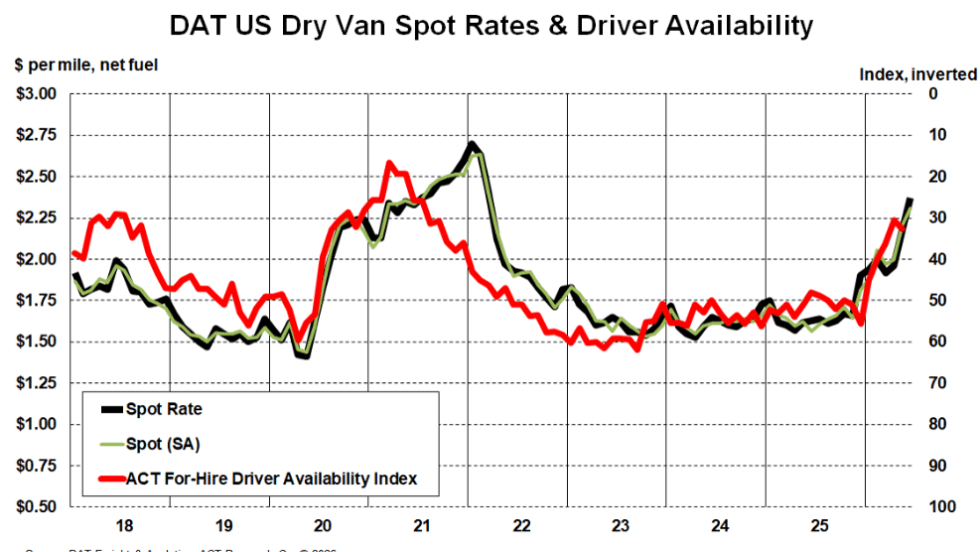
Truckload Rates Keep Rising as Tight Capacity Fuels Freight Market Recovery
Spot and contract rates continued climbing in May and June, not because freight demand is surging, but because fewer trucks and drivers are available.
Read More →