




The New Generation of Trailer Aero
Trailer side skirts are a common sight, but fleets may be missing out on fuel-saving opportunities if they’re not up to speed on the latest trends in trailer aerodynamic devices.
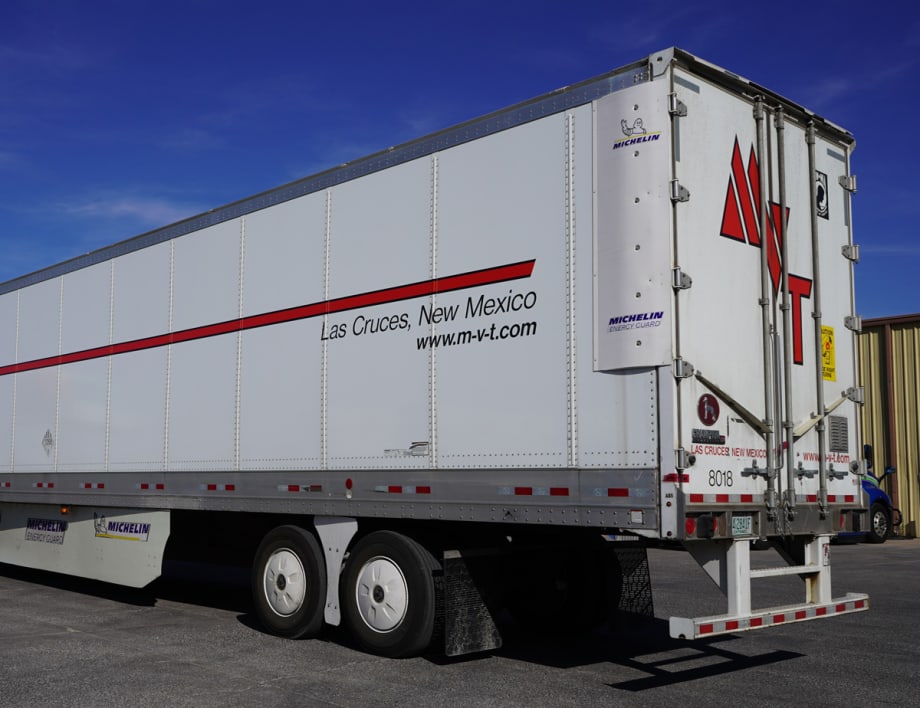
A Mesilla Valley Transportation trailer equipped with Michelin Energy Guard skirts, Trailer End Solution, Aero Flaps, and FlowBelow wheel covers.
Photo: Mesilla Valley Transportation Solutions
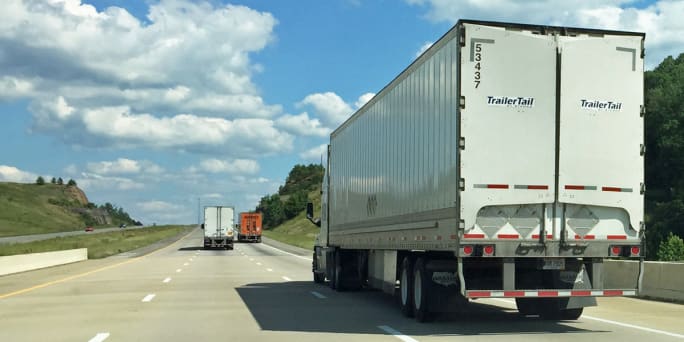
The latest aero devices to tame the air turbulence at the back of the trailer address some of the problems with early devices — such as their dependence on drivers to deploy them.
Photo: Deborah Lockridge
Today’s Class 8 tractors have sleek aerodynamic designs coming off the production line — but trailers are still largely square boxes. Fortunately, fleets have a variety of aerodynamic devices they can add to trailers to help tame the air flow.
Adding side skirts — also called fairings — to trailers will result in significant fuel savings. Skirts work by reducing air flow under the trailer and hitting the trailer bogie. While these devices have been available for years, developments and refinements are still occurring to make them smaller, lighter, and less expensive.
In its 2019 Annual Fleet Fuel Study, the North American Council for Freight Efficiency reported that 90% of the fleets in the study were using skirts on their trailers. It is estimated that more than 50% of new trailers in the U.S. have trailer skirts.
Royal Jones, president and CEO of Mesilla Valley Transportation, says he can’t remember a time when his fleet didn’t run skirts. In fact, at one point, the company was making its own trailer skirts. When skirt prices came down, they switched to skirts manufactured by another company.
The trucking industry is at a point where not investing in trailer skirts does not make good business sense. In fact, the industry is in the laggard phase of the technology adoption S curve, with some regional fleets hesitant to adopt skirts because they think their trucks travel too slowly to benefit from the improved aerodynamics. The reality is that many regional fleets travel the majority of their miles at speeds in excess of 50 mph, even if their average speed is below that due to time in traffic or cities. Therefore, skirts make sense for these regional-haul duty cycles.
Skirt fuel savings vary widely, and choosing the right skirt is a balance of reliability, ease of spec’ing and fuel savings.
Beyond Side Skirts
In addition to trailer skirts, fleets should consider adding aerodynamic mud flaps to their trailers. This should be an easy decision, as long as fleets choose the correct product. A quality mudflap is manufactured from very durable nylon material that does not crack or break easily. MVT testing has shown savings ranging from 0.75 gallons per 1,000 miles on a dry van to 3 gallons per 1,000 miles in a less-than-truckload application using two pup trailers.
(A note on gallons per 1,000 miles: MVT Solutions believes this is a more reliable method of calculating fuel savings than miles-per-gallon or percent and is the measurement we use in all our testing.)
Rear wheel covers also can generate a good return on investment, but not all brands are created equal. Select wheel covers that have reliable test data to back up the manufacturer’s fuel economy claims.
Other trailer aerodynamic devices include technologies that go in front of the wheels. One example MVT has tested is the NextGen EkoStinger, which mounts under the trailer, forward of the tandem and slides with the tandem. This device achieved a fuel savings of 5.72 gal/1,000 miles on a 53-foot dry van trailer. Streamliners’ Miniskirt is another under-trailer aerodynamic product, which is a short rear-mounted device. The Miniskirt, when tested with Eco Flaps, showed a fuel savings of 2.65 gal/1,000 miles.
The Back of the Trailer
Fleets have had a long, but not positive, experience with rear trailer “boat tail” devices and are extremely cautious about any new developments in this area. While the original rear trailer devices saved significant amounts of fuel, they had some shortfalls, including the need for driver involvement to open and close them. Maintenance costs and damage to the devices varied by fleet. For many fleets those negatives outweighed the fuel savings.
In addition, original “speed bump” air foil tail devices did not live up to their fuel efficiency claims, and manufacturers of those devices have since exited the market.
Today there is a new generation of air foil technologies. While they appear to be the same as the original versions, developments in their aerodynamic shapes have resulted in substantial fuel savings.
These new trailer rear air foil aerodynamic devices are achieving comparable savings to a “boat tail.” However, there are minimal to no operational complications, since there are no moving parts. They also have a very low-profile shape (unlike their predecessors, they do not overhang the trailer by several feet), and there is no driver involvement to deploy or stow them.
Fuel saving of 4 and 5 gallons per 1,000 miles have been achieved with these new devices, which are offered by both Michelin and Transtex. However, lower savings are being recorded when these devices are installed on refrigerated trailers, although the cause for the lower savings has not yet been discovered.

Hirschbach Motor Lines testing the Transtex Edge Elite Aero System, including skirts, TopKit+ and flaps.
Photo: Mesilla Valley Transportation Solutions
Adoption of these devices has been slow. Not only are fleets hesitant to buy new technology and apprehensive due to issues related to the first iteration of air foil technologies, but also, current supply chain issues are impacting product availability. On top of that, many fleets aren’t even aware of this new generation of products, in part because they are hardly noticeable when mounted on the trailer.
Booster-Tail is an example of a new generation of boat tail device that self-deploys through air flow at highway speeds. There are no electronic controls nor need for driver involvement in the deployment. In testing, this device saved 5.04 gal/1,000 miles on a 53-foot dry van trailer.
What’s Right for Your Fleet?
While there has been increased adoption of trailer aerodynamic devices, they still are underutilized. When combining the right trailer skirts, rear aero device, wheel covers and aerodynamic mud flaps, fuel savings can reach 12 gal/1,000 miles at 65 mph — meaning 12 gallons saved for every 1,000 miles traveled. If a truck travels 100,000 miles annually, this equates to 1,200 gallons of fuel saved — $6,000 at $5 per gallon. Return in investment can be anywhere from a few months to 24 months, with rates of returns reaching the thousands — rates Wall Street investors only dream of — and one of the best investments fleets can make.
No two fleets are the same, so no one suite of aerodynamic trailer devices is going to work for every fleet. Device manufacturers are a good starting place for information about which aerodynamic devices might work in a particular fleet’s operation. Ask them to provide data from real-world fuel economy tests that validate their fuel saving claims.
Take an analytical approach to device selection. Review your operations and duty cycles to determine where it makes sense to add aerodynamic devices. Consider hiring someone who is an expert in fuel economy to help you dig through your data. Fleets often discover that more of their trucks are operating at highway speeds for longer distances than expected, making them good candidates for trailer aero devices.

The NextGen EkoStinger in a sliding system on an Unlimited Carrier trailer. The unit was installed on a Utility trailer based out of Chicago.
Photo: Mesilla Valley Transportation Solutions
Another option for fleets to determine which trailer aerodynamic devices are appropriate for them is to examine what leading fuel-economy-minded fleets are doing. They can offer a different viewpoint than the people selling the devices. “When you do your math regarding aero devices, talk to someone you can believe,” MVT’s Jones says.
He adds, “We think about fuel even when it is $1 a gallon, because if I am buying 2 million gallons a month, I still want to save every penny I can. But when it is at $5.50 like it is now, then you just can’t go wrong. The ROI on aero products is quick, very quick. When fuel prices are high, the ROI is even faster.”
About the Author: Daryl Bear is the COO and lead engineer of Mesilla Valley Transportation Solutions, a subsidiary of the MVT fleet. A mechanical engineer with more than 20 years’ experience, he developed a proprietary test method for quantifying fuel savings in trucking, building on experiences from his previous roles as a race car engineer and test engineer. He has conducted nearly 700 fuel economy tests on Class 8 vehicles.
This article first appeared in the June 2022 issue of Heavy Duty Trucking.
More Equipment

How Volvo Updated Its D13 for EPA 2027 [Watch]
Volvo’s updated D13 promises lower emissions without sacrificing performance or fuel economy. Take a closer look at what changed inside the engine in this HDT Spotlight video.
Read More →
Michelin Tire Improves Efficiency and Durability for Regional Fleets
The Michelin X Multi Energy D2 is a regional haul drive tire engineered to help fleets improve fuel efficiency, durability and traction in demanding stop-and-go operations.
Read More →
ZF Expands Commercial Vehicle Push in North America
ZF is expanding its North American commercial-vehicle presence with new transmission applications, electrification, trailer technology and autonomous-driving systems.
Read More →
Tesla Wants a Self-Driving Semi. Are Cameras Enough?
Could Tesla’s camera-only autonomous driving technology work on an 80,000-pound Semi? In this commentary, HDT's Deborah Lockridge takes a look at Tesla, Cybercab, and how autonomous trucks see the road.
Read More →
Kodiak: Driverless Long-Haul Truck Launch on Track for 2026
Kodiak AI says its driverless long-haul safety case is 93% complete and it remains on track to begin commercial operations by year-end 2026.
Read More →
What DOT’s Automated Vehicle Strategy Means for Trucking
The U.S. Department of Transportation issued a new automated-vehicle strategy that outlines plans for driverless-truck regulations, cross-state freight corridors, and federal safety standards.
Read More →
East Coast Port Launches $45M Electric Truck Push
The Port Authority of New York and New Jersey announced millions in incentives for zero-emission drayage trucks, yard tractors, and new charging hubs near the port.
Read More →
PlusAI Going Public to Fund Autonomous Truck Launch
A SPAC deal could provide PlusAI with up to $300 million as it works toward a 2027 commercial launch of factory-built autonomous trucks.
Read More →
NHTSA Moves to Rewrite Truck Fuel-Economy Rules
The National Highway Traffic Safety Administration says it lacks authority to regulate medium- and heavy-duty truck engines separately from complete vehicles, but the existing standards have not yet been eliminated.
Read More →
Detroit Opens Orders for EPA 2027 Engines
Detroit isn’t starting from scratch to meet EPA 2027 diesel emissions standards. Its Gen 6 DD13 and DD15 engines keep much of today’s platform while updating the fuel and aftertreatment systems.
Read More →