





Read More: All Articles in the Modern Maintenance Manager Series
The Modern Maintenance Manager: Safety Matters
The twin forces of increasing safety regulation and a burgeoning driver shortage are compelling the modern maintenance manager to do nothing less than think, live, and breathe truck safety.
April 20, 2016

More than ever, maintenance is as much about safety as anything else.
7 min to read

More than ever, maintenance is as much about safety as anything else.
Proper vehicle maintenance is always factored into the safety equation by progressive fleets. But the twin forces of increasing safety regulation and a burgeoning driver shortage are compelling the modern maintenance manager to do nothing less than think, live, and breathe truck safety.
Just the need to rack up a positive score under the federal Carrier, Safety, Accountability safety-monitoring program is impacting how maintenance is managed. CSA measures safety performance by violations. Whether those are compiled by roadside inspections or crash data, the resulting scores are attached to motor carriers and their drivers alike.
Now that the program has been running for over five years, many fleet executives have come to realize they cannot get their best score without sharply reducing safety violations under CSA’s Vehicle Maintenance BASIC category.
On top of that, with unrelentingly high levels of driver churn, no trucking company can afford to lose safety-conscious drivers. And it’s the safest driver who has the most reason to quit if he or she feels an employer is dinging their own safety standing by overlooking, ignoring or deferring safety-related maintenance.
The maintenance manager is not tackling the safety challenge alone. The pressure for fleets to be safer in the eyes of the law and their own drivers — not to mention the motoring public — is breaking the maintenance department out of its managerial silo.
Everyone’s problem
“Our view is that safety has to be part of the culture for everyone here,” says Phil Taylor, vice president of fleet and procurement for Central Oregon Trucking Co. Taylor, who started his career as a driver, is one of the founders of Redmond, Ore.-based COTC, a 100% flatbed hauler now owned by Daseke Inc. of Addison, Texas. “Safety is everyone’s problem, from the very top right [down] to the drivers and the mechanics.”
He notes that the nine Daseke carriers work together on best practices and he meets often with maintenance execs at the sister companies. Daseke also has a cross-company safety committee, chaired by Brad Aimone, COTC’s director of driver safety and services. “The way we look at it,” says Aimone, “safety requires the concerted efforts of the safety and maintenance departments and our drivers.”
Taylor says when it comes to safety and preventive maintenance, “we stress the most important piece is the inspection process. That’s a culture shift from 20 years ago when maintenance people just fixed trucks. Because we run very new equipment, some complacency set in with doing pre-trips and what they should be looking for specifically. We then trained not only our mechanics but [also] our safety team and drivers on what they should be looking at and why. There’s been a dramatic improvement in catching things since we did this.”
Along the way the fleet identified brakes and tires as “chinks in our armor, so now they’re big target areas for us,” Taylor notes. “Keeping on top of those is also very important for our drivers, who may be out for a couple of weeks or a couple of months at a time.”
COTC’s brand of reaching out to its well-traveled drivers includes a nifty concierge service they’ve be running for about a year. A maintenance tech greets each driver as he enters the terminal — often with a cup of coffee — and then conducts a debriefing on how his trip went, inquiring if any issues had cropped up. Taylor says this shows the driver how important he is to COTC and it saves him for having to hunt someone down to report a problem.
“You have those management silos in companies,” adds Taylor. “But the lines are starting to blur. Here, we’re all looking to run trucks that are as safe and compliant as possible for the driver and everyone else around them.”
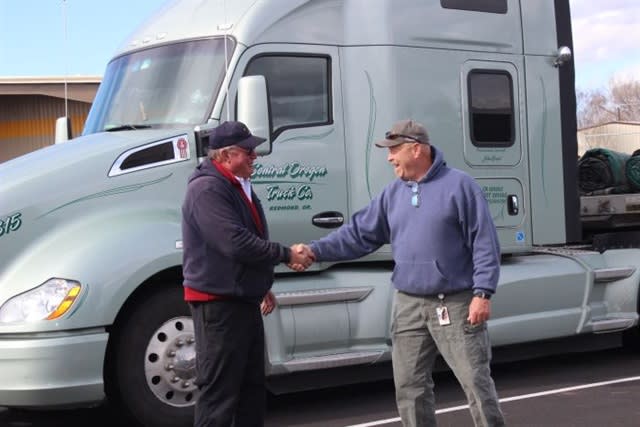
Central Oregon Trucking Co. maintenance concierge Mike Gillespie (left) greets a driver returning from a long trip to the flatbed carrier’s terminal.Photo: Central Oregon Trucking Co.
Breathing safety
“Employee buy-in is important,” says Rick Tapp, maintenance manager for Paccar Leasing (PacLease). “No one wants to do a bad job, and there’s a lot of satisfaction in doing a good job. You really have to have everyone breathing safety. We hold regular meetings with our staff where we keep them informed of the costs of accidents and the role proper maintenance plays to improve safety. Periodically, we’ll have a group of mechanics run through a vehicle inspection to see who uncovers what. Making the push for safety competitive helps.”
Tapp directly oversees the maintenance of trucks fielded by PacLease’s company stores and along with his team provides the lessor’s franchised dealers with maintenance reviews and other support.
“Our service advisors have regular contact with drivers, such as when they are coming in and out of the yard,” he explains. “Some of our locations have fuel islands. At those, our fuel techs will conduct a mini-inspection. It’s another opportunity to check over the equipment. We also do a lot of courtesy inspections of trailers our customers own to help catch things that need attention.”
In addition, the team will approach drivers individually to discuss any equipment issues they have spotted, and get driver managers involved if needed.
“At each of our locations, we work closely with customers’ safety teams. We’ll get in front of the drivers at customers’ safety meetings when asked. We help with things like explaining what they need to know to actually ‘check the brakes’ properly when inspecting their truck.”
PacLease targets the same areas that CSA looks at during regular preventive maintenance inspections, Tapp says. “Since most of our locations use VMRS coding, we can see where repairs are being made and that alerts us of any problem areas that should be getting more focus.”
In 2006, PacLease partnered with a telematics provider, making the system standard on rental vehicles and optional on leased units. “It has evolved to where alerts can be sent on excessive brake applications and sudden starts and stops. And we can identify high-idle and high-speed trucks that are costing more money to run.”
Tapp is a proponent of remote diagnostics, too, which comes standard on the Kenworths and Peterbilts that PacLease specs with Paccar MX engines. “Whether the system is turned on or not is up to our customers, but not using it makes no sense.” He says it monitors some 1,250 different faults, which can be monitored online, and sends email alerts on 117 critical faults that could cause breakdowns. “The driver gets an in-cab warning as well and we can contact him directly with a plan to handle the repair.”
Eric Peterson, vice president of maintenance of Dillon Transport, says at the Burr Ridge, Ill.-based fuel and dry-bulk hauler, being “forward-thinking on equipment” has lessened the potential impact of CSA on the operation. “We’ve been on disc brakes now for close to four years, which has eliminated a lot of our CSA brake issues, as has running with LED lights.
“Newer equipment always helps, too,” he continues, noting that trucks have collision mitigation, lane-departure warning, traction control, plus roll stability on all trailers, and camera-based event recorders on many trucks.
Other safety-oriented specs at Dillon include extra oval stoplights on the rear of trailers, and “because we’re a tanker company, we’ve started spec’ing on all new trailers a ‘2 or 3 o’ clock walkway’ position that helps protect drivers from falling off the tank.”
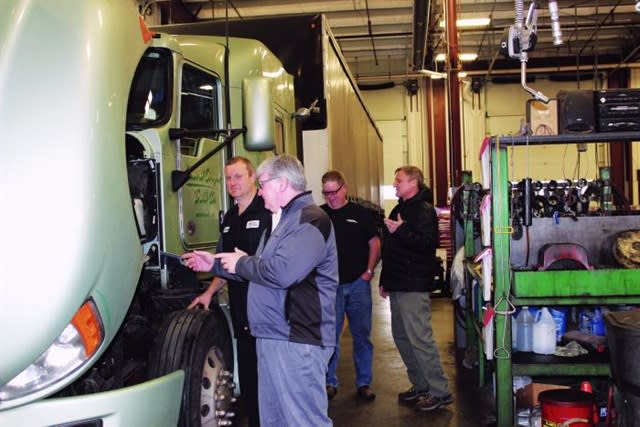
Central Oregon Trucking Co.’s Phil Taylor (foreground) checks in with a mechanic handling a PM inspection. Photo: courtesy Central Oregon Trucking Co.
Brotherly love
“I thought [early on] that CSA was only going to make everybody better at safety,” says Terry Clouser, vice president of fleet service for Fleet Advantage. The longtime fleet maintenance exec now works for the Florida-based firm that provides equipment financing and cost management to large private fleets. “By having someone else — ‘big brother’ — watching over it, everybody’s got to be more compliant and watch their CSA scores. Vehicle maintenance has a direct impact on your overall score and it’s one of the easy ones to regulate.”
He says the first line of defense against CSA is preventive maintenance. “Make sure [technicians] identify all the issues while it’s in the garage. They should test the truck to make sure there are no fault codes, no service engine lights. No indication of any problem. Then the truck should run error-free to the next PM.”
Clouser contends that deferring maintenance is only asking for trouble. “If you have it in the shop and you know something’s wrong, and you have the parts and the time and the labor available to fix it, that’s the time to fix it. If the supervisor or manager sees a trend of Part X or Y starting to fail, they need to look upstream before the whole fleet fails.”
Scott Webb, co-founder and principal data scientist at trucking consultancy Ten Four Analytics LLC, Las Cruces, N.M., who has a prior 20-year track record in fleet management, contends that if a carrier’s overall goal is to improve its CSA standing, “then the drivers should be the eyes and ears of the shop. They can identify problems before they grow.
“However,” he continues, “drivers won’t assist with this if they feel they have to be the squeaky wheel to get the attention their trucks need. The driver has to believe the shop wants to fix the problem. If trust is developed between the driver and the shop, the result will be solving maintenance and safety problems quickly and efficiently.”
Subscribe to Our Newsletter
More Safety & Compliance

NYC Expands Speed, Pedestrian Safety Tech Across Fleet
New York City is expanding intelligent speed assistance and pedestrian-alert systems across its municipal fleet, moving the technologies from pilot programs into vehicle procurement and retrofit requirements.
Read More →
FMCSA Removes 110 Truck Driver Training Schools from Certified ELDT List
Federal regulators also are targeting more than 160 additional training providers and launching a nationwide audit of third-party CDL skills testers as part of a broader crackdown on trucking fraud.
Read More →
Beyond DOT Compliance: What Makes a Trucking Fleet Truly Safe?
A trucking fleet can follow every rule and still make unsafe decisions. The real test comes when safety conflicts with freight, productivity, or cost.
Read More →
Hours of Service Pilot Programs: FMCSA Readies for 2027 Rollout
Two pilot programs could eventually reshape hours-of-service rules, giving truck drivers options to pause their 14-hour clock or use longer split sleeper rest periods.
Read More →
New Guide Offers Pet Safety Tips for Truck Drivers
Hundreds of thousands of pets travel in truck cabs. A new safety guide from Volvo Trucks and the Center for Pet Safety offers practical advice for truck drivers who bring dogs and cats along for the ride.
Read More →
Medical Cards, English Proficiency Reshape Roadcheck Violations
Medical-card violations jumped to the top of the driver out-of-service list during CVSA’s 2026 International Roadcheck, while English-language proficiency violations appeared among the leading violations for the first time.
Read More →
How Lance Evans Turns Enforcement Experience Into Better Fleet Safety
HDT Truck Fleet Innovator Lance Evans brings lessons from law enforcement to K&B Transportation’s approach to safety technology, data, driver coaching, and compliance.
Read More →
New FMCSA Chief Safety Officer Has Trucking Industry and Law Enforcement Experience
Steve Dowling joins FMCSA after serving as senior director of safety at Covenant Logistics and in leadership roles in commercial motor vehicle industry organizations.
Read More →
Driver Trust Can Make or Break the Success of Fleet Safety Technology
New Teletrac Navman research suggests that onboarding, transparency about driver data, and positive feedback can play a significant role in how commercial drivers respond to safety and coaching technology.
Read More →
FMCSA: Stop Using These 15 Electronic Logging Devices
Fleets and drivers must replace the revoked ELDs with ones on the FMCSA's registered device list of electronic logging devices.
Read More →