




The Case for RNG in Trucking
The time has come to seriously consider alternatives to zero-emission powertrains for long-haul trucking fleets. HDT Executive Editor Jack Roberts recounts recent conversations with RNG experts in the trucking industry to explore its viability as a short-term, near-zero emissions fuel solution for North American fleets.

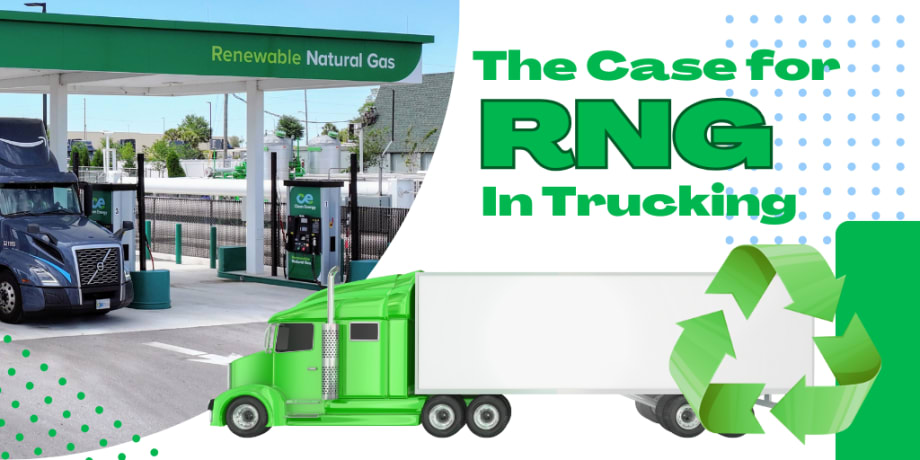
Are the benefits of renewable natural gas being ignored in the rush to transition trucking to zero-emission vehicles?
Graphic: HDT/Canva
It has become obvious that while battery-electric powertrains are a viable solution for short- and regional-haul fleets, zero-emission options for longer-range applications are sorely lacking.
It’s true that fuel cell battery-electric vehicles have the potential to move into long-haul applications. But no products are commercially available yet. And even if they were, acquisition costs and infrastructure issues are problematic. (As is still the case for commercial BEVs.).
Optimists in the industry are hopeful that internal combustion engines fueled by liquid hydrogen will one day offer fleets a viable, zero-emission option for long-haul applications.
But the best-case scenario is that hydrogen engines – assuming the technology proves out and production and infrastructure issues are resolved – could be a decade or more away from making a meaningful contribution to trucking’s decarbonization efforts.
A growing chorus of voices in the trucking industry has been lately proposing another, short-term, solution: renewable natural gas as a commercial vehicle fuel.
Is Renewable Natural Gas A Near-Zero-Emissions Fuel?
There is an immediate problem with natural gas, however. And it is one that seems to have caused the California Air Resource Board (CARB) and the U.S. Environmental Protection Agency to dig their heels in opposition to its widespread use as a truck fuel: Natural gas is not a zero-emission fuel.
“Renewable natural gas that is created by anerobic digesters (made from animal waste) get you pretty close to almost-zero carbon output when burned in a truck engine,” explains Kevin Otto, a former Cummins engineer who is now an analyst for the North America Council for Freight Efficiency (NACFE).
“The problem that I think that CARB is trying to address is that in inner city areas where there is a lot of truck traffic, the emissions from engines are still a problem from a health perspective for residents. So CARB seems to want to deal with this problem by getting rid of internal combustion engines in these areas.”

The good news about natural gas engines, says NACFE analyst Kevin Otto, is that they're a "heck of a lot better" than diesels when it comes to emissions.
Photo: Jack Roberts
The good news about natural gas from a NOx standpoint, Otto adds, is that it is a “heck of a lot better than diesel” in terms of tailpipe emissions.
“The latest diesel emissions regulations are now down to .035 grams per horsepower hour,” Otto says. “And you can beat that number easily with a natural gas engine.”
In layman’s terms, that puts a natural gas engine at about 95% of the way toward a complete, zero-emission powertrain.
Admittedly, it’s not perfect.
But a rising chorus of voices in the industry are starting to ask why natural gas doesn’t make sense as a short-term, low-emission fuel for long-haul trucks?
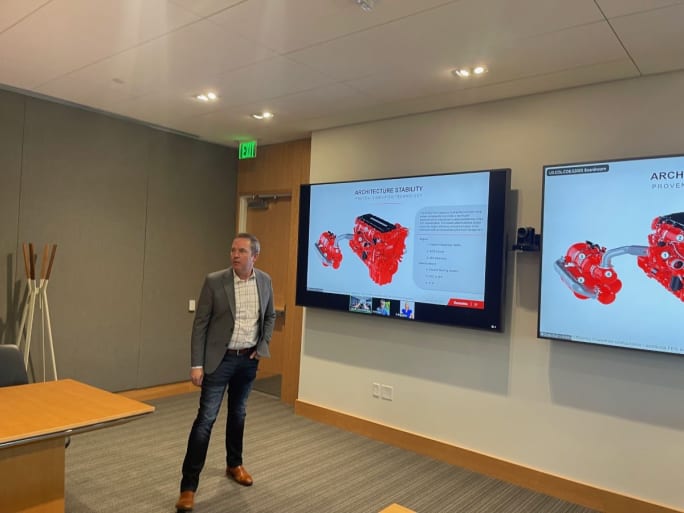
general manager, hydrogen internal combustion engines, Cummins, says that today's natural gas engines can deliver the same power, performance and range as diesels.
Photo: Jack Roberts
“Natural gas is here and ready now,” Jim Nebergall, general manager, hydrogen internal combustion engines, Cummins, told me at press event held at the OEM’s headquarters in Columbus, Indiana, this past summer.
“Moreover, its available at lower cost as a vehicle level. And it most likely will always be a lower initial cost. Because there's a lot less complexity in the fuel delivery system's lower pressures.
"It can do the job. It has the power of the torque and get the job done. You can get the range that you're used to with the diesel cost per mile is lower than diesel, and then it should continue to be that way with the low cost and stability of natural gas pricing.”
More Fuel Smarts

How Volvo Updated Its D13 for EPA 2027 [Watch]
Volvo’s updated D13 promises lower emissions without sacrificing performance or fuel economy. Take a closer look at what changed inside the engine in this HDT Spotlight video.
Read More →
Diesel Price Spike Shortens Payback for Natural Gas Trucks, Report Says
Energy Vision estimates fleets could recover the higher purchase price of an RNG-fueled Class 8 tractor in 1.3 to 2.8 years under current fuel-price scenarios.
Read More →
Calstart Becomes Catalyst Mobility, Reflecting Broader Focus
Calstart is now Catalyst Mobility, reflecting the nonprofit’s growing national role in clean transportation, including zero-emission trucks, infrastructure and incentive programs.
Read More →

Record Diesel Prices Squeeze Trucking Fleets
Average U.S. diesel prices have climbed to nearly $6 a gallon, surpassing the 2022 record as tight refinery capacity and Middle East disruptions keep fuel costs elevated.
Read More →
How Fuel Delivery Shapes Engine Performance
Fuel delivery depends on more than what happens at the injector. For fleet, maintenance and technical professionals, looking at the full path from pump to injector can provide useful context for understanding engine performance.
Read More →
East Coast Port Launches $45M Electric Truck Push
The Port Authority of New York and New Jersey announced millions in incentives for zero-emission drayage trucks, yard tractors, and new charging hubs near the port.
Read More →
California Bill Could Shed Light on Electric Truck Prices
Why do battery-electric Class 8 trucks remain so expensive? A California bill headed to Gov. Gavin Newsom would give fleets and state agencies more visibility into what manufacturers charge.
Read More →
Detroit Opens Orders for EPA 2027 Engines
Detroit isn’t starting from scratch to meet EPA 2027 diesel emissions standards. Its Gen 6 DD13 and DD15 engines keep much of today’s platform while updating the fuel and aftertreatment systems.
Read More →
Zero-Emission Truck Corridor Planned for West Coast
California, Oregon, Washington, British Columbia and Baja California are coordinating plans for truck charging and hydrogen fueling from Canada to Mexico.
Read More →
A Closer Look at Kenworth’s Electric T880E Vocational Truck [Video]
Learn more about Kenworth's T880E battery-electric vocational truck at the Paccar Technical Center, including its range, applications, upfitting considerations, and PTO options, in this HDT Spotlight video.
Read More →