





Related: The Future of Electrical Systems on Heavy Duty Trucks
The Case for On-Board Electrification in Class 8 Trucks
On-board electrification can take some of the load off the main diesel engine, allowing for greater operational flexibility and efficiency.
February 20, 2018
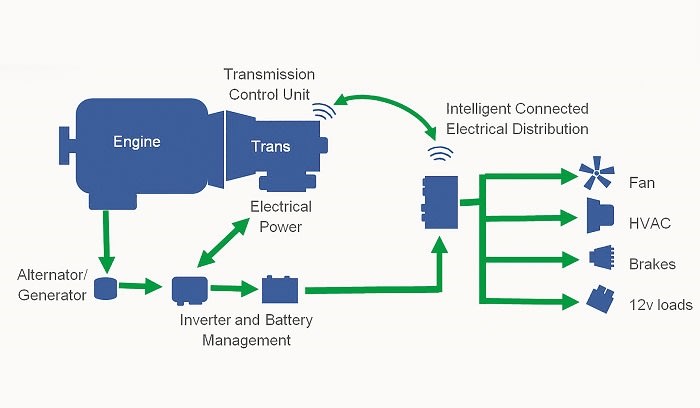
This schematic drawing illustrates some of the potential for off-boarding drive components to lessen parasitic loads on engines. Source: Eaton
3 min to read
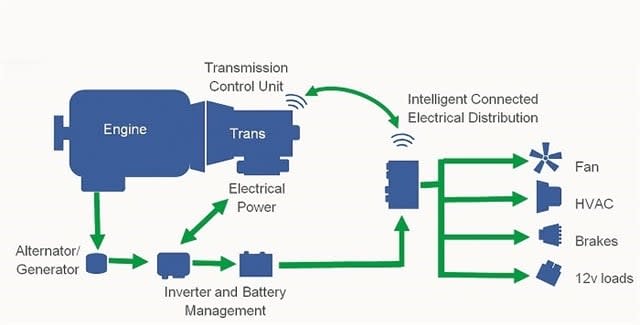
This schematic drawing illustrates some of the potential for off-boarding drive components to lessen parasitic loads on engines.Source: Eaton
The business case for electric trucks is no longer in any doubt. Even with their limited range, battery powered light- and medium-duty trucks work very well in applications tailored to those constraints.
While the case for battery-powered, long-haul Class 8s is still iffy, there’s no question that on-board electrification can take some of the load off the main diesel engine, allowing for greater operational flexibility and efficiency.
The move toward 48-volt electrical systems is still in its infancy, but SuperTruck concept fuel efficiency truck projects from Volvo and Navistar have shown they work. Likely applications for 48-volt power include HVAC, all-electric power steering, accessory drives like coolant and oil pumps, air compressors, engine fans, hybridization, etc., possibly right up to an electromechanical valve-train that can be very precisely controlled for improved engine efficiency (still maybe a decade away). We’re very restrained today by our legacy 12-volt systems, but the SuperTruck research is helping to build a compelling case for a faster move up the voltage ladder.
Larry Bennett, Eaton director of engineering, technology and innovation, says electrification will play a pivotal role in trucking powertrain technology over the coming decade. “Engine makers would like to take as much as they can off the engine itself to reduce all those parasitic losses,” he says. “We can drive a lot of it off-board, and do a great deal more in terms of power management and distribution, all using the transmission as the controller.”
Bennett says, for example, the generator and starter could be mounted on the transmission rather than the engine. It would allow electrical power to be generated while driving, but also, if engine-off coasting is developed, the transmission would continue generating power (driven by the rear wheels), and all the electrically powered systems, such as power steering, the air conditioner and the air compressor, would continue to operate.
Also, since all the accessory systems would be electric, like the air conditioner, a 48-volt electrical system would be better scaled to run the system for longer periods than the current 12-volt battery systems. This of course would require a switch from our current 12-volt battery to some advanced type of 48-volt battery, but that would all happen as these systems evolved.
“Once we have the 48-volt power distribution system in place, driven from the transmission, the OEMs can develop plug-and-play components, like 48-volt power steering and HVAC that just plug into a power distribution module,” Bennett says.
Once such systems are in place, trucks could be equipped with a hybrid powertrain where the motor/generator is capable of low-speed maneuvering, like when docking, or providing a power boost to smaller displacement engines when climbing hills, for instance.
Bennett says Eaton already has the components to develop power management systems and power distribution modules, and lessons have already been learned that make it possible to better manage batteries.
Subscribe to Our Newsletter
More Fuel Smarts

Wex Adds Cardless Fuel Payments for Over-the-Road Customers
A new fuel card feature for Wex customers offers convenience and security.
Read More →
New California Law Could Shed Light on Electric Truck Prices
Why do battery-electric Class 8 trucks remain so expensive? A California bill signed by Gov. Gavin Newsom would give fleets and state agencies more visibility into what manufacturers charge.
Read More →
How Volvo Updated Its D13 for EPA 2027 [Watch]
Volvo’s updated D13 promises lower emissions without sacrificing performance or fuel economy. Take a closer look at what changed inside the engine in this HDT Spotlight video.
Read More →

Diesel Price Spike Shortens Payback for Natural Gas Trucks, Report Says
Energy Vision estimates fleets could recover the higher purchase price of an RNG-fueled Class 8 tractor in 1.3 to 2.8 years under current fuel-price scenarios.
Read More →
Calstart Becomes Catalyst Mobility, Reflecting Broader Focus
Calstart is now Catalyst Mobility, reflecting the nonprofit’s growing national role in clean transportation, including zero-emission trucks, infrastructure and incentive programs.
Read More →
Record Diesel Prices Squeeze Trucking Fleets
Average U.S. diesel prices have climbed to nearly $6 a gallon, surpassing the 2022 record as tight refinery capacity and Middle East disruptions keep fuel costs elevated.
Read More →
Sponsored•September 9, 2026
How Fuel Delivery Shapes Engine Performance
Fuel delivery depends on more than what happens at the injector. For fleet, maintenance and technical professionals, looking at the full path from pump to injector can provide useful context for understanding engine performance.
Read More →
East Coast Port Launches $45M Electric Truck Push
The Port Authority of New York and New Jersey announced millions in incentives for zero-emission drayage trucks, yard tractors, and new charging hubs near the port.
Read More →
Detroit Opens Orders for EPA 2027 Engines
Detroit isn’t starting from scratch to meet EPA 2027 diesel emissions standards. Its Gen 6 DD13 and DD15 engines keep much of today’s platform while updating the fuel and aftertreatment systems.
Read More →
Zero-Emission Truck Corridor Planned for West Coast
California, Oregon, Washington, British Columbia and Baja California are coordinating plans for truck charging and hydrogen fueling from Canada to Mexico.
Read More →