




Test Drive: TerraStar Ready to Work
Does the world need another Class 4 and 5 vehicle in a market already crawling with trucks

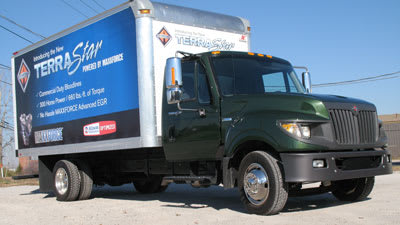
International TerraStar is a downsized heavier truck, and looks it, with its big cab nestled onto the low-slung frame.
Does the world need another Class 4 and 5 vehicle in a market already crawling with trucks?
Navistar International thinks so. Like all of us, Navistar International looked wide-eyed at the big gap left by General Motors when it discontinued its medium-duty line. Navistar could have bought the business, but decided it didn't make sense, and GM's car- and light-truck-oriented top management didn't have the will to continue feeding more than a fourth of a lively commercial-truck segment.
About a 27 percent share of even a down market is a lot of trucks, so Navistar got its International TerraStar ready in not much more than a year. It went into full production in October. Of course, everybody else also wants a piece of what GM walked away from, including Ford, which already claims about 55 percent of Class 5 with its very competent F-550. But Ford folks had better watch out, because the TerraStar has a couple of things that they don't.
First, this is a downsized medium-duty truck, whereas the F-550 is an upsized light-medium truck, based on the F-Super Duty pickups and cab-chassis models. There are pros and cons either way, and here they are in a proverbial nutshell: Salespeople at International dealers will claim that their candidate for your business is basically tougher, and that's why it'll cost you maybe a couple of grand more than a Ford.
Second, the TerraStar's hood-and-fender assembly tilts open, just like on a heavier truck, for easy access to the engine and its accessories. The F-550 has a wide alligator hood so mechanics have to work over the tall fenders, and what they first see is a mass of shrouds, hoses and wires. International mechanics will see the same thing, but the sides of that jumble are exposed so they can step around the front wheels and get comfortably close to put their hands on things.
From there on the two trucks become more similar, especially from behind the wheel.
In the truck
Wandering around the streets of Fort Wayne, Ind., the home of the Navistar Tech Center, in this plain-looking TerraStar box truck, I began thinking that it's a pretty nice machine. Some streets were smooth from recent paving, and some broken and bowed from years of frost heaving and heavy traffic, and what the suspension couldn't absorb in the way of bumps, the air-ride seat (powered by an integral pump) could.
I made a number of right-angle turns at street corners and found it nicely maneuverable, and backed around some to see what I could see in the mirrors, which was a lot. I drove briskly but as smoothly as I could, because I don't believe in beating on equipment to see if I can break it (let the crazy car writers do that). I found the engine to be lively and pretty quiet, with no signs of overheating, though there was no reason for it on this cool day.
There was room for three in the tall and wide steel cab, though there were only two of us in it. The other guy was Nick Lengacher, the program manager who oversaw much of this vehicle's development. As such he deserved a better ride than he was getting from the solid-mounted passenger seat, but he wasn't complaining.
Lengacher and his colleagues deserve much praise, I think, for how this truck turned out. It was crafted from some existing parts, like the cab that comes from the DuraStar line, and some things were new, like the mainframe, designed just for this Class 4 and 5 series. It allows the cab to sit about 4 inches lower than it does on heavier midrange models for easy entry and exit.
A prototype displayed at the truck's introduction last year at the NTEA Work Truck Show sat on a modified frame from the discontinued CF low cabover, and from that I got the impression that production trucks also would. But Lengacher said no, this frame's new.
The instrument panel and dashboard layout is smart, with easy-to-read and nice-to-use gauges and controls, including good ol' rotary switches for the HVAC. It's attractive but businesslike, very appropriate for the truck that'll work hard. It made me feel like I was doing something useful when all I was doing was driving it around.
MaxxForce power
The engine was a 6.4-liter MaxxForce 7 V-8, which has its roots in the old 6.9-liter and not-so-old 7.3-, 6- and 6.4-liter Ford Power Stroke, International T444E, etc.
But this latest version has been thoroughly revamped to meet 2010 exhaust emissions limits. It comes with 300 maximum horsepower and 660 pounds-feet, so it was more than gutsy enough to propel this lightly loaded (with about 2 tons of ballast) truck around.
The MaxxForce 7 ran through a smooth Allison 1000 6-speed automatic, which always does much of a driver's driving chores, leaving him or her to worry about other things. The Allison is the only transmission offered in the TerraStar.
MaxxForce 7's block is now cast in compacted graphite iron for greater stiffness and lighter weight than gray iron. It has two simple turbochargers - a less-costly alternative to variable-geometry turbos. Navistar's Advanced Exhaust-Gas recirculation needs no urea aftertreatment equipment to meet EPA 2010, and it has Navistar's own electronic controls and programming software.
The TerraStar gets the MaxxForce 7's top 300-horsepower rating to compete with the new Ford Power Stroke (and the Cummins Turbo Diesel in the Dodge Ram 4500/5500, another major competitor). Lower ratings of 240, 260 and 280 horsepower will be employed in International's DuraStar 4100, 4300 and 4400 trucks.
The Diamond Logic electrical system ties the engine to the chassis and, with its multiplexing feature, allows quick and easy hookups of switches to body tools and accessories. This truck didn't have a PTO or other power systems, complex lights or anything else to run, as the van behind the cab needed nothing more than a good dome light. But Diamond Logic can easily handle all that with no tangle of wires behind the dash.
Options now and future
While traversing the sometimes bumpy I-469 loop around Fort Wayne's north and east sides, I asked Lengacher about the possibility of adding a gasoline engine. He said yes. That's a choice Navistar hasn't offered almost since it became Navistar, in the early 1980s. Discussions are serious, partly because the high cost of meeting federal exhaust emission limits has boosted the price of a diesel.
One candidate is GM's 6-liter Vortec V-8, which is now used by Workhorse, Navistar's walk-in van builder. Later, Tim Shick, director of engine sales and marketing, said planners are also looking at gasoline V-8s from Nissan (the 5.6-liter from the Titan pickup) and Toyota (the 5.7 from the Tundra). All have the right displacement and power ratings for the TerraStar, but a supply deal has to be struck with one of those manufacturers.
A gasoline option would cut $8,000 or more from the price of a TerraStar, Lengacher said, because it would be not only less costly to buy but would also allow use of a smaller, less expensive cooling system. Plus, a gasoline mill could be easily adapted to burn propane and probably natural gas. That opens even more sales avenues for the new truck.
Oh - what do you think of that dark gray grille and matching headlight bezels? I'm happy to report that chrome plating for the grille and lamp trim are available for order on the TerraStar. Or you could take the cheaper standard satin finish and paint them a silver-gray or some such. Navistar people displayed a truck with that treatment in Denver, when they showed off running models to the press for the first time, and it looked kinda snappy.
Also available are extended- and four-door crewcab versions, plus a 4x4 option. So pretty soon now, the TerraStar will be ready to do all kinds of jobs and, everyone hopes, will deli
More Equipment

ZF Expands Commercial Vehicle Push in North America
ZF is expanding its North American commercial-vehicle presence with new transmission applications, electrification, trailer technology and autonomous-driving systems.
Read More →
Tesla Wants a Self-Driving Semi. Are Cameras Enough?
Could Tesla’s camera-only autonomous driving technology work on an 80,000-pound Semi? In this commentary, HDT's Deborah Lockridge takes a look at Tesla, Cybercab, and how autonomous trucks see the road.
Read More →
Kodiak: Driverless Long-Haul Truck Launch on Track for 2026
Kodiak AI says its driverless long-haul safety case is 93% complete and it remains on track to begin commercial operations by year-end 2026.
Read More →
What DOT’s Automated Vehicle Strategy Means for Trucking
The U.S. Department of Transportation issued a new automated-vehicle strategy that outlines plans for driverless-truck regulations, cross-state freight corridors, and federal safety standards.
Read More →
East Coast Port Launches $45M Electric Truck Push
The Port Authority of New York and New Jersey announced millions in incentives for zero-emission drayage trucks, yard tractors, and new charging hubs near the port.
Read More →
PlusAI Going Public to Fund Autonomous Truck Launch
A SPAC deal could provide PlusAI with up to $300 million as it works toward a 2027 commercial launch of factory-built autonomous trucks.
Read More →
NHTSA Moves to Rewrite Truck Fuel-Economy Rules
The National Highway Traffic Safety Administration says it lacks authority to regulate medium- and heavy-duty truck engines separately from complete vehicles, but the existing standards have not yet been eliminated.
Read More →
Detroit Opens Orders for EPA 2027 Engines
Detroit isn’t starting from scratch to meet EPA 2027 diesel emissions standards. Its Gen 6 DD13 and DD15 engines keep much of today’s platform while updating the fuel and aftertreatment systems.
Read More →
Carrier Transicold Adds All-Electric TRU for Stationary Cold Storage
Carrier Transicold’s new Vector 8200 all-electric transport refrigeration unit gives fleets a diesel-free option for temporary refrigerated and frozen trailer storage.
Read More →
A Closer Look at Kenworth’s Electric T880E Vocational Truck [Video]
Learn more about Kenworth's T880E battery-electric vocational truck at the Paccar Technical Center, including its range, applications, upfitting considerations, and PTO options, in this HDT Spotlight video.
Read More →