




Test Drive: Kenworth's T470 Serious Baby 8
Municipal trucks have to work all year round, and they work especially hard when heavy snow falls. "Plow trucks" keep motorized civilization moving, and for this task and others that demand strong specifications, Kenworth has the T470

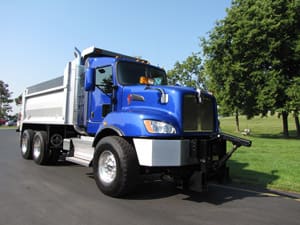
This Kenworth T470, set up with a dump bed and plow mount, aims at municipal and construction customers. Photo by Tom Berg
Municipal trucks have to work all year round, and they work especially hard when heavy snow falls. "Plow trucks" keep motorized civilization moving, and for this task and others that demand strong specifications, Kenworth has the T470.
This is a recently introduced medium-heavy model that, along with the even more recent T440, bridges the gap between the Class 7 T370 and KW's Class 8 T800.
Our bright-blue test truck was a "heavy 7" vehicle that's set up for snow plowing and salting in the winter and hauling sand, gravel, stone and dirt during the summer construction season.
Compared to the strictly medium-duty T370, the T470 has heavier frame, axle and suspension options that more resemble what you can have the factory install on a T800. A base T470 is a Class 7 truck rated at 33,000 pounds, just a pound shy of Class 8. Most 470s will be rated at over 33,000, and with midrange-size engines they're what many in the industry call Baby 8s. Two engines are available: Paccar's 8.3-liter PX-8 (otherwise known as the Cummins ISC), and Cummins' heavy duty 8.9-liter ISL, which is what this truck had.
The test truck
Our test truck's stated gross vehicle weight rating was 66,000 pounds, as it had 46,000-pound tandem rear axles and a beefy 20,000-pound rear-set steer axle designed to take the weight of any payload plus that of a 10-foot steel snow plow. The T470's standard fixed grille stays vertical as the hood tilts down around a plow's hoist hanger and pump (one of the differences between it and the new T440, whose grille tilts with the hood).
This 470's frame had full-length inserts, though available bigger rails can be used instead, and was extended to accommodate a front-engine power take-off to operate the plow. GVW would be higher if it had a pusher axle, another factory option with the T470, though then the steer axle would be of lesser capacity as the 470's top GVW rating is 68,000 pounds.
Like other KW conventionals, the T470 has a stout aluminum cab with doors hung on piano hinges, large windows, a "real truck" instrument panel and air-ride driver's seat. Almost nothing in it looks "automotive" except the steering wheel, but its smoothly contoured spokes provide a place to comfortably rest your hands, and in a frontal wreck the wheel won't pierce your chest the way an old-fashioned straight-spoke and small-hub wheel might (but you wear your lap-and-shoulder belt anyway, y'hear?). The steering column tilts and telescopes so you can get the wheel just right. The cab is narrower than some competitors offer, but in a work truck how often do you need to carry another guy?
On this trip I did. Jared White, Kenworth's Chicago-based Great Lakes regional sales manager, met me at KW's assembly plant in Chillicothe, Ohio, on a late-summer morning and briefed me on the test truck, which had been upfitted with the dump bed and other equipment at Beau-Roc over in Illinois. It had burly suspensions over its Dana Spicer axles, including 22,000-pound taperleafs on the steer and a 46,000-pound Chalmers walking-beam type on the tandem.
On the road
Even with several tons of crushed stone in the bed, the truck got a-bouncin' on a stretch of bowed concrete on our route over state and U.S. highways to Athens, about an hour east of "Chilli." But the ride otherwise was orderly, the steering rather precise and noise levels low. We cruised through the campus of Ohio University. Here I remarked that the view through the big windshield and side windows and over the sloped hood allowed me to spot everything easily. The truck turned rather sharply for having big "duplex" tires up front, and I could go from curb lane to curb lane in a right turn at a street corner.
Early in the run I had to look to see where the brake pedal was so I wouldn't miss it with my right foot. While waiting at a red light in Athens, I noticed that I had to press down really hard on the pedal to overcome the torque coursing through the Allison automatic, so I punched it into Neutral. My legs were at an almost 90-degree angle because the smallish cab forced the seat close to the controls, same as in a T170 that I drove last year (grumble-grumble).
But wait - this cab had the optional 6-inch extension, and I realized that I could slide the seat farther back (duh...). When I did, I could stretch my legs more, so could bring my body weight to bear on the brake pedal, which now also seemed better positioned on the floor. Moving the seat back made the seating position about 1,000 percent more comfortable, and I'm not tall.
I'd advise KW customers to spec the Extended Cab in any order for a daycab truck or tractor (though it's not available in lighter T-series trucks).
Under the hood
That strong low-end torque, as much as 1,150 pounds-feet of it, came from a 345-horsepower version of the Cummins ISL (a 365/1,250 rating is also available). It fit nicely under the hood and supplies plenty of power for whatever work a truck like this will do.
The 6-speed Allison 3000 RDS did much of the driving work and would've eased plowing snow or spreading gravel, had I been told to tackle such tasks. Those are among the reasons most municipal fleet managers went to Allisons years ago.
How many of these budget-constrained managers will consider a "pricey" Kenworth? Some will see value and long life in the corrosion-resistant aluminum cab and other premium manufacturing details, and argue for them in discussions with elected officials who dole out their limited tax revenues. Besides, everyone's dealing these days, and it could be that municipal buyers will be surprised at how competitive KW's pricing might be. Indeed, KW has already reported some orders for the T470, and some will be painted "muni" red, yellow or orange.
From the December 2009 issue of Heavy Duty Trucking.
More Equipment

How Volvo Updated Its D13 for EPA 2027 [Watch]
Volvo’s updated D13 promises lower emissions without sacrificing performance or fuel economy. Take a closer look at what changed inside the engine in this HDT Spotlight video.
Read More →
Michelin Tire Improves Efficiency and Durability for Regional Fleets
The Michelin X Multi Energy D2 is a regional haul drive tire engineered to help fleets improve fuel efficiency, durability and traction in demanding stop-and-go operations.
Read More →
ZF Expands Commercial Vehicle Push in North America
ZF is expanding its North American commercial-vehicle presence with new transmission applications, electrification, trailer technology and autonomous-driving systems.
Read More →
Tesla Wants a Self-Driving Semi. Are Cameras Enough?
Could Tesla’s camera-only autonomous driving technology work on an 80,000-pound Semi? In this commentary, HDT's Deborah Lockridge takes a look at Tesla, Cybercab, and how autonomous trucks see the road.
Read More →
Kodiak: Driverless Long-Haul Truck Launch on Track for 2026
Kodiak AI says its driverless long-haul safety case is 93% complete and it remains on track to begin commercial operations by year-end 2026.
Read More →
What DOT’s Automated Vehicle Strategy Means for Trucking
The U.S. Department of Transportation issued a new automated-vehicle strategy that outlines plans for driverless-truck regulations, cross-state freight corridors, and federal safety standards.
Read More →
East Coast Port Launches $45M Electric Truck Push
The Port Authority of New York and New Jersey announced millions in incentives for zero-emission drayage trucks, yard tractors, and new charging hubs near the port.
Read More →
PlusAI Going Public to Fund Autonomous Truck Launch
A SPAC deal could provide PlusAI with up to $300 million as it works toward a 2027 commercial launch of factory-built autonomous trucks.
Read More →
NHTSA Moves to Rewrite Truck Fuel-Economy Rules
The National Highway Traffic Safety Administration says it lacks authority to regulate medium- and heavy-duty truck engines separately from complete vehicles, but the existing standards have not yet been eliminated.
Read More →
Detroit Opens Orders for EPA 2027 Engines
Detroit isn’t starting from scratch to meet EPA 2027 diesel emissions standards. Its Gen 6 DD13 and DD15 engines keep much of today’s platform while updating the fuel and aftertreatment systems.
Read More →