




Test Drive: Detroit’s Smooth Self-Shifter
“Proprietary” is a magic word among truck builders. It describes components of the company’s own manufacture or design that are installed on the company’s own trucks. For truck users, this can be a good thing, because they’re designed to work specifically with a company’s other components.

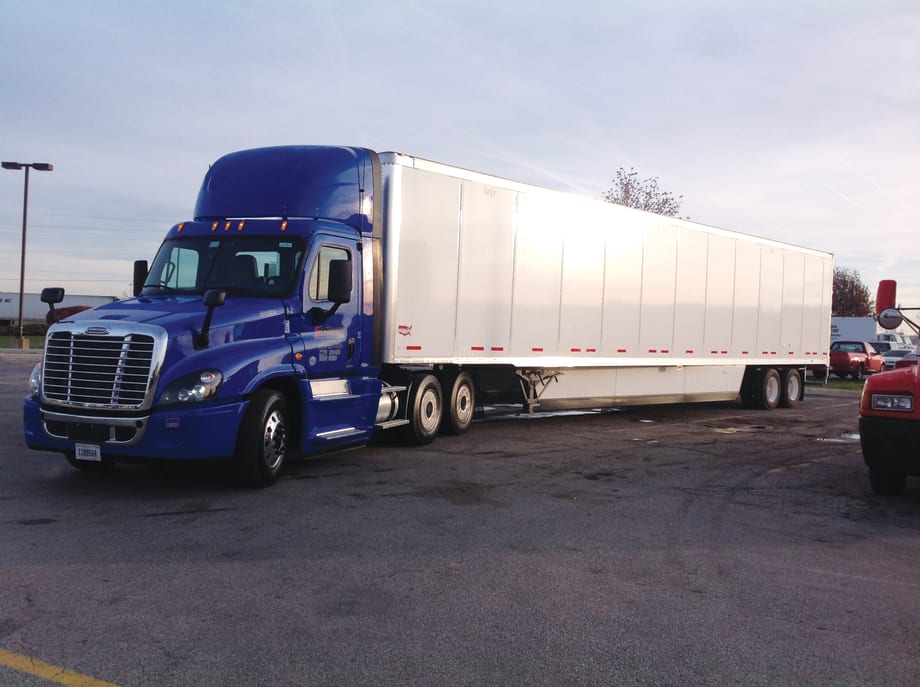
This Freightliner Cascadia Evolution is equipped with a Detroit DD13 diesel and smooth DT12 automated mechanical transmission. The van shown here was empty, so we swapped it out for a heavily loaded flatbed trailer for our evaluation.
“Proprietary” is a magic word among truck builders. It describes components of the company’s own manufacture or design that are installed on the company’s own trucks. For truck users, this can be a good thing, because they’re designed to work specifically with a company’s other components.
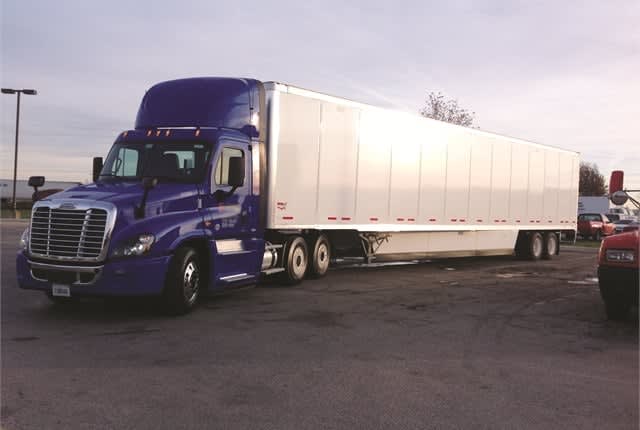
This Freightliner Cascadia Evolution is equipped with a Detroit DD13 diesel and smooth DT12 automated mechanical transmission. The van shown here was empty, so we swapped it out for a heavily loaded flatbed trailer for our evaluation.
One example is Daimler Trucks North America’s Detroit DT12 automated mechanical transmission. It lessens driver workload and betters fuel economy by several percent over a manual gearbox. The DT (for Detroit Transmission) 12 (for 12 ratios) is based on a Mercedes-Benz AMT used in Europe. It’s paired with Detroit engines in Freightliner Cascadias.
Last year the self-shifter debuted with the DD15 engine, and Equipment Editor Jim Park drove and wrote about it in our January 2013 issue.
The DT12 now comes in versions with less torque capacity for use with 12.8-liter DD13s. For now, DT12s are meant for highway service and have no PTO mounts, but might later be approved for vocational use.
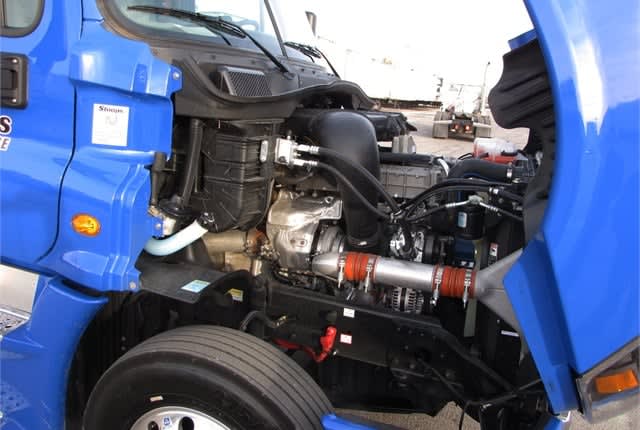
The Detroit DD13 was rated at 450 horsepower and 1,550 pounds-feet. The DT12 transmission recently became available with DD13 after debuting as a mate to the larger DD15.
With the help of Freightliner managers Mike McHorse and Doug Ackerman, I recently got to drive a Cascadia Evolution daycab tractor with one of these powertrains and came away impressed.
No, make that immediately impressed. Right from the get-go, the automated clutch engaged like a circle of silk, and the tranny made smooth, smart gear changes. Detroit representative Brian Sutherland and I were tooling around the premises of Stoops Freightliner on the south side of Indianapolis. We had dropped an empty van trailer and found a flatbed loaded with heavy concrete blocks that would give us some realistic weight. We hitched on and headed out of the yard and onto nearby Interstate 465.
Sutherland called out the gear choices made by the DT12’s electronic brain. It started out in a higher gear than most drivers would, usually 3rd, then quickly skip-shifted to 5th, and then to 7th or 8th, depending on grades (there weren’t any at first) and how much pressure he put on the accelerator (moderate). Upshifts were usually made at 1,400 or 1,500 rpm. At higher road speeds it tended to use more ratios until settling into 12th, where we cruised at 1,300 and 1,400 rpm. We circled through the suburbs so I’d get an idea of how the tranny operated. Then, with a much longer loop in mind, I took the wheel.
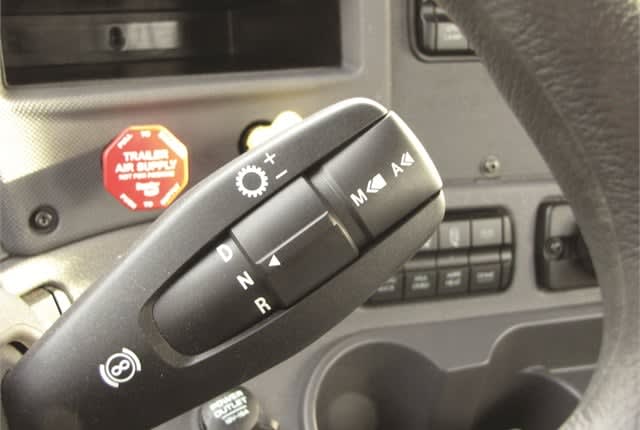
Stubby selector lets driver choose
Automatic or Manual modes and command up- or down-shifts. But most of the time he can just slip it in D and drive.
First I got acquainted with the column-mounted shift selector, a stubby stalk. A vertically sliding thumb switch allows going from Neutral to Drive or Reverse. A horizontal sliding switch chooses Automatic or Manual mode, and nudging the stalk up- or down induces an up- or down-shift if road speed isn’t too fast or slow. While in M the transmission will hang in the latest gear chosen, but will shift out of it while in A. Sutherland told me how it works, but drivers with some experience would figure it out pretty quickly. And really, all they usually have to do is put it in D, release the brakes and drive.
I proceeded onto eastbound I-465, as before, but continued to I-65, then southeast through a construction zone and onto open road. The DD-13 had 450 horses and 1,550 pounds-feet of torque, the Cascadia’s cab was very quiet, and the automated transmission was seductively smooth. In fact, it all caused me to accelerate to higher speeds than I meant to. Sixty-five and more were on the speedo rather soon, and I had to consciously back off and set the cruise control at 60 or 62 mph.
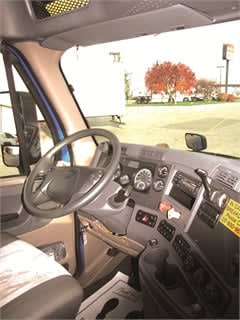
The Evolution daycab is roomy, quiet and pleasantly appointed. There’s no clutch pedal because it’s automated, like the transmission itself.
Within a few minutes I had appraised the transmission and remarked to Sutherland, “It’s as good as a Volvo.” He made a face, and I said, “That’s a compliment.”
Volvo’s I-Shift and its brother, Mack’s mDrive, have been the slickest automated transmissions available, at least in my experience. They, too, are 12-speeds. But Eaton’s come a long way with its UltraShift series, which in Plus form now has 10-, 13-, 16- and 18-speed versions.
Then I concentrated on monitoring the DT12, sometimes glancing at a small LED readout that displayed which gear the tranny was in. It downshifted smoothly from top gear to 11th and 10th, then back up to handle varying speeds from traffic and the ups and downs over freeway interchanges.
Several times it slipped into eCoast, when the clutch disengaged and the engine dropped to idle speed, which cuts drag and saves a bit of fuel. Soon the clutch would smoothly re-engage and the engine resumed working.
ECoast operates whether cruise control is on or off. Operating parameters can be programmed into the controls, and in any case the driver can quickly terminate eCoast by stepping on the brake or accelerator pedals.
There’s also a hill-hold feature, which works with the brakes to keep the rig from rolling backwards, but I never had occasion to use it.
The landscape was about as flat as it gets in northern Indiana, but that changed when we reached Columbus and I exited onto State Route 46 and headed west. This hilly territory must’ve been missed by the ground-grinding glaciers of 10,000 to 15,000 years ago, for Highway 46 has some surprisingly steep if short grades – just what I wanted to really put the DT-DD team to a test.
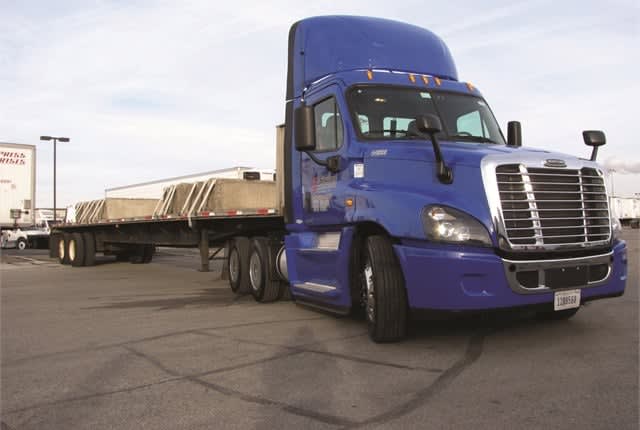
A flatbed loaded with heavy
concrete blocks gave us some realistic weight for our evaluation.
The engine ably powered us up the hills and, as directed, held back our speed on downgrades as its strong Jake Brake rapped away through the exhaust. With our weight near 78,000 or so pounds, we did slow to as low as 25 and 30 mph on stiff upgrades and a string of cars formed behind us. I’d have pulled over to let them pass, but there was nowhere to do it. I sped up to 55 to 60 mph and more on downgrades and level stretches, and then the motorists fell back.
The DT12 never missed a shift and almost always picked the right gear for the situation. The one time it didn’t was on a steep downhill section when it hung in 8th or so. (I wasn’t watching the readout because I had my eyes on the pavement and the tachometer.) I let it hang in that gear as we accelerated down the hill, and the tach needle went way past the 2,100-rpm redline – to 2,400, 2,500 and for an instant to 2,600 – before I intervened by applying the brakes and bumping the selector into a couple of upshifts to bring down revs.
After our drive, Sutherland consulted with Detroit engineers about that incident. They reported that the transmission operated properly on that downhill situation. It is programmed to let the driver control shifting in such situations, just as he’d do with a manual transmission. In other words, the machine sometimes needs some human intervention, which I didn’t realize.
The DT12 otherwise acted as I expected and we enjoyed the ride. Highway 46 leads to Bloomington and SR 37, which we followed north back to Indy.
The four-lane road parallels ridges and waterways, so the terrain remains interesting, but grades are fewer and the trip was even more relaxing.
By the time we had returned to Stoops Freightliner we had put about 120 miles on the odometer, I gained new appreciation for modern technology, proprietary or not.
More Fuel Smarts

How Volvo Updated Its D13 for EPA 2027 [Watch]
Volvo’s updated D13 promises lower emissions without sacrificing performance or fuel economy. Take a closer look at what changed inside the engine in this HDT Spotlight video.
Read More →
Diesel Price Spike Shortens Payback for Natural Gas Trucks, Report Says
Energy Vision estimates fleets could recover the higher purchase price of an RNG-fueled Class 8 tractor in 1.3 to 2.8 years under current fuel-price scenarios.
Read More →
Calstart Becomes Catalyst Mobility, Reflecting Broader Focus
Calstart is now Catalyst Mobility, reflecting the nonprofit’s growing national role in clean transportation, including zero-emission trucks, infrastructure and incentive programs.
Read More →

Record Diesel Prices Squeeze Trucking Fleets
Average U.S. diesel prices have climbed to nearly $6 a gallon, surpassing the 2022 record as tight refinery capacity and Middle East disruptions keep fuel costs elevated.
Read More →
How Fuel Delivery Shapes Engine Performance
Fuel delivery depends on more than what happens at the injector. For fleet, maintenance and technical professionals, looking at the full path from pump to injector can provide useful context for understanding engine performance.
Read More →
East Coast Port Launches $45M Electric Truck Push
The Port Authority of New York and New Jersey announced millions in incentives for zero-emission drayage trucks, yard tractors, and new charging hubs near the port.
Read More →
California Bill Could Shed Light on Electric Truck Prices
Why do battery-electric Class 8 trucks remain so expensive? A California bill headed to Gov. Gavin Newsom would give fleets and state agencies more visibility into what manufacturers charge.
Read More →
Detroit Opens Orders for EPA 2027 Engines
Detroit isn’t starting from scratch to meet EPA 2027 diesel emissions standards. Its Gen 6 DD13 and DD15 engines keep much of today’s platform while updating the fuel and aftertreatment systems.
Read More →
Zero-Emission Truck Corridor Planned for West Coast
California, Oregon, Washington, British Columbia and Baja California are coordinating plans for truck charging and hydrogen fueling from Canada to Mexico.
Read More →
A Closer Look at Kenworth’s Electric T880E Vocational Truck [Video]
Learn more about Kenworth's T880E battery-electric vocational truck at the Paccar Technical Center, including its range, applications, upfitting considerations, and PTO options, in this HDT Spotlight video.
Read More →