




Test Drive: Clarke-APG Dual-Fuel Glider
From the ground and behind the wheel, you’d think this Freightliner Columbia is brand new. This was obvious on a run out on Interstate 70 in eastern Missouri, pulling a hopper-bottom trailer with a heavy load of granulated lime destined for an animal-food plant in Montgomery City, west of St. Louis. It rode, shifted and ran like new, and was just as comfortable.

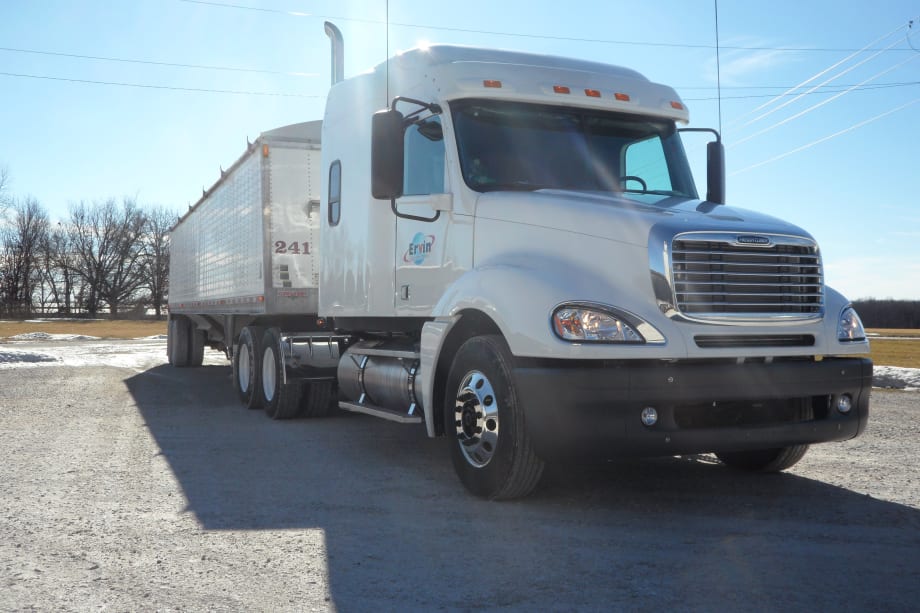
This Columbia sleeper-cab tractor looks new, because most of it is. The powertrain components are remanufactured. Daimler Trucks North America offers glider kits for most Freightliner and some Western Star models. The Wilson hopper-bottom trailer carries crushed lime.
From the ground and behind the wheel, you’d think this Freightliner Columbia is brand new. This was obvious on a run out on Interstate 70 in eastern Missouri, pulling a hopper-bottom trailer with a heavy load of granulated lime destined for an animal-food plant in Montgomery City, west of St. Louis. It rode, shifted and ran like new, and was just as comfortable.
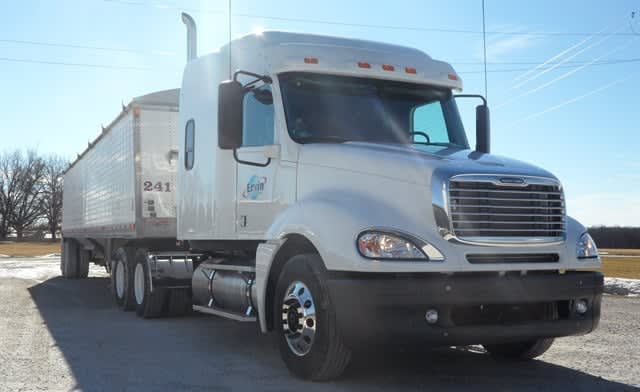
This Columbia sleeper-cab tractor looks new, because most of it is. The powertrain components are remanufactured. Daimler Trucks North America offers glider kits for most Freightliner and some Western Star models. The Wilson hopper-bottom trailer carries crushed lime.
Most of it is new, because this tractor was built from a glider kit from Daimler Trucks North America. The engine, transmission and rear axles are all remanufactured components, which perform and have warranties like new but cost considerably less. In most cases a glider is exempt from the 12% federal excise tax on new heavy trucks (though the Internal Revenue Service has given some signals it may be changing its stance on that). And there are other advantages.
The tractor’s Detroit Reliabilt Series 60 diesel doesn’t have exhaust-gas recirculation, because the engine must meet EPA emissions limits for the period it was originally built, 1998-2002, not the ’02/’04 regulations where EGR began. And its exhaust system doesn’t need a bulky diesel particulate filter or the diesel exhaust fluid required with selective catalytic reduction, which debuted in 2007 and 2010, respectively. Most gliders go out the door set up to burn straight diesel fuel like any normal truck or tractor.
However, this one’s also got a dual-fuel system that enables the Series 60 to burn natural gas as well as diesel. That raises the selling price but greatly lowers fuel costs and delivers a quick payback, according to the companies involved with the vehicle: Clarke Power Services, which assembled the glider; American Power Group, which supplied the dual-fuel kit; and Ervin USA, a trailer and equipment dealer that ordered this and other tractors for fleet customers.
Their representatives met me at Clarke’s main facility in Wentzville, Mo. Workers there assemble gliders, and had the one for our test drive ready to go on a sunny and mild January day. Clarke and Ervin executives had arranged a real-life run with a real driver and a real load, courtesy of Rollet Brothers Trucking, which transports agricultural and mining products and is testing this tractor. While we waited for a Rollet rig to arrive, the execs briefed me extensively on their glider.
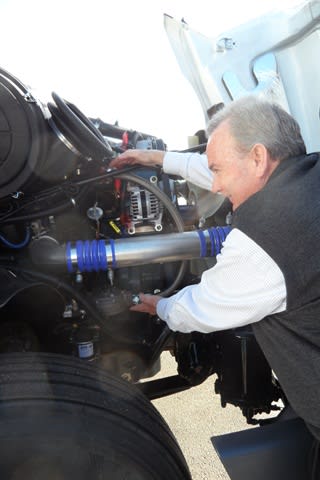
Keith Webb, a Clarke Power national
accounts manager, points out the natural gas pressure regulator (bottom) and injector, just upstream of the Series 60’s turbocharger.
The pieces
The WheelTime Network of parts and service centers, of which Clarke is a member, has a supply agreement with APG for the dual-fuel system. That’s why Clarke installed it on this tractor. The system is approved for use on 449 different diesels, including Detroit, Caterpillar, Cummins, Mack and Volvo truck models, said Steve Majkowski, APG’s vice president, sales and marketing.
Federal regulations say a system can be installed on an existing diesel that has run past the 435,000-mile “useful life” of its emissions system, and on certain other engines, like this older (but renewed) Series 60. Engine builders will honor warranties on engines they’ve approved for the system, and APG will warranty any repair work due to damage from gas. That’s never happened, Marjkowski said, adding that their systems are working on thousands of engines in truck, industrial and agricultural applications around the world.
APG’s system injects natural gas upstream of the turbocharger, so the gas is drawn into the inlet air. That’s easier on the injector than if it were downstream of the turbo and had to force-feed the gas, Majkowski explained.
The system’s electronic controller monitors the engine’s controls so it knows what’s happening and injects the right amount of gas all the time. Amounts vary from zero to 65%. No gas is used during start-up and idle, and at no throttle while coasting down a highway.
“You still have a diesel,” he pointed out, and the engine will run on straight diesel if the dual-fuel system ever malfunctions or the natural gas tank runs dry.
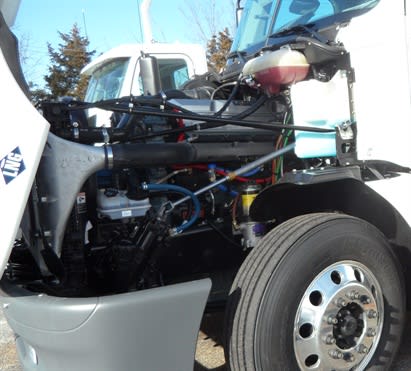
The Reliabilt Detroit Series 60 meets EPA 1998-2002 emissions limits, so it has no exhaust gas recirculation, diesel particulate filter or selective catalytic reduction equipment. Exhaust emissions are substantially cleaner when an engine is burning natural gas. The liquified natural gas tank is the most
costly part of American Power Group’s dual-fuel conversion kit. A tank for compressed natural gas is also available and is less expensive.
Majkowski said APG’s dual-fuel system adds $30,000 to $33,000 – most of it for the natural gas fuel tank – to the glider’s price. Some states have grants that pay portions of that, and APG has just lined up lease-financing for fleets that want to do conversions. On average the system displaces about half the usual amount of expensive diesel with cheap natural gas, saving 18 to 23 cents per mile in fuel costs. In high-mileage applications (100,000 to 120,000 per year) a system will pay for itself in about 15 months, he said, after which the savings would simply accrue.
Some question a glider-kitted vehicle’s residual value, but not Ken Eggen, Ervin’s director of business development.
“We strongly believe the resale value of a 2014 glider will be stronger than a new 2014 truck,” Eggen told me, because modern diesel trucks are so complex and maintenance-heavy. Whether straight diesel or dual-fuel, a used glider will appeal to farmers and fleets similar to the one that bought it new.
And unlike 2007 or later diesels with DPFs that require ultra-low-sulfur diesel fuel, a glider kitted truck with its “pre-emissions” engine can be exported to countries that don’t have ULSD.
Taking it for a spin
About this time the Rollet rig rolled past our meeting room’s windows, and we wrapped up the discussion and went outside. Driver Jay Helms dropped the trailer, a 45-foot Wilson Commander, and parked his diesel tractor.
After being familiarized with the demo dual-fuel tractor, I backed it onto the trailer. We hooked the lines, then moved out, with Helms riding shotgun and consulting engineer Marc Murawski sitting on the sleeper bunk monitoring engine performance on his laptop computer.
A dual-fuel engine runs like a diesel. The driver wouldn’t know what it was doing except for a special readout affixed to the dash which tells how much gas is being used at any given moment, among other items. I glanced at it occasionally and Murawski called out percentages. But mostly I kept my eyes on traffic and the road, and worked the Eaton Fuller 10-speed manual transmission as appropriate.
The Series 60 ran quietly and pulled well, right down to 1,100 and 1,000 rpm without a whimper. It almost always ran smoothly no matter what the fuel mix was.
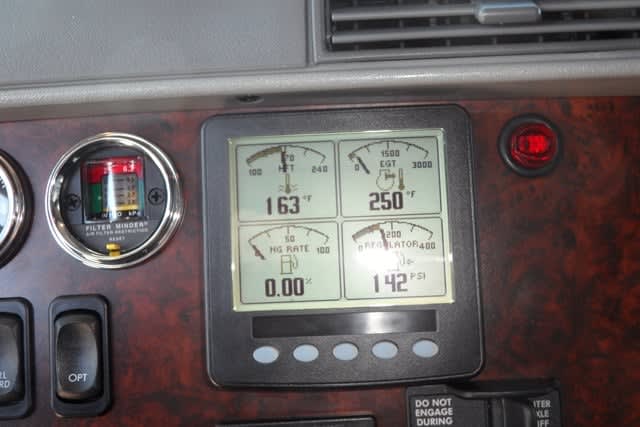
An LED readout offers various info on the natural gas fuel system’s
status. At idle, as now, no gas is being used, but the rate goes as high as 65% and averages about 50% while at highway speeds.
Two or three times, however, it shuddered slightly while coasting at cruising speed. The vibrations were brief, as though the engine was momentarily starved for fuel. Neither Helms nor Murawski knew what might have caused this and were puzzled by it. So was Mike Schiltz, APG’s vice president of operations and engineering, who later said by phone that he’d not heard of this in any comments or complaints from customers, “and believe me, they’d complain.” So I’ll just call it an anomaly.
Helms said driving this Freightliner is pretty much like driving the diesel tractors in Rollet Brothers’ fleet, except at top-off time. The dollars spent in filling the diesel and gas tanks are usually less than half what’s required for diesel alone. So the savings are there.
About 30 miles west of Wentzville we exited I-70 at Missouri 19 and drove north another 14 miles to Montgomery City. It’s not a big town, and we encountered almost no traffic as we made three left turns and pulled into the Cargill facility. “Looks like I’ll be here a while,” Helms observed as he spied the half-dozen or so rigs waiting ahead of him. There was only a single offloading point and it could take 45 to 60 minutes for each trailer to discharge its cargo, so he figured he’d have to mill around for four hours. And of course the rig wouldn’t be saving any money in fuel while sitting there, but those are the breaks in trucking.
Fortunately for me, a couple of my hosts had followed the rig in their car and offered me a ride back to our starting point. I felt a little guilty about deserting Helms, but he said, “No problem – I’ve gotta wait anyway.” So I bid him thanks and goodbye. But I’ll bet this is far from the last dual-fuel glider-kitted truck I’ll see or hear about.
More Equipment

PlusAI Going Public to Fund Autonomous Truck Launch
A SPAC deal could provide PlusAI with up to $300 million as it works toward a 2027 commercial launch of factory-built autonomous trucks.
Read More →
NHTSA Moves to Rewrite Truck Fuel-Economy Rules
The National Highway Traffic Safety Administration says it lacks authority to regulate medium- and heavy-duty truck engines separately from complete vehicles, but the existing standards have not yet been eliminated.
Read More →
Detroit Opens Orders for EPA 2027 Engines
Detroit isn’t starting from scratch to meet EPA 2027 diesel emissions standards. Its Gen 6 DD13 and DD15 engines keep much of today’s platform while updating the fuel and aftertreatment systems.
Read More →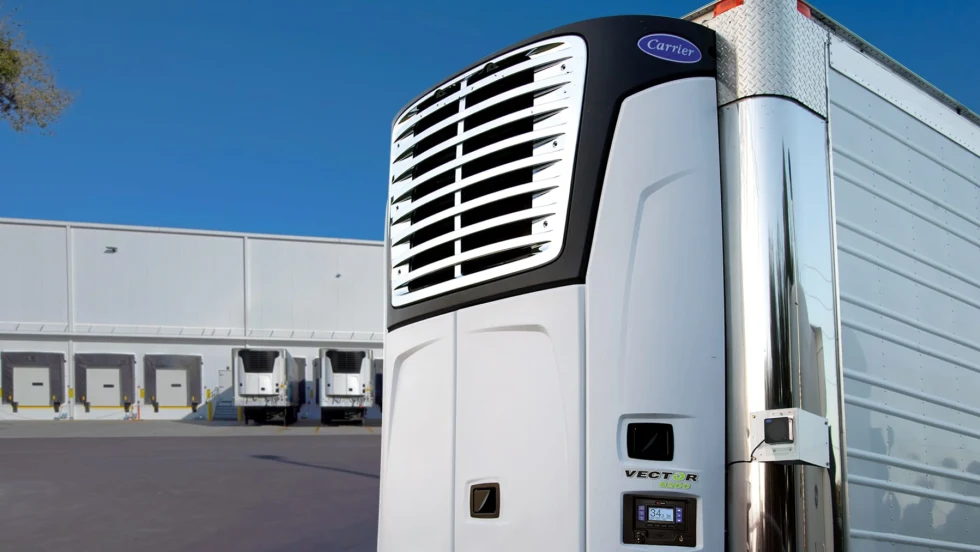
Carrier Transicold Adds All-Electric TRU for Stationary Cold Storage
Carrier Transicold’s new Vector 8200 all-electric transport refrigeration unit gives fleets a diesel-free option for temporary refrigerated and frozen trailer storage.
Read More →
A Closer Look at Kenworth’s Electric T880E Vocational Truck [Video]
Learn more about Kenworth's T880E battery-electric vocational truck at the Paccar Technical Center, including its range, applications, upfitting considerations, and PTO options, in this HDT Spotlight video.
Read More →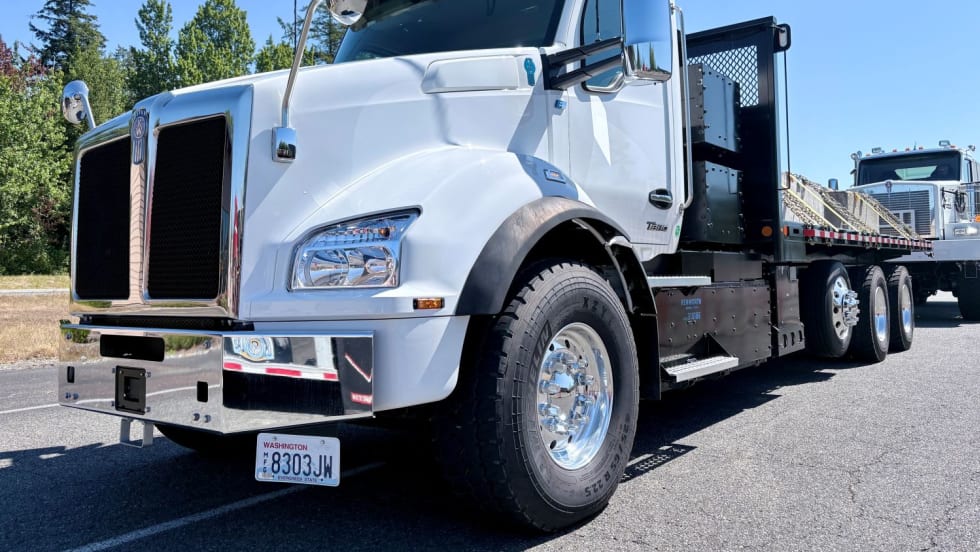
Kenworth T880E Brings EV Power to Vocational Trucks
A closer look at the Kenworth T880E’s range, charging, powertrain and upfit options — and where fleets are showing the most interest.
Read More →
What the U.S.-Canada Trade War Means for Trucking
Escalating U.S.-Canada tariffs could disrupt cross-border freight, reduce truck volumes, raise costs, and create new uncertainty for carriers on both sides of the border.
Read More →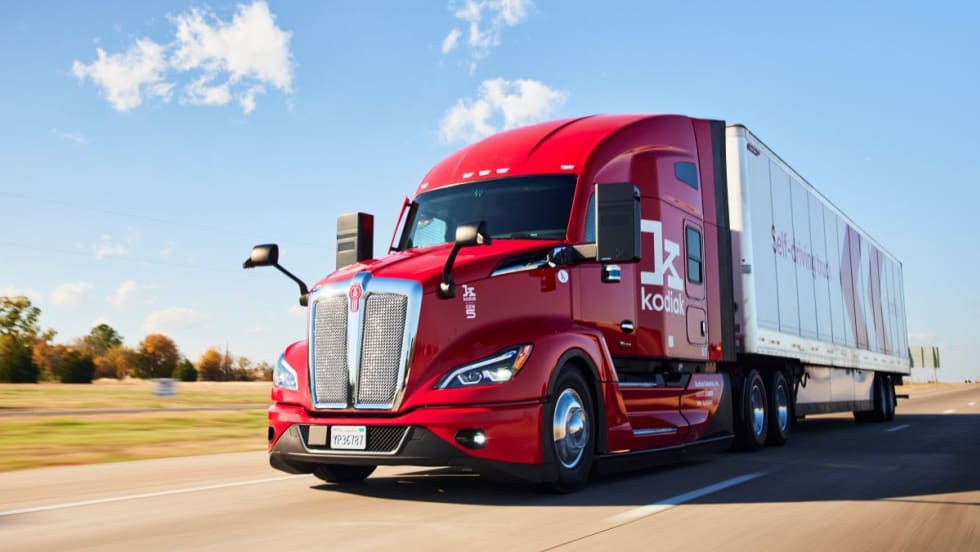
Autonomous Truck Testing Moves Ahead in California as Teamsters Challenge Rules
California has begun permitting heavy-duty autonomous truck testing, with Aurora and Kodiak among the first to receive approval, as the Teamsters sue the DMV over the new regulations.
Read More →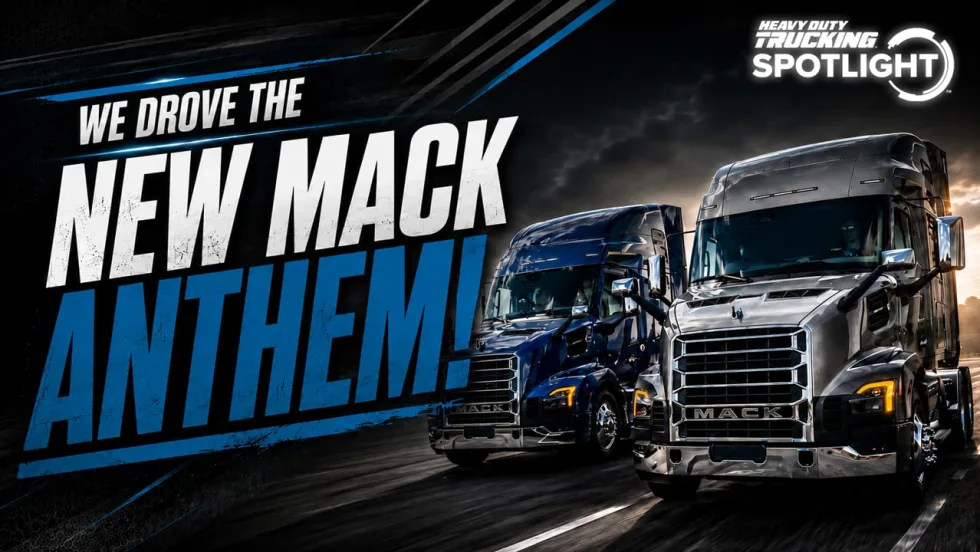
Behind the Wheel of the New Mack Anthem [Video]
HDT takes the new Mack Anthem around Mack’s Pennsylvania test track to see how its driver-focused design, technology, visibility and handling perform from behind the wheel.
Read More →
DTNA Plans New U.S. Truck Plant as Manufacturing Footprint Shifts
Daimler Truck North America is evaluating sites for a new assembly plant expected to open in 2029 while winding down operations at its longtime Portland manufacturing facility.
Read More →