




Tending Liftgate Batteries
Bruce Purkey knows where the electrons go. And, as president of Purkey’s Fleet Electric and his many activities in the Technology & Maintenance Council of the American Trucking Associations, he’s well aware that some of them flow to batteries that support the electric-over-hydraulic systems for liftgates on trucks and trailers. Usually there are two and as many as four Group 31 batteries, like the ones on a truck or tractor.

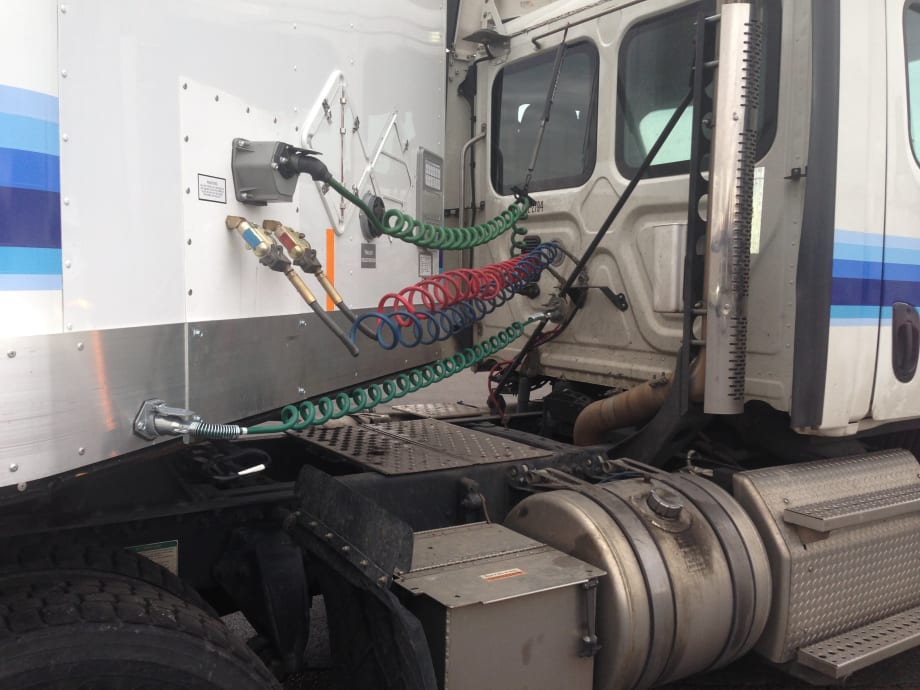
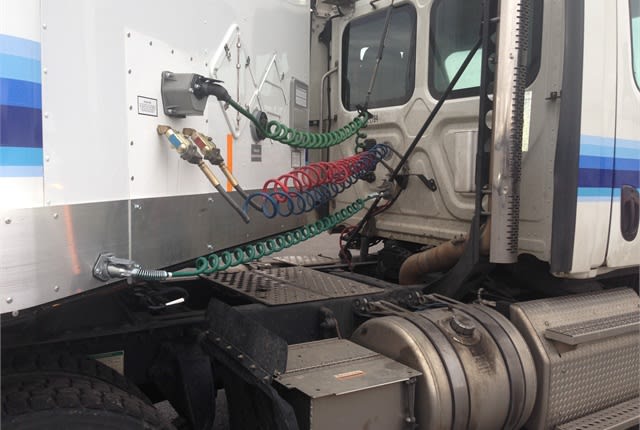
Bruce Purkey knows where the electrons go. And, as president of Purkey’s Fleet Electric and his many activities in the Technology & Maintenance Council of the American Trucking Associations, he’s well aware that some of them flow to batteries that support the electric-over-hydraulic systems for liftgates on trucks and trailers. Usually there are two and as many as four Group 31 batteries, like the ones on a truck or tractor. Often the vehicle will carry an electric pallet jack so the driver can move cargo without much strain. The jack usually has four 6- or 12-volt batteries, and they also need charging between stops.
Purkey also knows that all too often, not enough power gets to the batteries, and when they run down the driver is stuck out on a run without a working liftgate. This can happen more on trailers, where the rear-mounted batteries can be 50 to 60 feet from the tractor that supplies the juice. It’s a challenge to get enough volts to travel that distance and through connections and fuses.
That’s especially true if the current is routed via the auxiliary circuit on the seven-way harness. Unless that wire is made for this duty, it might not be of sufficient gauge to carry the load. Some fleets solve the wire-length problem with a dedicated cable (more on this below).
Voltage drops from a desired 14.6 to 12 or less are common along that long wire, Purkey says.
The problem is even worse if pick-up and delivery stops are close together and the tractor’s alternator isn’t spun long enough to replenish the batteries.
Purkey believes the solution is to manage the charging with a DC-to-DC converter that can boost volts back up where they need to be. The one he prescribes is a device he discovered about 10 years ago: the Trail Charger, from Sure Power Industries. It’s also offered through liftgate companies such as Maxon and Waltco.
“A Trail Charger can step up 9 volts (in cold weather) to 14.6 so the battery charges,” Purkey says.“A portable charger you use on a truck can be set at 10 or 20 amps, and it’s the same here. Higher voltage pushes more current and amperes through the line. With this you get about 25 amps.” It can be set up numerous ways to accommodate different operating situations. A Trail Charger also will not let the auxiliary batteries back-charge into the tractor’s batteries.
Trailer antilock braking systems are powered by the harness’s auxiliary circuit. So if that circuit is used for battery charging, it must be interrupted when brakes are applied so that power flows to the ABS. Trail Charger has a lock-out that does this; then, when brakes are released, it reroutes power to the batteries.
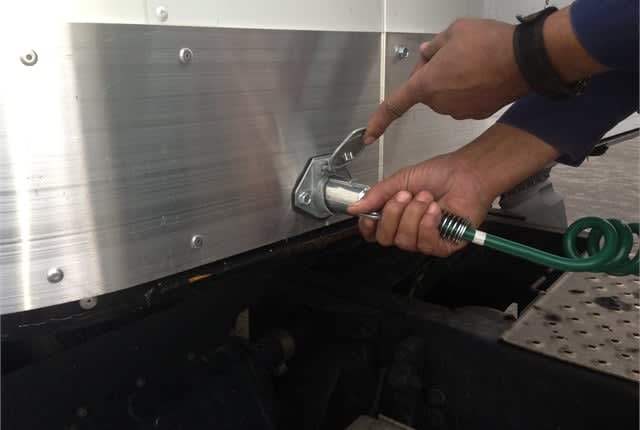
The lower green curled cord is the dedicated charging line used by Con-way. Drivers must remember to connect this cord with the others when they hook up to a trailer.
“Most less-than-truckload carriers like this system, as all of their tractors can now pull a trailer with liftgates,” Purkey says. “No stinger cord is needed.”
A stinger cord is an extra cable dedicated to powering the batteries. Some fleets prefer this as a more positive method of getting voltage back where it’s needed. One is Con-way Freight, which will have more than 1,300 28-, 45- and 48-foot trailers with Waltco and Maxon liftgates by the end of this year, according to Tim Killilee, senior director, fleet maintenance. Most of the liftgates are tuck-aways, which needn’t be folded down at docks.
Through trial and error, Con-way has settled on a 4-gauge line running the length of each trailer, and plugged into a tractor via an extra cord.
Power is pulled from the tractor’s batteries. As they are pulled down by the trailer batteries, the tractor batteries are recharged by the engine-driven alternator.
Nothing special needs to be done to the alternator, except to be sure it’s of big enough capacity to charge both sets of batteries. Con-way uses two Group 31 batteries on each trailer.
“In Con-way’s operation there is ample distance between customers and deliveries to keep batteries charged,” Killilee says. “The liftgate is not depleting the tractor batteries to a point that this is an issue. By the time the tractor and trailer make it back to the service center the batteries are charged.”
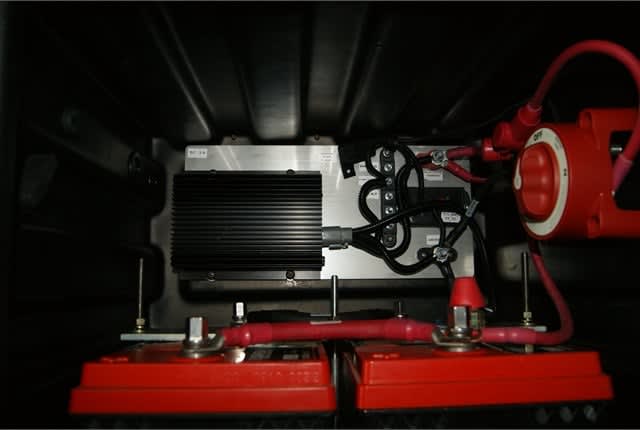
The finned black box is a Trail Charger that’s wired to a trailer’s batteries and keeps them charged.
Regular maintenance keeps the batteries checked and healthy, he says. That includes the connecting cord and its plugs. The only operational problem is if a driver forgets to plug in the charging cord when he hooks onto a trailer, but it doesn’t happen often and a driver soon learns to remember that detail.
Con-way uses a two-pole circuit for the charging cord, meaning the ground is carried back to the tractor on that cord. Some fleets have used single-pole cords and rely on the trailer’s frame to carry the ground through the fifth wheel and into the tractor’s charging system. This is far less reliable, Purkey says, so more fleets are moving to two-pole systems.
If a trailer has a refrigeration unit, as many food-service P&D vehicles do, its battery can be tapped into to supply power to the trailer’s batteries, and the reefer engine’s alternator will keep both sets charged. That’s a cool idea.
More products for charging liftgates
There’s an increasing number of products that can help address the liftgate charging problem. In addition to the Trail Charger mentioned in the article, here’s a sampling of what’s available.
Cole Hersee: Cole Hersee’s Smart Isolator can be installed on tractors in the circuit between the battery and the two-pole connector. The alternator and starter motor are connected to the starting battery, and via the Smart Isolator to the auxiliary battery. When the truck is running, the alternator charges both batteries. When the truck makes a delivery, the alternator is not charging the batteries, and there’s a draw on both batteries from the liftgate motor. If the draw reduces the battery voltage to 12.7, the Smart Isolator cuts the starting battery out of the circuit, preserving starting power.
The auxiliary battery continues to power the liftgate. When the truck is started, the Smart Isolator enables the alternator to charge the starting battery up to 13.2 volts, then allows charging of the auxiliary battery as well.
ENow: This company has developed solar-powered idle reduction, refrigeration, liftgate and battery charging systems. The eCharge Solar Battery Charger can supply power to stand-alone liftgate batteries to reduce the demand on the engine alternator. It’s offered through Anthony Liftgates.
Maxwell Technologies: Maxwell is expanding its ultracapacitor-based Engine Start Module product line to medium-duty Class 3-6 trucks. The ESM Ultra 31/900 replaces traditional lead-acid starting batteries, delivers reliable starts and allows extensive use of liftgates and buckets while the engine is off without fear of the truck not starting, according to the company. It stays fully charged even when the truck’s lead-acid battery is as low as 9.5 volts.
Phillips Industries: Phillips’ Permalogic Selector System selects between the tractor (via dual pole) or the trailer’s reefer unit as a source of power to charge the liftgate batteries to capacity. The system will automatically shut off if it senses a problem with the reefer’s electrical system and will not cause any out of balance issues with either the reefer unit or the tractor. It can be included in the Phillips i-Box housing or as a component of the Sta-Dry S7 swivel electrical socket.
More Equipment

PlusAI Going Public to Fund Autonomous Truck Launch
A SPAC deal could provide PlusAI with up to $300 million as it works toward a 2027 commercial launch of factory-built autonomous trucks.
Read More →
NHTSA Moves to Rewrite Truck Fuel-Economy Rules
The National Highway Traffic Safety Administration says it lacks authority to regulate medium- and heavy-duty truck engines separately from complete vehicles, but the existing standards have not yet been eliminated.
Read More →
Detroit Opens Orders for EPA 2027 Engines
Detroit isn’t starting from scratch to meet EPA 2027 diesel emissions standards. Its Gen 6 DD13 and DD15 engines keep much of today’s platform while updating the fuel and aftertreatment systems.
Read More →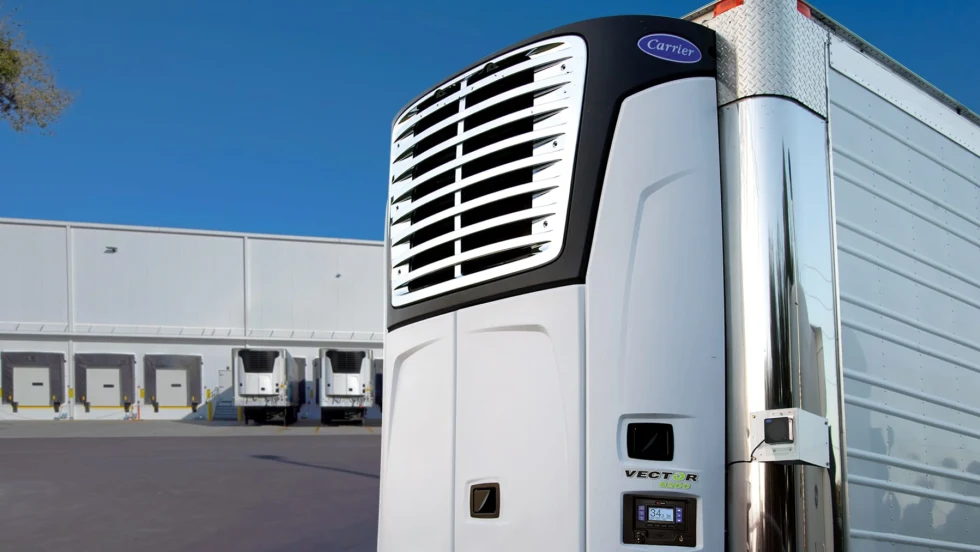
Carrier Transicold Adds All-Electric TRU for Stationary Cold Storage
Carrier Transicold’s new Vector 8200 all-electric transport refrigeration unit gives fleets a diesel-free option for temporary refrigerated and frozen trailer storage.
Read More →
A Closer Look at Kenworth’s Electric T880E Vocational Truck [Video]
Learn more about Kenworth's T880E battery-electric vocational truck at the Paccar Technical Center, including its range, applications, upfitting considerations, and PTO options, in this HDT Spotlight video.
Read More →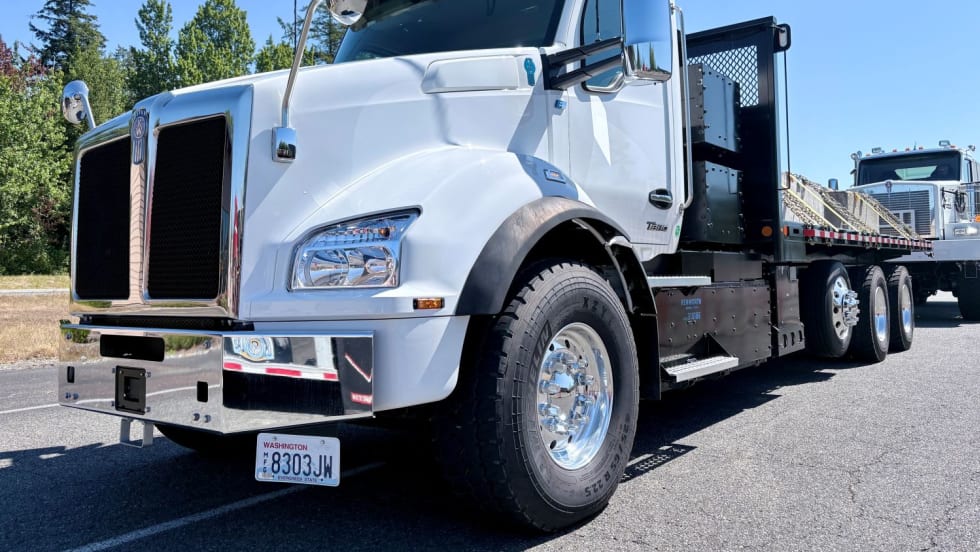
Kenworth T880E Brings EV Power to Vocational Trucks
A closer look at the Kenworth T880E’s range, charging, powertrain and upfit options — and where fleets are showing the most interest.
Read More →
What the U.S.-Canada Trade War Means for Trucking
Escalating U.S.-Canada tariffs could disrupt cross-border freight, reduce truck volumes, raise costs, and create new uncertainty for carriers on both sides of the border.
Read More →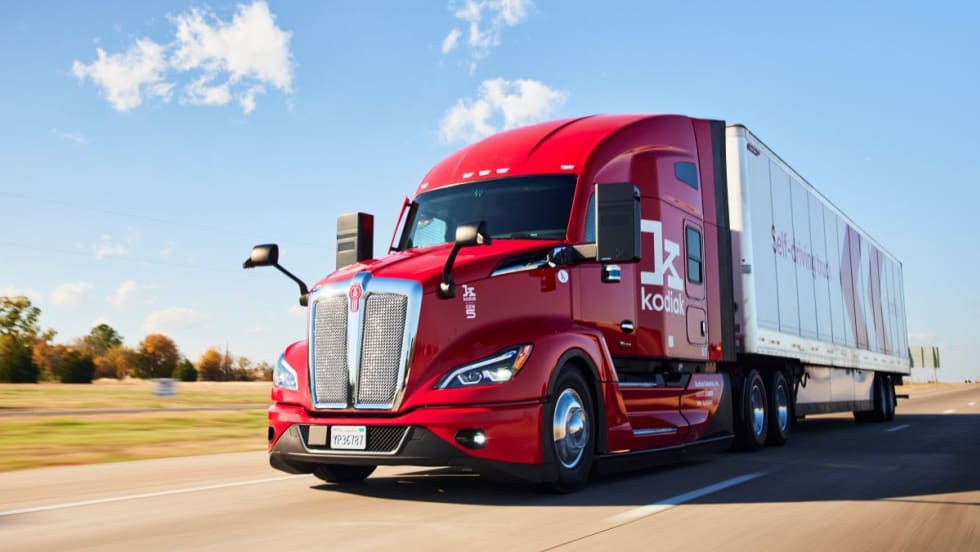
Autonomous Truck Testing Moves Ahead in California as Teamsters Challenge Rules
California has begun permitting heavy-duty autonomous truck testing, with Aurora and Kodiak among the first to receive approval, as the Teamsters sue the DMV over the new regulations.
Read More →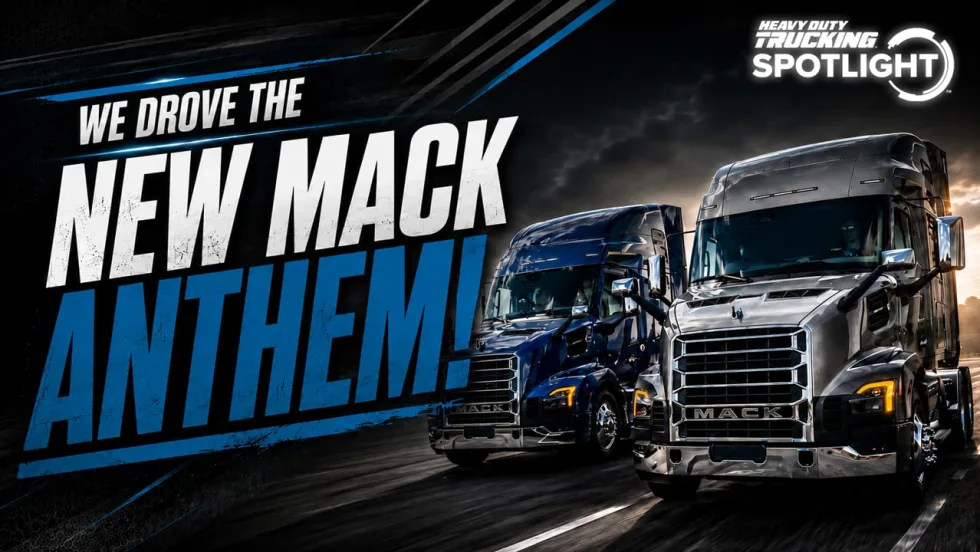
Behind the Wheel of the New Mack Anthem [Video]
HDT takes the new Mack Anthem around Mack’s Pennsylvania test track to see how its driver-focused design, technology, visibility and handling perform from behind the wheel.
Read More →
DTNA Plans New U.S. Truck Plant as Manufacturing Footprint Shifts
Daimler Truck North America is evaluating sites for a new assembly plant expected to open in 2029 while winding down operations at its longtime Portland manufacturing facility.
Read More →