




Starship Rig Shooting for Top MPG
By the early ’80s some fleets were using roof-mounted air fairings on their road tractors to reduce drag. That got the attention of owner-operator Bob Sliwa, who figured a lot more could be done.

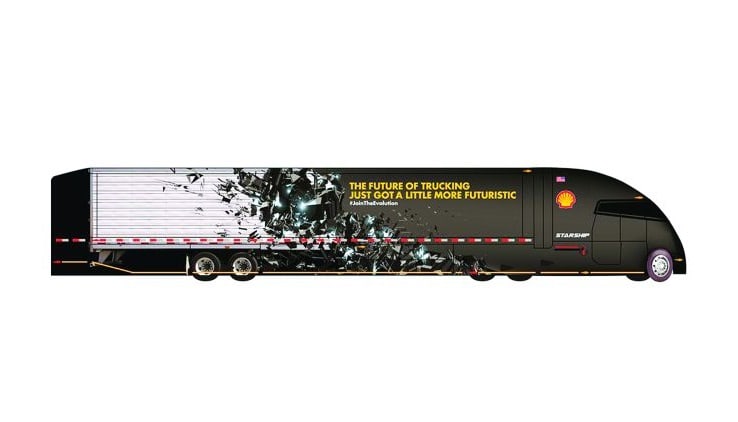
Artist’s rendering of what the StarShip fuel-econnomy vehicle may look like.
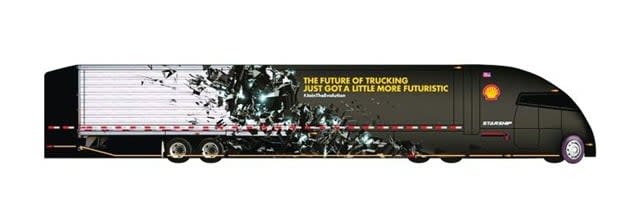
Artist’s rendering of what the StarShip fuel-econnomy vehicle may look like.
Those who lived through the Arab Oil Embargoes of the ’70s know how they shocked Americans and got fleet managers interested in trying to save fuel. By the early ’80s some were using roof-mounted air fairings on their road tractors to reduce drag. That got the attention of owner-operator Bob Sliwa, who figured a lot more could be done.
He started working to improve his “square” Ford CL9000 cabover tractor, whose Cummins diesel got 4.4 mpg, typical for the time. He added smoothly contoured fiberglass panels on its front end, a bulbous shield on its roof, and deep side skirts to his van trailer. With careful, light-footed driving during one test, Sliwa got 10.4 mpg. HDT put his rig on the cover of the November 1984 issue.
Sliwa left trucking to pursue other interests, but returned to the mpg quest in 2008 when he began working on the Bullet Truck, inspired by Japan’s “bullet trains.” Based on a Cummins ISX-powered 2003 Kenworth T2000, it pulled a deeply skirted van trailer. It got 13.4 mpg in a coast-to-coast run hauling a revenue load, grossing 65,000 pounds while cruising at 55 mph. He ran it in daily service and got similar results.
He exhibited the Bullet at truck shows to drum up interest and attract sponsors (among them Cummins, Goodyear Tire and Flex-a-Lite fan). He’s since formed AirFlow Truck Co. and continued his aerodynamics endeavors at a shop at Newington, Conn.
Sliwa is now into his third project, which he calls the StarShip. And he has picked up a major sponsor, Shell Lubricants.
“Shell is always looking at ways to improve fuel economy, and at working collaboratively with others for improvement beyond working on our own,” explains Dan Arcy, Shell’s OEM technical manager. While not disclosing the dollar amount involved in the backing, he says the deal includes help from Shell engineers.
StarShip will be based on a 2016 International ProStar chassis. Sliwa removed the stock cab and nose and will replace it with a smoothly contoured body whose main material is to be lightweight carbon fiber.
The tractor’s components include a Cummins ISX15 diesel, Eaton UltraShift Plus automated 18-speed transmission, and a Meritor 6x2 tandem with a 2.50 axle ratio. The Cummins will operate in downspeed mode, near its 1,000-rpm torque peak, Sliwa explains, and he’ll probably change the axle’s differential to an even lower 2.10 ratio. The double-overdrive 18-speed will provide flexibility in choosing cruising speeds for testing. He’ll test StarShip at 65 mph because many fleets operate that fast.
StarShip will be an integrated tractor-trailer using a 53-foot dry van. The trailer will have deep side skirts, gap-closing fairings at its nose and a boat tail structure at its rear. Testing and experience has shown that “the trailer’s rear is more important than the tractor’s front,” Sliwa says. “The best shape is a teardrop,” but he doesn’t think that’s practical for a 13-foot, 6-inch-high vehicle that hauls regular freight, which his trailer will be expected to do. He’s been talking with trailer builders and expects to choose one soon.
Sliwa believes vehicle integration is unrealistic for multi-trailer drop-and-hook operations. Aero improvers do nothing for trailers sitting in yards or at docks, and they wouldn’t always match up with the tractors that hitch up to them. But integration will work for an owner-operator with his own trailer and fleets with one-to-one tractor-to-trailer ratios.
With Shell’s support, StarShip development will include computational fluid dynamics and will stretch well into next year, he says. A mockup should be done by summer of 2016, shakedown testing to prove structural integrity by autumn, and regional and long-distance freight hauling by 2016’s fourth quarter.
Arcy says Shell will probably use StarShip’s diesel to demonstrate the PC-11 motor oil that it’s formulating, and possibly other low-viscosity, low-friction lubricants. (Arcy chairs the American Petroleum Institute committee that’s developing the proposed-category oil for the newest engines.)
Sliwa declined to name StarShip’s mpg goal, except that it will be better than the Bullet and “better than anybody else.”
Long-term, he has additional ambitions.
“I aspire to be an OEM,” building entire aero trucks using stripped chassis, similar to his StarShip and Bullet Truck projects, but in greater volume, he says. “If a big fleet gave me a commitment to build 100 trucks, then I’d go to the bank and see what I could do.”
More Fuel Smarts

Record Diesel Prices Squeeze Trucking Fleets
Average U.S. diesel prices have climbed to nearly $6 a gallon, surpassing the 2022 record as tight refinery capacity and Middle East disruptions keep fuel costs elevated.
Read More →
How Fuel Delivery Shapes Engine Performance
Fuel delivery depends on more than what happens at the injector. For fleet, maintenance and technical professionals, looking at the full path from pump to injector can provide useful context for understanding engine performance.
Read More →
East Coast Port Launches $45M Electric Truck Push
The Port Authority of New York and New Jersey announced millions in incentives for zero-emission drayage trucks, yard tractors, and new charging hubs near the port.
Read More →

California Bill Could Shed Light on Electric Truck Prices
Why do battery-electric Class 8 trucks remain so expensive? A California bill headed to Gov. Gavin Newsom would give fleets and state agencies more visibility into what manufacturers charge.
Read More →
Detroit Opens Orders for EPA 2027 Engines
Detroit isn’t starting from scratch to meet EPA 2027 diesel emissions standards. Its Gen 6 DD13 and DD15 engines keep much of today’s platform while updating the fuel and aftertreatment systems.
Read More →
Zero-Emission Truck Corridor Planned for West Coast
California, Oregon, Washington, British Columbia and Baja California are coordinating plans for truck charging and hydrogen fueling from Canada to Mexico.
Read More →
A Closer Look at Kenworth’s Electric T880E Vocational Truck [Video]
Learn more about Kenworth's T880E battery-electric vocational truck at the Paccar Technical Center, including its range, applications, upfitting considerations, and PTO options, in this HDT Spotlight video.
Read More →
Kenworth T880E Brings EV Power to Vocational Trucks
A closer look at the Kenworth T880E’s range, charging, powertrain and upfit options — and where fleets are showing the most interest.
Read More →
Jennie Abarca Is Proving Electric Trucks Can Do the Job
HDT Truck Fleet Innovator Jennie Abarca is building confidence in fleet electrification one load at a time while openly sharing the challenges she encounters along the way as a small-fleet owner.
Read More →
Cummins Adjusts 2027 Engine Rollout After EPA Proposal
The engine maker will gradually introduce its new Model Year 2027 diesel engines while continuing to offer current models during the transition, citing the EPA's proposed emissions rule changes.
Read More →