




Spec’ing Last-Mile Truck Bodies with Drivers in Mind
As e-commerce explodes, more trucking companies are getting into the last-mile delivery business – not just for package delivery from the likes of Amazon, but also for larger items, appliances, even groceries and pharmaceuticals.

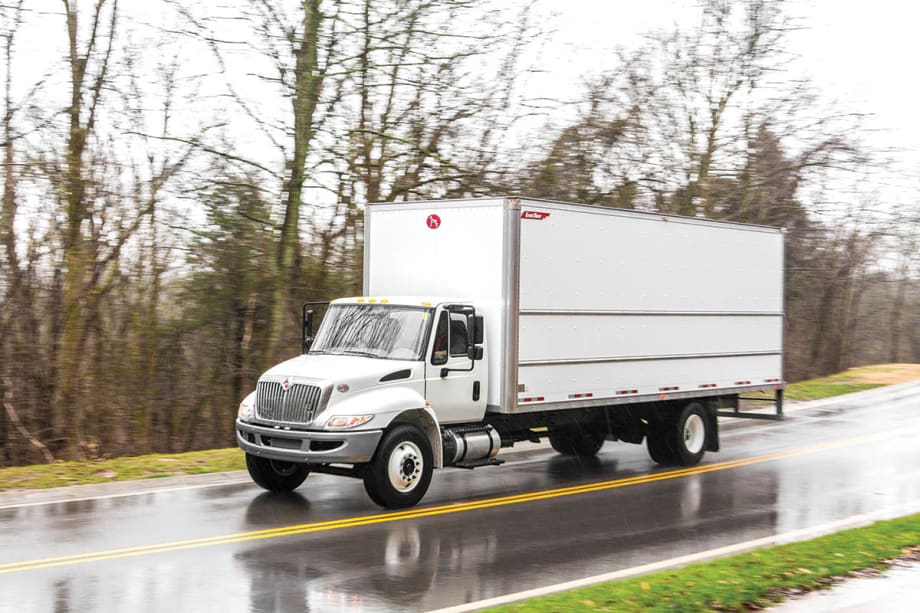
As the demand for final-mile delivery services heats up, customers need smaller delivery vehicles that can navigate residential and small business areas, says Great Dane. Shown here, its Sahara Series dry freight truck body.
Photo: Great Dane
As e-commerce explodes, more trucking companies are getting into the last-mile delivery business – not just for package delivery from the likes of Amazon, but also for larger items, appliances, even groceries and pharmaceuticals.
Efficiency is a key factor in the success of such operations, and that starts with spec’ing a truck body that allows the driver to operate as efficiently, safely, and comfortably as possible.
“Obviously the scope of home delivery is growing exponentially right now,” says Kevin Sumrak, senior product manager for final mile products at Wabash. “I think it’s moved on from focusing on small packages and parcels, and today we’re seeing more home goods, bulk type deliveries; we’re talking more about pharmaceutical deliveries.”
For truck buyers, Sumrak says, “rather than just having your legacy dry freight truck body with some e-track and a ramp or a liftgate, you have to start thinking about things like, does the equipment need refrigeration? Can it handle multiple types of packages, whether that be a small parcel or the bulk furniture or appliance delivery? More than ever, fleets need to be thinking about equipment and how they can optimize the specifications of that equipment to handle all types of different packages.”
When evaluating your final-mile delivery body needs, you’ll need to consider the product you’re moving, the routes you’re driving, the delivery locations, the package type, how many packages, the size of the packages, and more.
One thing customers often overlook when spec’ing a last-mile delivery body, says Sumrak, is “really thinking about cargo control and how the driver actually uses the body most efficiently to get the freight in and out. I think there’s lot of times where you may have someone creating the specification for the body, but they haven’t actually done a ride-along with the driver or gotten the driver’s input.”
Jon Schultz, Great Dane Truck Bodies’ product manager, agrees. “The design of any truck body needs to meet not only the delivery of product, but also the needs of the operation. This may seem obvious; however, a large number of fleet managers do not include or get buy-in internally from drivers and loaders, and/or externally from truck body manufacturers.”
Drivers Are Key
Paul Rosa, senior vice president with Penske, says last-mile body spec’ing concerns fall into three main areas: “Driver efficiency, driver fatigue, and driver safety. Each of them is as important as the other.”
Efficiency, he explains, means being as organized and as efficient as possible. That gets into things like what type of shelving or cargo control solutions are needed, the type and number of doors, and ingress and egress.
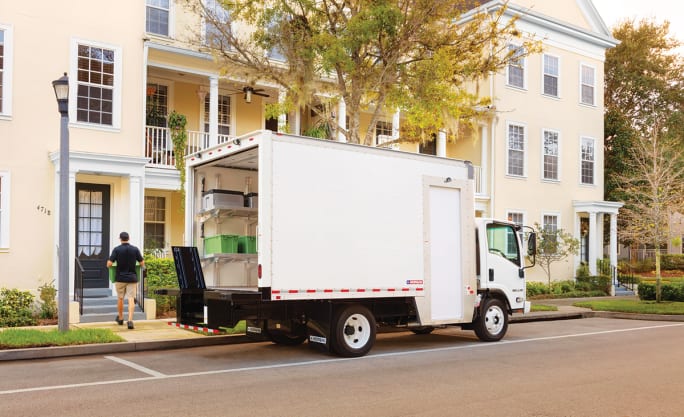
Morgan Truck Bodies’ Maximizer offers options such as a step well and automatic roll-up doors to make final-mile drivers’ lives easier.
Photo: Morgan Truck Bodies
Fatigue involves not only the number of times a driver will be getting in and out, but also how many times he or she is going to be opening and closing doors. You’re looking for “ways to make the driver less fatigued throughout the day so they can be alert and handling their responsibilities effectively,” Rosa says.
Door placement is also a concern when it comes to safety. Here you’re also looking at things such as where drivers should exit so they’re not getting out in traffic and non-slip surfaces for inclement weather.
“Driver fatigue and driver safety are always paramount in any decision,” agrees Wabash’s Sumrak. “With routes expanding, more consumers having product delivered to their home, the driver is going to be entering and exiting that vehicle more than they ever have before. You have to think about the ergonomics of the truck, about providing them a safe, clean, slip-resistant point of access to the body. There’s more and more equipment we’re contemplating as standard or options that we can offer to help increase driver safety and reduce driver fatigue.”
Size and Weight
Some fleet managers are moving to chassis that are under 10,000 pounds GVWR to minimize regulatory requirements, such as drivers needing to have a commercial driver’s license.
In addition to not requiring a CDL, these “tend to be on smaller chassis that are easier to drive, and that seems to be a selling point,” says Paul Jarossy, director of marketing for Morgan Corp. “It’s easier for them to recruit and keep drivers.
“What’s also important obviously is the size of the truck in the big cities; you don’t want to maneuver a 26-foot straight truck. There’s the congestion, there’s nowhere to park.”
Great Dane’s Schultz cautions that “it’s important to consider how the chassis of choice will affect the truck body design and the product payload availability.”
In addition to looking to smaller sizes to address driver issues, there’s also a large emphasis on removing weight from the truck body itself, which offers additional benefits. “Every pound removed from the truck body design will affect the chassis’ mpg and provide cost savings to increase ROI,” Schultz says.
As well, Jarossy says, the move toward electric chassis for last-mile delivery means it’s important to use lighter materials in the body to help offset the weight of the batteries and extend the distance these trucks can drive.
Ingress and Egress
“The ergonomics of getting in and out of the truck is obviously very important when you’re making 10, 15, 20 deliveries a day,” Jarossy says.
Where will drivers access the body? Do they need side doors? Steps? Will they be delivering in urban or residential areas? Do they need curb access out of the body, and if so, how large does that access need to be? Does it need to be a full-width door? Or will a 32-inch swing door on the side work, just to have access to the cargo body so they can maneuver the freight properly?
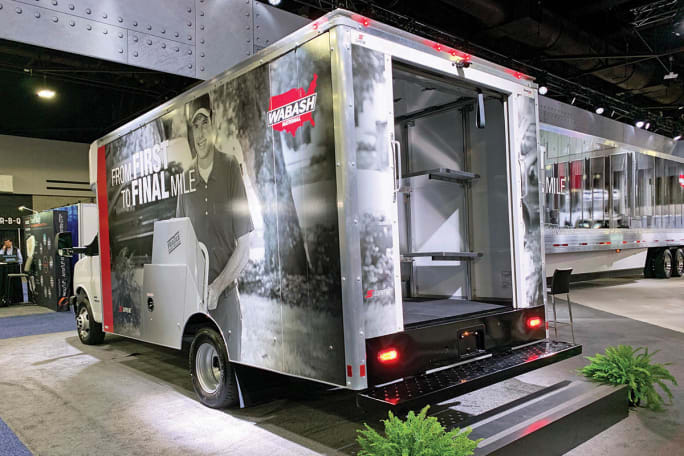
Wabash emphasized the growth of last-mile delivery in its display at the North American Commercial Vehicle Show last October.
Photo: Deborah Lockridge
Schultz notes that some fleets are requiring drivers to work from ground level and trying to eliminate entering/exiting at dock height. “They are looking at cost reductions in workers compensation cases as well as missing route days due to injuries.”
Penske’s Rosa says in addition to looking at how drivers get in and out, the actual door-opening process should be considered. “You might want to consider lighter doors, or an automated door like a power rollup or power sliding door.”
Sumrak says Wabash product designers are looking at technology that could automatically open the entry door for the driver if their hands are full with packages, “or even a way to just keep them from having to constantly grab a handle and open and close the door.”
Liftgate Considerations
For some types of trucks and cargo, liftgates are a must. “Everybody’s application and needs are unique,” Penske’s Rosa says, and different applications may require specific types of liftgates, with various capacity options and platform sizes.
Another thing to consider for liftgates, he adds, is flashing safety lights. “When it’s 4:30 and already dark out, or companies are delivering earlier in the morning (before daybreak), if you’re in a dark parking lot, cars may not see that liftgate.”
Make sure you consider how to keep the liftgate batteries charged. “Liftgate batteries are notorious for running down if you don’t drive far enough in between deliveries,” Morgan’s Jarossy says.
Talk to your body supplier about options for keeping liftgates charged. There are “smart” liftgate power management systems available; another option becoming more popular is mounting solar panels to the roof.
Cargo Control
Sumrak says customers often overlook cargo control. “Most of the time cargo control consists of E-track mounted to the sidewalls, and that’s one of the things most customers will contemplate. But they may not think about whether they need D-rings in the floor, or do they need a vertical type track rather than a horizontal type track to optimize how they load the vehicle? In a lot of cases E-track works, but not in all.”
Jarossy makes a similar point, noting that large pieces may need to be strapped to E-track or D-rings, but parcels and boxes need shelving – and can shelves fold up if the load needs more room for those big-and-bulky items?
“Take a retailer like Best Buy,” he says. “They could be delivering a refrigerator and a laptop at the same time. So, they need heavy-duty cargo control and they need shelving probably.”
Drivers also need to be able to easily see inside the body so they can quickly grab the right packages, so don’t forget interior lighting options. These may include new compact, corner-mount interior LEDs that reduce shadows and dark areas.
Ask for Advice
Body makers emphasize that they or a knowledgeable salesperson can work with you to get the right body for your operations.
“Sometimes they have a specific chassis model in mind, whether it’s a brand or a length of chassis, and they want a certain body length that is not compatible,” Jarossy says. “We like to engineer the solution before we get the order, so we know it’s going to work, rather than get an order and find out later that it’s not going to match.”
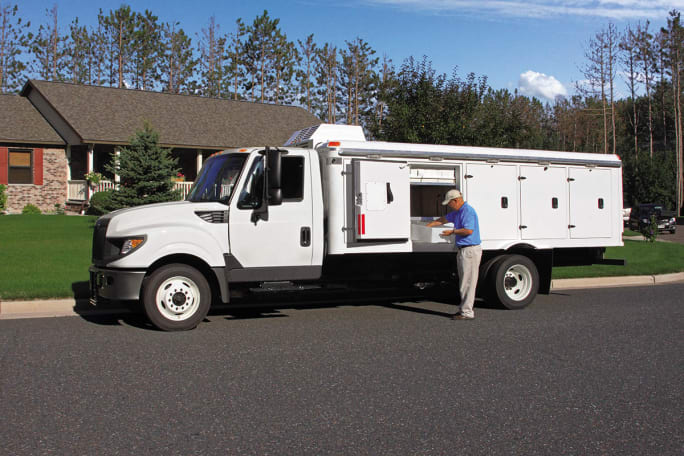
Some last-mile delivery fleets want drivers to be able to stand on the ground and reach in, without climbing up and down and in and out of body doors all day. The Johnson Series from Great Dane is a line of composite refrigerated truck bodies that are highly customizable to meet each fleet’s unique final-mile needs.
Photo: Great Dane
Penske’s Rosa agrees. A common mistake, he says, is to “just go to a dealer and buy a van and not pay attention to options they could select. They should work with the prospective seller and explore every possible option.”
That’s because when it comes to last-mile delivery, it’s far from a one-size-fits-all solution – and new options are coming on the market all the time.
“Everyone has their own specific needs for their application or the kind of product they’re moving. It’s an interesting space; it’s one that’s still evolving,” Rosa says, predicting that customer feedback will lead to more innovative delivery body options in the near future.
More Equipment

How Volvo Updated Its D13 for EPA 2027 [Watch]
Volvo’s updated D13 promises lower emissions without sacrificing performance or fuel economy. Take a closer look at what changed inside the engine in this HDT Spotlight video.
Read More →
Michelin Tire Improves Efficiency and Durability for Regional Fleets
The Michelin X Multi Energy D2 is a regional haul drive tire engineered to help fleets improve fuel efficiency, durability and traction in demanding stop-and-go operations.
Read More →
ZF Expands Commercial Vehicle Push in North America
ZF is expanding its North American commercial-vehicle presence with new transmission applications, electrification, trailer technology and autonomous-driving systems.
Read More →
Tesla Wants a Self-Driving Semi. Are Cameras Enough?
Could Tesla’s camera-only autonomous driving technology work on an 80,000-pound Semi? In this commentary, HDT's Deborah Lockridge takes a look at Tesla, Cybercab, and how autonomous trucks see the road.
Read More →
Kodiak: Driverless Long-Haul Truck Launch on Track for 2026
Kodiak AI says its driverless long-haul safety case is 93% complete and it remains on track to begin commercial operations by year-end 2026.
Read More →
What DOT’s Automated Vehicle Strategy Means for Trucking
The U.S. Department of Transportation issued a new automated-vehicle strategy that outlines plans for driverless-truck regulations, cross-state freight corridors, and federal safety standards.
Read More →
East Coast Port Launches $45M Electric Truck Push
The Port Authority of New York and New Jersey announced millions in incentives for zero-emission drayage trucks, yard tractors, and new charging hubs near the port.
Read More →
PlusAI Going Public to Fund Autonomous Truck Launch
A SPAC deal could provide PlusAI with up to $300 million as it works toward a 2027 commercial launch of factory-built autonomous trucks.
Read More →
NHTSA Moves to Rewrite Truck Fuel-Economy Rules
The National Highway Traffic Safety Administration says it lacks authority to regulate medium- and heavy-duty truck engines separately from complete vehicles, but the existing standards have not yet been eliminated.
Read More →
Detroit Opens Orders for EPA 2027 Engines
Detroit isn’t starting from scratch to meet EPA 2027 diesel emissions standards. Its Gen 6 DD13 and DD15 engines keep much of today’s platform while updating the fuel and aftertreatment systems.
Read More →