




Sourcing the Right Tire Repair Partner
If you're going to have trouble on the road, chances are a tire is at the root of your grief. Tires remain the single most common reason for roadside service calls, no matter who you talk t

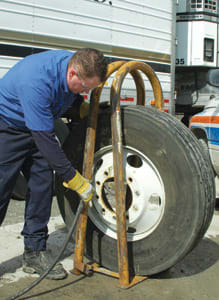
Do you know who is actually doing the service work? In-house national-account service programs take the mystery out of roadside service calls. (Photo by Jim Park)
If you're going to have trouble on the road, chances are a tire is at the root of your grief. Tires remain the single most common reason for roadside service calls, no matter who you talk to
.
One anecdote we never have any trouble soliciting is a tire-repair horror story. Thousand-dollar tires aren't uncommon, nor are service calls that take 10 hours or more to complete to the owner's satisfaction.
One operator told us of a incident in Nevada where he had called a shop to have a wide-based tire replaced at roadside. The driver swears up and down he told the operator who took the call that he wanted a 445/50R22.5. The service truck arrived with a 295/75R22.5 - three of them actually, so he had a choice of brands. Considerate, but not very helpful. Fortunately for the driver, the service guy arrived in a 40-ton wrecker, so he could chain up the drive axle with the flat tire and tow it back to the shop, 108 miles away.
The bill for the work came to more than $500 - not counting the tire. It's still in court, so we can't report any more detail, but suffice it to say the carrier smelled a scam as soon as management was made aware of the situation. We wish we could report incidents like this were rare. They're not, though the magnitude of this one puts it into a category all its own.
Of course, not all tire repair people are villains. When a problem arises, it's often the result of a lack of oversight. You're a thousand miles away from your problem, and you're handing it off to someone you don't know, who has a vested interest in selling you a tire. You're probably low on options at that point, too.
"At one time, we had worked out national account pricing with one of our tire suppliers, but it didn't always work out that way on the road," says Rick Ellis, vice president of Marvin Keller Trucking in Sullivan, Ill. "It was worse in the middle of the night when nobody was around to make decisions on those kinds of things."
Keller says it wasn't uncommon to pay $500 for a tire at roadside.
"Compare that to the $325 we had a deal on locally. Tire prices are extremely inflated at some of those service outlets," he says.
But what if you could make a single call any time of the day and get the same service and price you get from your local supplier?
All the major tire brands offer a 24/7 roadside support system with pre-defined pricing. While the bigger fleets have had access to these plans for years, most are now offered to smaller fleets as well, and even owner-operators. Of course pricing varies, but you get the advantage of service from a distributor you're familiar with, who has a reputation to uphold - and a paper trail to keep them honest.
Voices in the night
When you're researching tire service providers, there's more to consider than who answers the phone - yet that can make a big difference to the outcome of the service call. If the person on the other end is an answering service, he or she may serve a list of clients from plumbers to dentists to tire shops. If you call to request road service, you may not get reliable information from the first point of contact.
Charlie Walters, general manager of Goodyear's Fleet HQ system, says the company used to outsource their tire service business but found it wasn't the best way of serving the customer.
"At one point, we were getting nearly 50 percent of our service requests declined for one reason or another. Usually the service provider didn't want to get out of bed and answer the call," he says. "Because of the third-party set up, we couldn't track how much business we were losing - or how many customers had to go elsewhere for service - but we knew it was a problem."
Fleet HQ has brought it all in-house now, and every call is time-stamped, documented and recorded. Walters says the primary contact is no longer a contract answering service, but a trained responder who knows what questions to ask, and how to take the request to the next level.
"At that point, the customer even has some say in who does the work," Walters says. "When the account is set up, the customer outlines his preferences, in this case, whether he wants a local provider to do the call or anyone on the network. We'll refer the call accordingly."
Michelin's On-Call service offers online and e-mail interactivity, so the customer can view work orders in progress, showing appropriate information such as vehicle number and location, as well as the wheel position of the offending tire, the name of the service provider, contact information, etc.
"It's as close as we can get the customer to the jobsite," Michelin says. "On-Call offers a high degree of customer oversight, so you know what's happening at roadside."
Bridgestone Firestone's National Preferred emergency road service plan offers customers guaranteed-in-writing pricing as well as simplified billing to eliminate the need to transfer funds to drivers. National Preferred is available to fleets as small as 25 trucks, and they have an arrangement with the Owner-Operator Independent Drivers Association designed specially for owner-operators.
Real-time accountability
Perhaps the worst aspect of roadside tire service is not knowing what you're going to get: who will come out, how trustworthy they are, and what the call will cost. Newer roadside assistance programs are promoting a high degree of transparency thanks to e-mail and the Internet.
In choosing a tire repair provider, you can now expect full documentation and a record of the repair work as well as time-to-completion estimates, preferred pricing, and even a choice of replacement product based on pre-established customer profiles. It's getting to be more like your own service manager is handling the call.
Fleet HQ's Walters says the customer can conduct the transaction online or over the phone, but every step in the process is documented and available for review.
"There's no more he-said, she-said," notes Walters. "If the customer wants a particular tire, and something else arrives, we'll know what went wrong. We have a record of the call and the response. It's all documented."
Goodyear will soon be adding photo records of the service call - pictures of what came off and what went on.
The biggest complaint reported by roadside service customers, besides price, is accountability. Once the work is done and the truck is rolling again, it's hard to go back and argue about something, and let's face it, at that point, getting the truck rolling again is a priority. If the driver is dealing one-on-one with the service technician, he or she might not be looking out for your best interests.
Bridgestone's Guy Walenga recommended fleets stay as close as possible to their tire brand in seeking a service partner. "They know the product, obviously, and they have an interest in keeping the customer happy," he says. "Just because your head office is halfway across the country doesn't mean you should expect any less from a service provider."
Simply put, don't settle for anything less than local service on a national level, with accountability on par with your local tire provider.
"We haul freight; we don't manage tires," says Ellis, who recently signed on to Fleet HQ. "I'd like to stick more closely to what we do well, and leave the tire work to an expert."
From the April 2010 issue of Heavy Duty Trucking.
More Equipment

How Volvo Updated Its D13 for EPA 2027 [Watch]
Volvo’s updated D13 promises lower emissions without sacrificing performance or fuel economy. Take a closer look at what changed inside the engine in this HDT Spotlight video.
Read More →
Michelin Tire Improves Efficiency and Durability for Regional Fleets
The Michelin X Multi Energy D2 is a regional haul drive tire engineered to help fleets improve fuel efficiency, durability and traction in demanding stop-and-go operations.
Read More →
ZF Expands Commercial Vehicle Push in North America
ZF is expanding its North American commercial-vehicle presence with new transmission applications, electrification, trailer technology and autonomous-driving systems.
Read More →
Tesla Wants a Self-Driving Semi. Are Cameras Enough?
Could Tesla’s camera-only autonomous driving technology work on an 80,000-pound Semi? In this commentary, HDT's Deborah Lockridge takes a look at Tesla, Cybercab, and how autonomous trucks see the road.
Read More →
Kodiak: Driverless Long-Haul Truck Launch on Track for 2026
Kodiak AI says its driverless long-haul safety case is 93% complete and it remains on track to begin commercial operations by year-end 2026.
Read More →
What DOT’s Automated Vehicle Strategy Means for Trucking
The U.S. Department of Transportation issued a new automated-vehicle strategy that outlines plans for driverless-truck regulations, cross-state freight corridors, and federal safety standards.
Read More →
East Coast Port Launches $45M Electric Truck Push
The Port Authority of New York and New Jersey announced millions in incentives for zero-emission drayage trucks, yard tractors, and new charging hubs near the port.
Read More →
PlusAI Going Public to Fund Autonomous Truck Launch
A SPAC deal could provide PlusAI with up to $300 million as it works toward a 2027 commercial launch of factory-built autonomous trucks.
Read More →
NHTSA Moves to Rewrite Truck Fuel-Economy Rules
The National Highway Traffic Safety Administration says it lacks authority to regulate medium- and heavy-duty truck engines separately from complete vehicles, but the existing standards have not yet been eliminated.
Read More →
Detroit Opens Orders for EPA 2027 Engines
Detroit isn’t starting from scratch to meet EPA 2027 diesel emissions standards. Its Gen 6 DD13 and DD15 engines keep much of today’s platform while updating the fuel and aftertreatment systems.
Read More →