




Solving Liftgate Charging Problems
Liftgates take goods from a trailer or truck body to the ground, where drivers can roll the cargo into customers' establishments

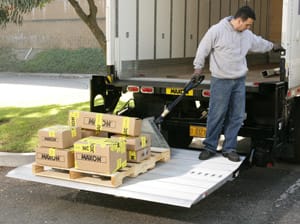
The heavier the load, the greater the draw on the auxiliary batteries that power a liftgate's electric motor. State and municipal restrictions on engine idling often reduce time for recharging.
Liftgates take goods from a trailer or truck body to the ground, where drivers can roll the cargo into customers' establishments.
They allow drivers to move more poundage at one time and in a smaller area than ramps.
But a liftgate becomes nothing more than an extra door if the batteries powering its electric-over-hydraulic mechanism run down. A common failure is a gate stuck on the ground because the batteries don't have the juice to raise it. The result is an expensive road-service call and delivery delays.
To keep auxiliary batteries charged, drivers commonly let the truck or tractor's engine idle to keep the alternator spinning. But local and state laws increasingly prohibit idling, notes Bruce Purkey, an industry guru on electrical matters and president of Purkey's Electrical Consulting. Thus batteries must work alone to power liftgates. The more stops a truck or tractor-trailer makes in a day, the shorter the trips between them, and the less time the engine's running and the alternator's turning to recharge the auxiliary batteries.
Charging basics
Charging time is important, and so is the quality of the voltage. The Technology & Maintenance Council of the American Trucking Associations has a Recommended Practice on the subject. RP 129 suggests that power to those batteries drop no more than half a volt, no matter what length the wiring from the truck or tractor's batteries are.
This becomes a problem with long trailers where the total length of the "run" between the two battery packs can exceed 60 feet. Even the shorter run on a straight truck can be a problem, because electrical resistance comes from sometimes-insufficient wire gauge as well as resistance from fuses and connections. Charging voltage should be 14 or higher, but often drops to 13.25 or lower, according to data collected by on-board monitors placed on Purkey's customers' vehicles. Insufficient voltage lessens battery life and endangers motors in the gate's lift mechanism.
Trailers are generally equipped with one of several types of charging circuits, Purkey explains, and there are problems with each:
* Single-pole: One single positive connection between tractor batteries and trailer batteries, with the ground established through the tractor's fifth wheel. The ground depends on how well the fifth wheel is attached to the tractor's frame, grime amid the grease on the fifth wheel's plate, corrosion present, interference during turning, etc.
* Dual-pole: One single positive cable and one single negative cable connection between the tractor and trailer batteries, connected by an insulated plug. Current can flow two ways, and will go to the batteries with the lowest state of charge. When the driver cranks the engine, the trailer batteries will try to help power the starter motor. Electrical loads from either vehicle will discharge batteries on both.
* Reefer charging: Trailer batteries are connected in parallel to the reefer's battery, and all are charged when the reefer's engine runs. This can overload the reefer unit and there can still be a voltage drop in the run to the batteries near the end of the trailer. When the reefer's engine is off, as it often is during cold weather, there's no charging.
One solution
Purkey says a solution is the Trailcharger, a DC to DC converter from SurePower Industries. Trailcharger boosts any input from 9 to 16 volts and corrects it to 14 volts, so batteries are charged and maintained at the proper level. It also compensates for low temperatures by charging at higher voltages - 15.2 volts at zero degrees, for example. Operation is completely automatic.
Trailchargers come in 20- and 50-amp versions, and which one's needed depends on the liftgate's duty cycle. Purkey suggests a test that factors in the heaviest load the gate is likely to handle (the "weighted load") and measures the amperes the gate's motor draws to raise and lower that load, plus the time for each. The average amp load and other operating conditions, such as normal ambient temperatures and the percentage of time the gate operates with the truck or tractor's engine running, determine which model to install. The unit is placed at the auxiliary battery box and the Trailcharger is appropriately wired into the charging circuit.
In some cases Purkey adds an "extender," an electronic module he designed for use with a Trailcharger and a dual-pole circuit. During engine-off use, the extender keeps trailer batteries charged as long as the tractor batteries can support it. When the liftgate is at rest, the extender stops taking a charge for at least 10 seconds and reads the available voltage at the trailer end. If voltage is sufficient to continue, charging is resumed; if not, charging ceases so tractor batteries stay healthy enough to crank the engine.
Purkey has also designed an indicator light that's wired to the auxiliary batteries. The light glows green if the batteries are fully charged and red if they're not. Drilling a small hole in the battery box allows the driver to see the light, or a short harness can place the light outside the box where it's more readily visible. Purkey says a driver should check the light as part of his pre- and post-trip inspections.
Purkey says he has installed hundreds of Trailchargers and many extenders for his customers, and the devices invariably solve charging complaints and eliminate disruptive battery run-downs and expensive road-service calls. A Trailcharger costs about $300 and the extender about $70, which is about the cost of a service call, so the devices quickly pay for themselves.
Dousing dome lights
Liftgates are often used on temperature-controlled trailers and truck bodies, and one bugaboo to their operation is drivers leaving dome lights on. These draw current from batteries that must be recharged by alternators in reefer units or in trucks or tractors. Extra electrical load from the dome lights takes power that's needed by liftgate motors, which are more likely to be immobilized by run-down batteries.
One solution is the PermaLogic (pictured), a control box that automatically shuts off dome lights when a vehicle's parking brakes are released. Phillips Industries makes and sells the product.
Lighting manufacturers also have started offering interior dome lights that are motion activated.
Grote Industries just released its new 61F61 Infrared Motion-Activated LED Dome Lamp, aimed at the refrigerated transport market. The 61F61's passive infrared motion sensor is calibrated to recognize the human heat signature, so when a person moves within 6 feet, it activates the lamp. The lamp remains on while activity is detected and stays on for three minutes following the last human motion.
Truck-Lite's new Super 80 LED Interior Trailer lamp also features infrared motion sensor technology. The LED Dome's IR sensor, which compares changes in heat coupled with motion, can sense movement up to 10 feet away from the lamp surface. The lamp is designed to stay on through five minutes of inactivity before automatically shutting off.
Potential downsides to motion detectors include extra wiring as well as difficulties figuring out the problem if the motion detector stops working.
From the June 2010 issue of Heavy Duty Trucking.
More Equipment

How Volvo Updated Its D13 for EPA 2027 [Watch]
Volvo’s updated D13 promises lower emissions without sacrificing performance or fuel economy. Take a closer look at what changed inside the engine in this HDT Spotlight video.
Read More →
Michelin Tire Improves Efficiency and Durability for Regional Fleets
The Michelin X Multi Energy D2 is a regional haul drive tire engineered to help fleets improve fuel efficiency, durability and traction in demanding stop-and-go operations.
Read More →
ZF Expands Commercial Vehicle Push in North America
ZF is expanding its North American commercial-vehicle presence with new transmission applications, electrification, trailer technology and autonomous-driving systems.
Read More →
Tesla Wants a Self-Driving Semi. Are Cameras Enough?
Could Tesla’s camera-only autonomous driving technology work on an 80,000-pound Semi? In this commentary, HDT's Deborah Lockridge takes a look at Tesla, Cybercab, and how autonomous trucks see the road.
Read More →
Kodiak: Driverless Long-Haul Truck Launch on Track for 2026
Kodiak AI says its driverless long-haul safety case is 93% complete and it remains on track to begin commercial operations by year-end 2026.
Read More →
What DOT’s Automated Vehicle Strategy Means for Trucking
The U.S. Department of Transportation issued a new automated-vehicle strategy that outlines plans for driverless-truck regulations, cross-state freight corridors, and federal safety standards.
Read More →
East Coast Port Launches $45M Electric Truck Push
The Port Authority of New York and New Jersey announced millions in incentives for zero-emission drayage trucks, yard tractors, and new charging hubs near the port.
Read More →
PlusAI Going Public to Fund Autonomous Truck Launch
A SPAC deal could provide PlusAI with up to $300 million as it works toward a 2027 commercial launch of factory-built autonomous trucks.
Read More →
NHTSA Moves to Rewrite Truck Fuel-Economy Rules
The National Highway Traffic Safety Administration says it lacks authority to regulate medium- and heavy-duty truck engines separately from complete vehicles, but the existing standards have not yet been eliminated.
Read More →
Detroit Opens Orders for EPA 2027 Engines
Detroit isn’t starting from scratch to meet EPA 2027 diesel emissions standards. Its Gen 6 DD13 and DD15 engines keep much of today’s platform while updating the fuel and aftertreatment systems.
Read More →