




Smart Fleets Verify Fuel-Saving Technologies
Fuel is gold," says Jimmy Ray, fleet manager at Mesilla Valley Transportation in Las Cruces, N.M. He's out to save a lot of it with innovative components that have proven themselves in testing and everyday operations

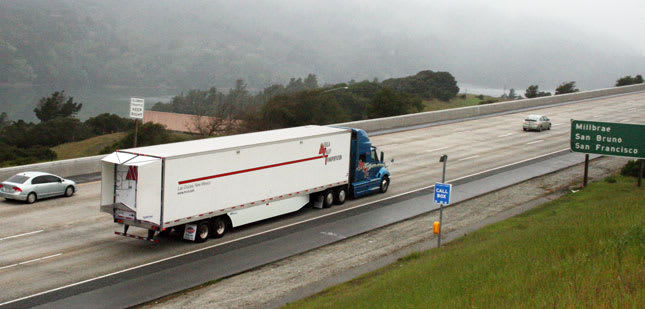
Fuel is gold," says Jimmy Ray, fleet manager at Mesilla Valley Transportation in Las Cruces, N.M. He's out to save a lot of it with innovative components that have proven themselves in testing and everyday operations.
When the price of fuel goes up, so do the pitches for various devices that claim to improve fuel mileage, from aero improvers to additives. Savvy fleets adopt the ones that work for them after testing them in their operation and assessing the payback opportunities, now enhanced by rising fuel prices.
Some testing is formal, often using the demanding TMC/SAE Type II procedure. Other tests are in-service, which take longer and are less scientifically precise, but perhaps more convincing. We spoke with two fleets that have used such testing to show the worth of aerodynamic devices and fuel-saving tires.
Boxy vans are the most obvious target of improved aerodynamics, and are what Mesilla Valley Transportation pulls. But tankers can also benefit, as Air Products & Chemicals has determined through research and testing.
One component adopted by MVT is the ATDynamics TrailerTail, the folding-panel boat tail fitted to the rear of van trailers. Ray is blunt about what he thinks of its looks. "Who'd want to put that crap on a trailer?" he comments. "But when you see the money it saves, you have to." TrailerTail alone saves 0.4 mpg, according to tests.
Transtex side skirts, also from ATDynamics, save another 0.4 mpg. And wide-base single tires pick up 0.35. Together the three components save nearly 1.2 mpg compared to a bare trailer, and Ray said so in a display shown last year to skeptical drivers. Drivers compete in a fuel economy incentive program, and positive results of the trailer equipment have helped them win money and motorcycles.
Ray tested the components at the Bridgestone Tire test track at Fort Stockton, Texas. He and his crew ran a TMC/SAE Type II procedure that requires use of separate fuel tanks or cells that are equipped with valves that allow tapping at the desired speed. This way, economy at cruising speed is carefully measured apart from fuel consumed during acceleration and deceleration. Fuel consumption with and without the subject component is measured and compared to a "control" truck without the device. This is how Ray knows determines the exact savings.
Tire testing, which pitted new wide-base singles against duals, showed the big singles saved 0.25 mpg. When the fresh tread is somewhat worn, rolling resistance is less, so he figures the 0.35 mpg saving is realistic. MVT uses steel wheels to save purchasing money instead lighter-weight aluminum wheels.
MVT's latest tractors are streamlined International ProStar+. Each tractor's wide-base single rear wheels get aluminum hubcaps that smooth air flow over the wheel. "We make about $200 a year (per tractor) at $2.80 a gallon" with the hubcaps, Ray says. At $4 a gallon, that's probably more like $250.
The Type II testing procedure was devised more than two decades ago by members of The Maintenance Council (now the Technology & Maintenance Council) of the American Trucking Associations. Type II and other numbered procedures were adopted by the Society of Automotive Engineers.
The TMC/SAE tests aren't cheap. "There are a lot of guys out there" while one's being run, Jimmy Ray says, and the special tanks and scales to weigh fuel in them are part of the protocol. The major advantage of these tests is that they can show in a short time whether a component can save the fuel its supplier claims. And if done right and supervised by experienced people, they can be run on public highways as well as test tracks.
The formal testing should be verified by in-service operations during which fuel economy is precisely tracked, Ray says. He adds, "I'll tell you what's a good verifier. It's when an owner-operator starts looking for those trailers. We've got owner-operators who pull our trailers and we see 'em walk along a row of trailers 'til they find one with all the stuff on it. They know a lot about what saves money."
MVT plans to install the boat tails, side skirts and wide-base tires and wheels on all of its 3,500 trailers. Each trailer will cost $3,000 to $4,000 to outfit, but will save the fleet more than 1 million gallons of fuel a year. That will pay back the investment in one to two years, figures Ray and his partner, CEO Royal Jones.
Air Products is another progressive fleet. It was one of the first to adopt air disc brakes for safety, and wide-base single tires to reduce weight. Managers, headed by Ron Szapacs, a maintenance specialist at the Allentown, Pa., headquarters, commissioned a study by Lehigh University in nearby Bethlehem, Pa., to look at fuel-saving devices. A complete tractor-trailer was sent to the campus for engineers to study over several months. They built a scale model and tested it in a wind tunnel to heighten their observations.
The result was a list of recommendations, and managers picked several as feasible:
* Maximizer-brand vinyl half-round fenders that hug the upper arcs of the tires on a tractor's drive axles, replacing flat-profile aluminum half-fenders, and allowing removal of the large trailer-mounted upper fenders;
* EcoFlaps, which are slotted mudflaps that catch road spray but allow air to pass through, to be used on both tractor and trailer; and
* Airtabs, the wishbone-shaped vortex generators that smooth the flow of air as it leaves vehicles' trailing edges. In Air Products' case, the tabs would be applied to the rear of tanker trailers.
Marty Byrd managed the resulting test project out of Air Products' Pryor, Okla., location. For starters he used two sample rigs, each pulling a pressurized tanker. The first was the control vehicle, pulled by a Freightliner Columbia on which he had detailed fuel-use data from 18 months and about 180,000 miles of operation. He installed the devices, then ran the rig on regular revenue routes for several weeks while watching closely for any economy differences.
The second rig had a newer Freightliner Cascadia tractor. The tractor and trailer got the upgrades, re-entered service, and fuel use was monitored and compared to that of the control rig. Conclusion: The three devices together improved fuel economy by 7 percent on both rigs, Byrd reports. This was in mostly mild weather. Later, through a rough winter, the improvement dropped to 2 percent.
Limited adoption of the devices was deemed worthwhile and installation has begun. As of mid-May the company had installed them on 281 pieces of equipment. "We've identified 1,250 pieces that will be modified because of the routes they run," Byrd says, where there are enough miles running at highway speeds to let the aerodynamics work. Those tractors and trailers run about 80 percent of the miles in the fleet, Szapacs adds.
The Minimizer vinyl fenders allow removal of the aluminum fenders and steel brackets on tractor and trailer, which altogether saves 140 to 150 pounds, Szapacs says. That's their principal benefit, because "one pound means 10 dollars to us" in payload enhancement. The large trailer fenders above the tractor tandems act as "air catchers," researchers noted, so with them gone, aerodynamics are improved.
The fenders and flaps have advantages not directly related to fuel economy, Szapacs says. The vinyl tractor fenders flex, so "they can actually be hit with a hammer and they don't dent. The green color is molded in and remains even if a fender is nicked."
Airtabs seem to reduce turbulence at a trailer's rear, so contributed to the 7 percent fuel economy betterment found in the Oklahoma tests. Makers of the tabs have testimonials from drivers who've sai
More Fleet Management

Color Match Smarter: Tools That Restore & Perform
For fleet managers and collision repair professionals keeping heavy-duty trucks on the road, getting the color right the first time isn't just about appearance — it's about efficiency, turnaround time, and bottom-line results. Discover how today's digital color tools are transforming the repair process from guesswork to precision.
Read More →
FMCSA Pauses Biennial-Update Enforcement Amid Motus Transition
Carriers whose updates were due on or after June 1 have more time, while FMCSA works to stabilize its new registration system and warns of phishing sites impersonating its new carrier registration system, Motus.
Read More →
2026 Blueprint for Countering Smarter Supply Chain Theft
Cargo theft is no longer just the cost of doing business. It's a multi-billion-dollar criminal enterprise exploiting vulnerabilities across your fleet, drivers, and supply chain.
Read More →


How Telematics Improves Visibility, Control, and Performance in Refrigerated Fleets
Explore how telematics help refrigerated fleets improve visibility, uptime, efficiency, compliance, and cargo protection across connected cold chain operations.
Read More →
What the U.S.-Canada Trade War Means for Trucking
Escalating U.S.-Canada tariffs could disrupt cross-border freight, reduce truck volumes, raise costs, and create new uncertainty for carriers on both sides of the border.
Read More →
What Are Trucking’s Top Concerns for 2026?
The American Transportation Research Institute wants to know what's worrying trucking fleet managers, drivers, and other stakeholders in its annual Industry Issues survey.
Read More →
American Trucking Associations Looks for a New Leader
ATA President and CEO Chris Spear abruptly left his job at the association on August 21, at a pivotal time for the trucking industry.
Read More →
Public Wi-Fi Cybersecurity Risks: How Truck Drivers and Fleets Can Protect Their Data
Public Wi-Fi can expose truck drivers and fleets to credential theft, malware, and other cyber threats. Here’s how to reduce the risk on the road.
Read More →
For Nicky Cupp, Fleet Innovation Starts With Frustration
HDT Truck Fleet Innovator Nicky Cupp turns everyday pain points at Fraley & Schilling into opportunities for better technology and smarter processes.
Read More →
Adam Buttgenbach’s Approach to Electric Trucks: Start With Where They Fit
HDT Truck Fleet Innovator Adam Buttgenbach helped PepsiCo build one of North America’s largest EV fleets by focusing on where electric trucks make operational sense.
Read More →