




Schwan's Home Service Runs 3,300 Propane-Powered Units Nationwide
After more than 40 years of using propane as a motor fuel, the people at The Schwan Food Co. still believe they’ve got the right stuff. Schwan’s experience with propane goes back to the 1970s, when Arab oil embargoes threatened supplies of gasoline and diesel and drove up their prices.

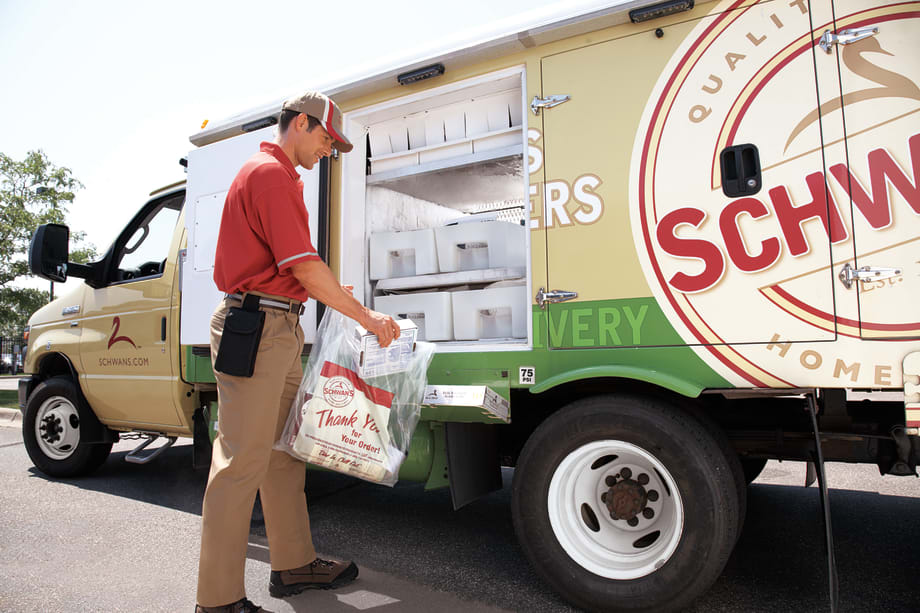
Schwan’s Ford E-450s are among the many that run on propane, which the company has used since the 1970s.
After more than 40 years of using propane as a motor fuel, the people at The Schwan Food Co. still believe they’ve got the right stuff. Schwan’s experience with propane goes back to the 1970s, when Arab oil embargoes threatened supplies of gasoline and diesel and drove up their prices.
Schwan’s Ford E-450s are among the many that run on propane, which the company has used since the 1970s.
“The embargo was a big driver of a conversion to propane” from gasoline, according to Jeff Schueller, director of fleet maintenance, quoting a bit of company history that occurred before his time.
Reliable supplies and cheap, steady prices continue to verify that long-ago decision.
Propane is also known as LPG, for liquefied petroleum gas, because it’s a byproduct of petroleum refining. Propane also occurs in “wet” natural gas as it’s extracted from the ground, and a large majority of propane fuel is now made from natural gas.
It’s called “autogas” overseas, where it’s far more popular as an automotive fuel.
Schwan’s Home Service, the company’s home-delivery business, carries ice cream and prepared foods with 3,300 propane-powered units nationwide, a mixture of General Motors, Ford E-450s and Isuzu NPR Gas trucks. (It also has 1,300 diesels bought after GM got out of the medium-duty business in 2009.)
“We can hedge fuel purchasing,” locking in prices for months at a time, Schueller says in listing propane’s benefits.
“It burns cleaner than other fossil fuels, so we have been able to extend oil drains, and that has offered a price reduction in our maintenance plan.”
Oil analysis has shown the safety of 15,000- to 24,000-mile intervals, versus 4,000 to 7,000 miles with gasoline, which alone saves Schwan Food $1.2 million annually.
“Engines last 150,000 to 200,000 miles before they get tired,” and then are pulled and replaced with GM remanufactured long blocks,” he says.
A typical truck chassis runs 24,000 miles a year and goes through two engines before it is retired after six to eight years. Its multi-compartment refrigerated body is transferred to a new chassis, serves through another cycle, and then is scrapped.
Fuel cost itself is significantly less per gallon after a 50-cent-a-gallon federal tax credit, compared to an average of $3.70 per gallon for gasoline. State grants are available to cover a percentage of the equipment conversion costs, which are pegged at $16,000 per unit.
“We have bulk storage tanks on our depot properties,” he explains. “We have it trucked in and refill the units each night on our properties.”
Schwan is so dedicated to propane that it has its own equipment supplier, Bi-Phase Technologies, which makes a system that replaces factory gasoline fuel injection. That system will soon be available to other users.
“We continuously look at other alternatives, other fuels, and at hybrid options,” Schueller says.
“But propane always comes back through analysis as the favorite choice.”
Propane trucks and engines
Schwan Food, an early adopter of propane, uses a propane conversion system designed and manufactured by a subsidiary, Bi-Phase Technologies.
It’s installed on trucks purchased primarily from General Motors in the past. Since GM’s exit from the medium-duty market, Schwan has been buying Ford and Isuzu trucks. Isuzu NPR Gas models come with the familiar GM Vortec 6000 gasoline V-8, which then gets the Bi-Phase conversion.
Bi-Phase has struck an agreement with Power Solutions International, a maker of alternative-fuel engines based on GM cylinder blocks, to market Bi-Phase’s propane system for general use. The system will use Bi-Phase mechanical components with PSI electronic controls.
Freightliner Custom Chassis Corp. has begun building its S2G Class 7 chassis with an 8-liter V-8 that runs on propane autogas. The S2G uses an FCCC chassis with a cab and hood from Freightliner’s M2-106.
Several aftermarket suppliers offer propane conversion kits for Ford and GM vehicles and engines. They include:
• American Alternative Fuel (www.aafuel.com): Has bi-fuel (gasoline and propane) kits for Ford trucks and cars. The company also makes CNG equipment and small electric vehicles.
• CleanFuel USA (www.cleanfuelusa.com): Dedicated propane kits for GM vehicles. It says its fuel system is used in the Freightliner S2G truck.
• ICOM North America (icomnorthamerica.com): Its JDG injection system is used by CleanFuel, and a bi-fuel version is available for GM and Ford vehicles and engines. ICOM also makes propane tanks.
• Impco Automotive (www.impcoautomotive.com): Makes bi-fuel and dedicated systems for Ford and GM vehicles and engines. Impco also makes CNG systems for compressed natural gas, and assembles GM’s bi-fuel (gasoline-CNG) 2500-series pickup.
• Roush CleanTech (www.roushcleantech.com): Specializes in dedicated propane conversions for Ford F-series trucks and E-series trucks and buses.
For more propane options, go to www.autogasusa.org. The site is maintained by the Propane Education & Research Council, which works to boost the use of “autogas” in North America.
More Fuel Smarts

Wex Adds Cardless Fuel Payments for Over-the-Road Customers
A new fuel card feature for Wex customers offers convenience and security.
Read More →
New California Law Could Shed Light on Electric Truck Prices
Why do battery-electric Class 8 trucks remain so expensive? A California bill signed by Gov. Gavin Newsom would give fleets and state agencies more visibility into what manufacturers charge.
Read More →
How Volvo Updated Its D13 for EPA 2027 [Watch]
Volvo’s updated D13 promises lower emissions without sacrificing performance or fuel economy. Take a closer look at what changed inside the engine in this HDT Spotlight video.
Read More →

Diesel Price Spike Shortens Payback for Natural Gas Trucks, Report Says
Energy Vision estimates fleets could recover the higher purchase price of an RNG-fueled Class 8 tractor in 1.3 to 2.8 years under current fuel-price scenarios.
Read More →
Calstart Becomes Catalyst Mobility, Reflecting Broader Focus
Calstart is now Catalyst Mobility, reflecting the nonprofit’s growing national role in clean transportation, including zero-emission trucks, infrastructure and incentive programs.
Read More →
Record Diesel Prices Squeeze Trucking Fleets
Average U.S. diesel prices have climbed to nearly $6 a gallon, surpassing the 2022 record as tight refinery capacity and Middle East disruptions keep fuel costs elevated.
Read More →
How Fuel Delivery Shapes Engine Performance
Fuel delivery depends on more than what happens at the injector. For fleet, maintenance and technical professionals, looking at the full path from pump to injector can provide useful context for understanding engine performance.
Read More →
East Coast Port Launches $45M Electric Truck Push
The Port Authority of New York and New Jersey announced millions in incentives for zero-emission drayage trucks, yard tractors, and new charging hubs near the port.
Read More →
Detroit Opens Orders for EPA 2027 Engines
Detroit isn’t starting from scratch to meet EPA 2027 diesel emissions standards. Its Gen 6 DD13 and DD15 engines keep much of today’s platform while updating the fuel and aftertreatment systems.
Read More →
Zero-Emission Truck Corridor Planned for West Coast
California, Oregon, Washington, British Columbia and Baja California are coordinating plans for truck charging and hydrogen fueling from Canada to Mexico.
Read More →