





Related: Trucking Through the Pandemic
How Trucking Fleets are Running Lean to Survive COVID
Fleets share tactics they’ve taken in the wake of the COVID-19 pandemic to cut costs and operate more efficiently.
September 14, 2020

Fleets have found ways to cut costs while dealing with COVID-19 disruption.
Image: Gettyimages.com/maogg; ryasick
7 min to read
“These truly are the times that try a man’s soul!” says Steve Rush, president of tanker fleet Carbon Express, saying the COVID-19 pandemic, resulting shutdowns, and damage to the economy have forced his team to “work smarter.”
We’ve asked fleet executives and managers in various parts of trucking operations to share some of the strategies they have used to conserve cash flow, operate more efficiently, and cut costs over the last six months as the novel coronavirus turned the world upside down.
Operations
“In order to sustain business, our first focus, and really learning curve, was to make sure all employees had the ability to perform their daily functions remotely,” says T.J. Hunt, senior director of operations at Colorado-based Navajo Express. “In order to run lean and keep costs down, we needed to make sure our team members were able to stay healthy and focused in a safe working environment.”
For many fleets, suspension or restriction of travel was not only a necessary tactic to slow the virus spread, it also kept expenditures down.
Some fleets used the slowdown to take a detailed look at areas where they could cut costs or improve efficiency, not just for the current crisis, but also for the longer term.
“The pandemic slowdown was severe for our company for a little while,” says John Elliott, CEO of expedited fleet Load One. “This time gave us the chance to review all of our process and workflows from top to bottom. We looked at job positions and responsibilities. Amazing what you can find when you have that slower time to catch your breath and do it,” he told HDT. “As well, we pushed our team to work with our technology team to identify more areas we could possibly automate and enhance.”
We heard from many fleets that they were accelerating planned technology investments to improve efficiency and reduce COVID-19 contact, such as implementing electronic bills of lading or signing up for weigh-station bypass or toll management. As lanes and networks have been scrambled by COVID-19, we’re seeing carriers and shippers turn to cloud-based transportation management systems that allow them to increase collaboration and better match freight with available capacity.
“This time gave us the chance to review all of our process and workflows from top to bottom…Amazing what you can find when you have that slower time to catch your breath and do it.”
– John Elliott, Load One
Ryder System used zero-based budgeting in the immediate aftermath of COVID-19 shutdowns to manage its monthly spending. According to an article in the Wall Street Journal, this means starting from a budget of zero, then justifying every expense, assessing spending patterns, and rethinking how to deploy resources.
That led to moves such as furloughs in Ryder’s back-office function and a reduction in its travel budget that were expected to lead to discretionary spending savings of $20 million in the second quarter. Ryder started using the budgeting technique in 2017 and repeats the process every month.
Equipment
Capital expenditures such as purchasing trucks and trailers were postponed at many fleets, although truck and trailer orders have since picked back up nationally.
At System Freight Inc., says owner Jim Lamarca, because of the uncertainty of the pandemic, it suspended its capital expenditures through the second quarter in an effort to preserve cash flow to run the business. “We have since resumed and have placed orders for tractors and trailers.”
Another major area where SFI was able to cut costs in March and April was trailer rentals. The New Jersey-based fleet, which provides dedicated services in the Northeast, keeps a group of rental trailers that it can terminate at any point in time that represents approximately 15% of the trailer fleet. When COVID hit, Lamarca says, “we immediately returned 125 trailers that enabled us to avoid carrying the monthly cost of the trailers where volume had been soft. The returns in rentals represented just under 5% of our trailer fleet, but that was a savings of about $42,000 per month.”
On the Road
Carbon Express trucks are spec’ed as lightweight daycabs to maximize payload. In normal times, that means drivers are put up in hotels if they must be on the road overnight. Although the company already was running some of its routes as relays, “we have really had to practice relays in order to keep our drivers out of the motel and home and still make money,” Rush says.
For instance, if the company has a load from New York City to Chicago, it sends a truck from its New Jersey headquarters to take the NYC load to its location in Altoona, Pennsylvania, about four and a half hours away, and swaps the driver out there so he can come home to New Jersey. Then the Altoona truck takes it to Toledo, Ohio, and returns, while the Toledo driver goes to Chicago and back. “Everyone sleeps home and we save money.”
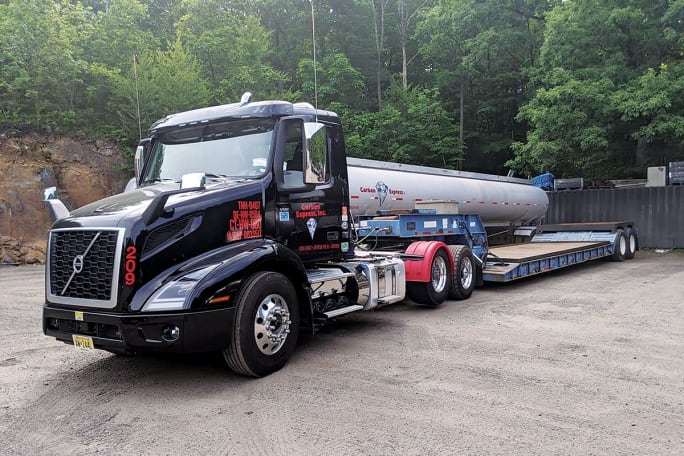
Carbon Express has added a flatbed division and is using relays rather than putting drivers in hotels.
Photo: Carbon Express
In order to keep its trucks moving, Carbon Express also diversified and added a flatbed division, “which has really helped fill some of the void from the lost revenue,” Rush says, although it has not been without its challenges, especially having to rely more on brokers.
“When the pandemic hit, we knew the only way to stay lean was to be true to our roots as a long haul carrier,” says Navajo’s Hunt. “We have maintained a disciplined network by keeping drivers on our ‘power lanes,’ rather than sending trucks all over the 48 states to keep them moving.
“It’s never been more important to book the right freight, meaning loads that are driver friendly, create density/velocity for our network, and are at the right rate. … With a focused network during challenging times, we have seen our deadhead reduce drastically and our week-over-week load count increase.”
System Freight Inc. tightened up its fuel purchase program. “As always, fuel price and economy is a key driver to our profitability,” Lamarca says. “So we really focused our fuel program to only purchase where we receive the best pricing, where prior we may have been a little more relaxed and not have paid as close of attention on a day-to-day basis.”
Efficiency in the Shop
“Our maintenance team is built to adjust for the flow of business levels,” says Doug Lloyd, director of maintenance at Tennessee-based Averitt Express. “During the pandemic, we maintained our KPIs to manage costs.”
Mike Palmer, vice president of fleet services for Virginia-based less-than-truckload carrier Estes Express Lines, took a back-to-the-basics approach.
“We analyzed multiple areas within the department and narrowed the group down to only a few items that would give the most benefit of reducing costs, based on the time and labor involved in the project compared to the cost savings,” he said, as follows:
Efficiency in the shops: “We looked at the repair times that existed on our equipment. After analyzing and even timing specific high-usage repairs, we determined that certain job times could be trimmed without affecting the quality of the work.”
Labor hours: “We set the hours at a certain number and held the shops to those limits. If for any reason the set hours would be exceeded, manager approval must be obtained. Accountability for overages helped control abuse or excessive amounts.”
Outside labor costs: “We monitored these costs and worked on doing nearly all repairs in-house. Similar to labor hours, if work had to be done outside at our shop locations, manager approval was needed.”
Supplier costs: “Part of our part and equipment costs involved evaluating these costs. We teamed with our suppliers, with some resulting in renegotiating products and pricing.”
Tire costs: “We decided to focus on the tire repairs and replacements at our non-shop locations. We installed tire inventories at our high-usage terminals, and the tire costs dropped considerably at these terminals.”

At Estes Express Lines, they took a back-to-the-basics approach of finding cost savings in the maintenance operations.
Photo: Estes Express Lines
Payroll Costs
At Nebraska-based Werner Enterprises, among the measures it took to run lean included executive officers and senior vice presidents voluntarily reducing their base salaries by anywhere from 10% for senior vice presidents to 25% for CEO Derek Leathers.
Canada’s largest fleet, TFI International, in April said it cut executive salaries by 5-15%, director salaries by 15%, and implemented a four-day work week for more than 1,000 full-time employees. Temporary layoffs were implemented, with those affected eligible for a salary recovery program when they return. Incentives go from $100 a week for the first four weeks, to $125 for the following four, and $150 a week afterwards, to be collected when they return.
Although it may seem counterintuitive in an article about running lean, at Carbon Express, they opted to pay drivers more.
“We may have taken a risk, but when we received the PPP money, we decided that giving our drivers a hazardous pay increase was fair, since the money would be forgiven. We took the lead from President Trump, who suggested early on that the first responders deserved hazard pay. In the end, it showed our drivers just how much we truly care about them. In fact, just today we hired what we believe will be a great new hire who left his company after five years of service because they cut their drivers’ pay 10%.”
Subscribe to Our Newsletter
More Fleet Management

Sponsored•September 16, 2026
Color Match Smarter: Tools That Restore & Perform
For fleet managers and collision repair professionals keeping heavy-duty trucks on the road, getting the color right the first time isn't just about appearance — it's about efficiency, turnaround time, and bottom-line results. Discover how today's digital color tools are transforming the repair process from guesswork to precision.
Read More →
FMCSA Pauses Biennial-Update Enforcement Amid Motus Transition
Carriers whose updates were due on or after June 1 have more time, while FMCSA works to stabilize its new registration system and warns of phishing sites impersonating its new carrier registration system, Motus.
Read More →
Sponsored•September 14, 2026
2026 Blueprint for Countering Smarter Supply Chain Theft
Cargo theft is no longer just the cost of doing business. It's a multi-billion-dollar criminal enterprise exploiting vulnerabilities across your fleet, drivers, and supply chain.
Read More →


Sponsored•September 1, 2026
How Telematics Improves Visibility, Control, and Performance in Refrigerated Fleets
Explore how telematics help refrigerated fleets improve visibility, uptime, efficiency, compliance, and cargo protection across connected cold chain operations.
Read More →
What the U.S.-Canada Trade War Means for Trucking
Escalating U.S.-Canada tariffs could disrupt cross-border freight, reduce truck volumes, raise costs, and create new uncertainty for carriers on both sides of the border.
Read More →
What Are Trucking’s Top Concerns for 2026?
The American Transportation Research Institute wants to know what's worrying trucking fleet managers, drivers, and other stakeholders in its annual Industry Issues survey.
Read More →
American Trucking Associations Looks for a New Leader
ATA President and CEO Chris Spear abruptly left his job at the association on August 21, at a pivotal time for the trucking industry.
Read More →
Public Wi-Fi Cybersecurity Risks: How Truck Drivers and Fleets Can Protect Their Data
Public Wi-Fi can expose truck drivers and fleets to credential theft, malware, and other cyber threats. Here’s how to reduce the risk on the road.
Read More →
For Nicky Cupp, Fleet Innovation Starts With Frustration
HDT Truck Fleet Innovator Nicky Cupp turns everyday pain points at Fraley & Schilling into opportunities for better technology and smarter processes.
Read More →
Adam Buttgenbach’s Approach to Electric Trucks: Start With Where They Fit
HDT Truck Fleet Innovator Adam Buttgenbach helped PepsiCo build one of North America’s largest EV fleets by focusing on where electric trucks make operational sense.
Read More →