




QuickSpin: A First Look at Hino's New COEs
The dynamics of the U.S. transportation market are changing, opening the door to smaller, more efficient trucks

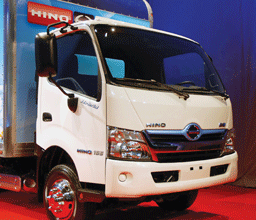
Hino's compact 155 and 195 series trucks, including a diesel-electric hybrid, will be at home on congested city streets.
The dynamics of the U.S. transportation market are changing, opening the door to smaller, more efficient trucks.
That was the message of Sumio Fukaya, president and CEO, Hino Motors Sales U.S.A., when the company launched its new line of Class 4-5 cabover trucks earlier this year.
"There are several factors behind that shift: first, vehicle acquisition cost, and second, urbanization," Fukaya pointed out. "With vehicle emissions regulations, we have seen new vehicle prices soar by as much as 20 to 25% over the past four years. As a result, companies are switching to smaller trucks to manage shorter urban or regional routes."
On top of that, he said, the U.S. population is expected to reach by 320 million by 2020, with 90% of the population living in urban areas.
"That will increase demand for product delivered into cities, which will drive demand for smaller, more maneuverable trucks."
If that is indeed the case, then Hino's new pair of COE trucks are spot on target.
While in Japan for a sneak preview of the new hybrid version of the 2012 Hino 155/195 COE, we took a few laps around the test track. Because hybrids work best in a stop-and-go environment, I spent as much time on the brake pedal as the accelerator. The truck grabs a charge from regenerative braking and uses the hybrid drive system to launch the truck at start-up, and at times when a little extra grunt is needed.
Hino's hybrid is a parallel system that uses regenerative braking to charge a bank of NiMH batteries, coupled with what Hino calls its hybrid adaptive control system to assist the diesel during drive cycles. Hino says combining diesel and electric power keeps the engine in its fuel economy sweet spot as much as possible. This can improve fuel efficiency by as much as 37%. More fuel savings can be had by switching between normal and "eco" driving modes, which electronically sensitizes the engine for efficiency rather than performance.
A gauge on the dash shows the charging/driving status of the system, as well as the battery state of charge, so when driving at normal road speed, the system is neutral. When the accelerator is depressed, the drive system engages to assist the diesel. Rather than apply a power "boost" to the engine, it lessens the load on the engine at a given power output, thereby reducing fuel consumption.
Lifting your foot off the accelerator engages the charging side of the system. The load created by the generator helps slow the vehicle, so you get a double bonus: charged batteries and reduced brake wear. It's noticeable, and will take a little getting used to. It doesn't "coast" the way a diesel-only powertrain would.
When the truck comes to a stop, the engine shuts off. That, too, will take a little getting used to. Drivers who creep at traffic lights or around corners on red lights won't see the benefits of the system. As the brake pedal is released and the throttle is applied at launch, the engine starts and away you go. It's completely smooth and seamless. Other than the fact the truck is silent when at rest, the driver won't notice any difference in operation.
Hino says the batteries will last eight to 10 years, and combined with the rest of the hybrid system, add less than 450 pounds to truck.
The four-cylinder, 5-liter, 210-horsepower, J05E-TP diesel is more than enough for a Class 4/5 truck, and it delivers 441 pounds-feet of torque. It's peppy and responsive at the high end of the rpm band, and there's enough torque in the lower end to prevent unnecessary upshifts. The 6-speed Aisin automatic transmission uses a torque converter, and it gets up into the higher gears pretty quickly. The hybrid version uses both a torque converter and a wet clutch, which engages and disengages automatically depending on the hybrid cycle.
There's a gauge on the dash that changes from blue to green, indicating the truck is in its peak efficiency range, but the hybrid was easy enough to feel without the visual indication. It provides a palpable surge of power when demand is there, and the regenerative braking contributes in a big way to the stopping effort.
As for basic drivability and comfort, the truck is great. It's quick and nimble, and turns on a dime. The visibility is second to none thanks to the large windshield and redesigned A-pillars. Hino says this model cab is larger than the previous version, but having never driven one, I can't say by how much. I can tell that my 6-foot, 210-pound frame fit quite nicely in the driver's seat, and everything I needed was in easy reach.
If Fukaya's predictions are accurate, North America's city centers, like Tokyo where the 155 and 195 models first cut their teeth, could see many more of these small COE trucks on the streets. They are well suited to tight urban environments, and the hybrid drive and 2010-EPA engines won't leave great clouds of black, sooty smoke in their wake.
It's a little truck for the big city.
From the September 2011 issue of HDT.
More Equipment

ZF Expands Commercial Vehicle Push in North America
ZF is expanding its North American commercial-vehicle presence with new transmission applications, electrification, trailer technology and autonomous-driving systems.
Read More →
Tesla Wants a Self-Driving Semi. Are Cameras Enough?
Could Tesla’s camera-only autonomous driving technology work on an 80,000-pound Semi? In this commentary, HDT's Deborah Lockridge takes a look at Tesla, Cybercab, and how autonomous trucks see the road.
Read More →
Kodiak: Driverless Long-Haul Truck Launch on Track for 2026
Kodiak AI says its driverless long-haul safety case is 93% complete and it remains on track to begin commercial operations by year-end 2026.
Read More →
What DOT’s Automated Vehicle Strategy Means for Trucking
The U.S. Department of Transportation issued a new automated-vehicle strategy that outlines plans for driverless-truck regulations, cross-state freight corridors, and federal safety standards.
Read More →
East Coast Port Launches $45M Electric Truck Push
The Port Authority of New York and New Jersey announced millions in incentives for zero-emission drayage trucks, yard tractors, and new charging hubs near the port.
Read More →
PlusAI Going Public to Fund Autonomous Truck Launch
A SPAC deal could provide PlusAI with up to $300 million as it works toward a 2027 commercial launch of factory-built autonomous trucks.
Read More →
NHTSA Moves to Rewrite Truck Fuel-Economy Rules
The National Highway Traffic Safety Administration says it lacks authority to regulate medium- and heavy-duty truck engines separately from complete vehicles, but the existing standards have not yet been eliminated.
Read More →
Detroit Opens Orders for EPA 2027 Engines
Detroit isn’t starting from scratch to meet EPA 2027 diesel emissions standards. Its Gen 6 DD13 and DD15 engines keep much of today’s platform while updating the fuel and aftertreatment systems.
Read More →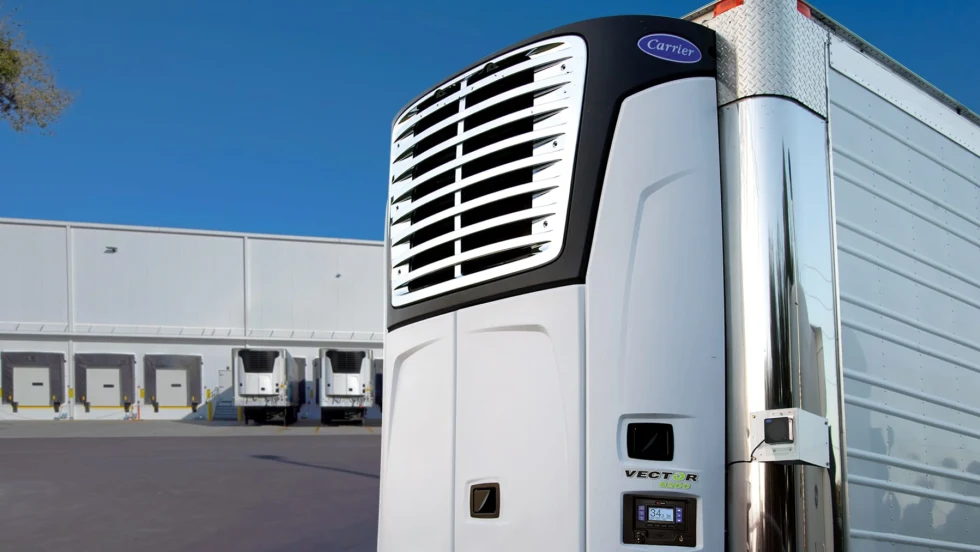
Carrier Transicold Adds All-Electric TRU for Stationary Cold Storage
Carrier Transicold’s new Vector 8200 all-electric transport refrigeration unit gives fleets a diesel-free option for temporary refrigerated and frozen trailer storage.
Read More →
A Closer Look at Kenworth’s Electric T880E Vocational Truck [Video]
Learn more about Kenworth's T880E battery-electric vocational truck at the Paccar Technical Center, including its range, applications, upfitting considerations, and PTO options, in this HDT Spotlight video.
Read More →