





Related: The Electric Truck Landscape
Quick Spin: Dana’s Electrified Truck Powertrain
Dana hosted a test drive of trucks outfitted with its latest technology at TMC’s annual meeting in Atlanta.
March 20, 2019
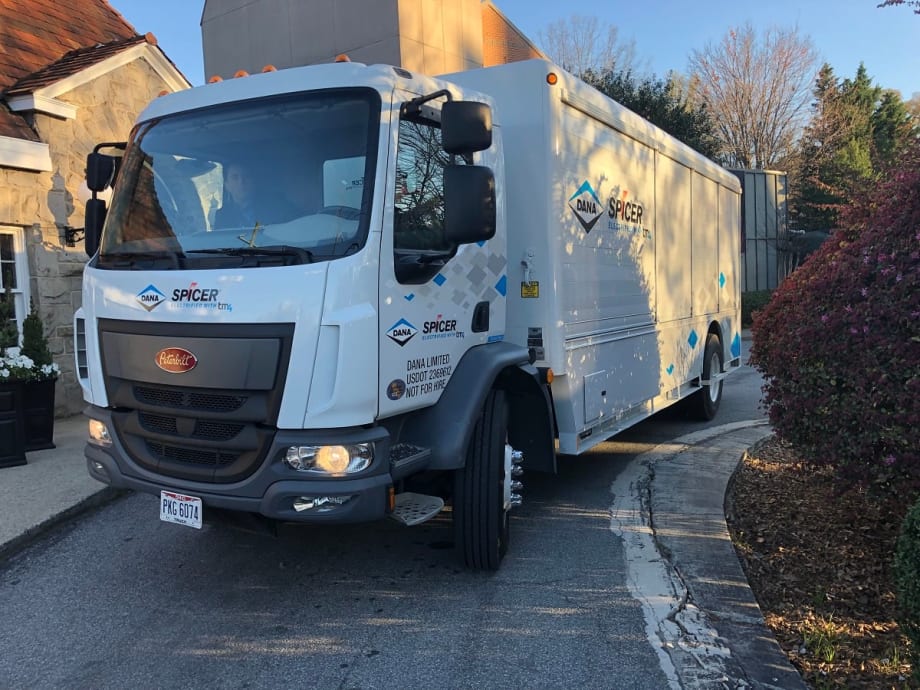
Dana has been carving out a position as a leader in electric truck technology, which it showcased at the TMC annual meeting, powering a Peterbilt Model 220 cabover urban delivery box truck.
Photos: Jack Roberts
5 min to read
Driving in Atlanta is never fun. But when Hyliion and its new partner-in-technology Dana offer you a test drive of their latest, most advanced electrified truck designs, you take that opportunity — even if it means spending time on some of the most crowded, narrow urban streets in the country.
Dana and Hyliion have been collaborating for a while now. And the two companies officially took that relationship to the next level just a couple of weeks ago. The annual meeting of the American Trucking Associations' Technology & Maintenance Council in Atlanta was the perfect opportunity to showcase what full-electric and mild-hybrid commercial vehicles could soon look like in North America, while featuring the Dana components that power them.
You’ve likely seen press coverage of Hyliion’s boldly colored green-and-white Freightliner Cascadia tractor, fitted with its proprietary mild-hybrid drivetrain. You can check out a video about my drive of that truck at TMC here.
But you may not know that Dana has also developed battery-electric drivetrains. An example of that technology was on hand in the shape of a Peterbilt Model 220 cabover urban delivery box truck, which we'll explore here.
This is a new, turnkey electric design featuring a Spicer S130 single-reduction medium duty drive axle, a Dana SPL 100 driveshaft and — at the heart of the system — a TM4 SUMO MD HV2600-6P high-torque, low-speed reluctance-assisted electric motor working in conjunction with Dana’s CO200 inverter.
In real-world terms, all of this new technology boils down to a medium-duty cabover beverage delivery truck with a daily range of 100 miles and a top speed of 67 mph (not that you’ll ever get close to that driving around downtown Atlanta). All told, when compared to a conventional diesel truck spec’d for this application, Dana says you’re looking at 67% reduction in “energy costs,” as well as a 40% reduction in greenhouse gas emissions.
Out on the road, the electric Peterbilt rides and handles much as a conventional version of this truck would. Of course, there’s no diesel engine roar or clatter to contend with. And the truck is extremely peppy taking off from a dead stop or accelerating compared to a diesel or gasoline truck.
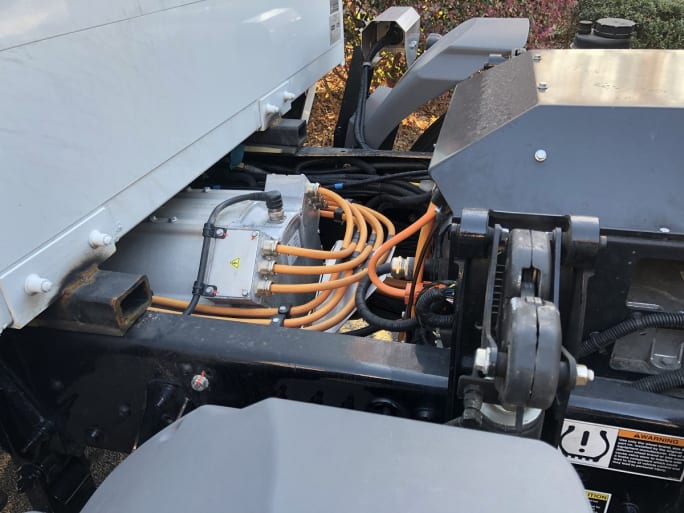
Tilting the Peterbilt Model 220’s cab up reveals the Dana electric drivetrain in place of a conventional diesel engine and automatic transmission.
Rethinking Range Anxiety
Most interesting to me on this drive was the regenerative braking system on the Peterbilt Model 220. The system is so aggressively tuned that I only needed to actuate the brake pedal in the last few seconds before rolling to a complete stop. At any other time, simply taking my foot off the throttle was enough to immediately begin decelerating the truck as the system captured the energy created by the truck’s forward momentum, converted it to electrical power and stored it in the truck’s onboard batteries. Even on downhill grades, the system generated enough stopping power that I actually needed to add throttle to maintain my desired speed.
Harry Trost, senior manager, product planning for Dana, who was riding shotgun with me, said that system was completely tunable so it can easily be adjusted to a fleet’s preference. You can easily dial back regenerative brake force so the truck coasts more efficiently. However, doing so cuts into the amount of kinetic energy the system captures.
And capture kinetic energy it does. The system is so efficient that it has changed my thinking on “range anxiety” somewhat. Range anxiety has long been touted as a major perceptive stumbling block for the acceptance of electric trucks. The basic premise is that drivers will be constantly worried about an electric truck’s limited single-charge driving range and won’t be willing to drive the vehicle because of the limit it puts on the flexibility in terms of drive time and distance.
But the Dana regenerative braking system is so efficient, I found that any energy I used going up a grade or on a level stretch of road was largely replaced by the energy captured by the brake system on the downhill portions of the drive.
In other words, it seems that vehicle range is not quite so carved in stone as people believe – the idea that a truck starts the day with, say, 140 miles of range, and that mileage number will do nothing but steadily decrease as the vehicle goes about its work during the day.
Actually, it seems “vehicle range” is more of a fluid concept — and one that will vary based on routes, roads, traffic and terrain.
In more hilly terrain — and Atlanta is certainly a good example of such an operating environment — it’s likely the truck’s available energy/range will ebb and flow throughout the course of a workday to a greater degree than a truck working on flat terrain. A good driver on a good day will be able to put more energy back into the battery as conditions on the route allow. A less talented driver may use more energy and not put as much kinetic energy back into the batteries as his colleague. However, even in hilly terrains, the same driver in the same truck on the same route will still perform very much the same way on a daily basis in terms of energy management and how much range/charge they have in the batteries when their shift ends.
For me, these capabilities and performance features lead me to believe that range anxiety will prove to be a non-issue as electric trucks come online in real world applications. If a truck is being used in an appropriate application on an appropriate route with appropriate range capability, range simply won’t be a concern for drivers.
In summary, assuming reasonable purchase price and ROI, it’s getting harder and harder for me to see why an urban delivery fleet wouldn’t take a hard look at electric trucks for set, predictable urban delivery operations. In terms of basic capabilities, there is no reason an electric truck cannot perform those duties as capably as a diesel- or gasoline-powered one.
Subscribe to Our Newsletter
More Fuel Smarts

How Volvo Updated Its D13 for EPA 2027 [Watch]
Volvo’s updated D13 promises lower emissions without sacrificing performance or fuel economy. Take a closer look at what changed inside the engine in this HDT Spotlight video.
Read More →
Diesel Price Spike Shortens Payback for Natural Gas Trucks, Report Says
Energy Vision estimates fleets could recover the higher purchase price of an RNG-fueled Class 8 tractor in 1.3 to 2.8 years under current fuel-price scenarios.
Read More →
Calstart Becomes Catalyst Mobility, Reflecting Broader Focus
Calstart is now Catalyst Mobility, reflecting the nonprofit’s growing national role in clean transportation, including zero-emission trucks, infrastructure and incentive programs.
Read More →

Record Diesel Prices Squeeze Trucking Fleets
Average U.S. diesel prices have climbed to nearly $6 a gallon, surpassing the 2022 record as tight refinery capacity and Middle East disruptions keep fuel costs elevated.
Read More →
Sponsored•September 9, 2026
How Fuel Delivery Shapes Engine Performance
Fuel delivery depends on more than what happens at the injector. For fleet, maintenance and technical professionals, looking at the full path from pump to injector can provide useful context for understanding engine performance.
Read More →
East Coast Port Launches $45M Electric Truck Push
The Port Authority of New York and New Jersey announced millions in incentives for zero-emission drayage trucks, yard tractors, and new charging hubs near the port.
Read More →
California Bill Could Shed Light on Electric Truck Prices
Why do battery-electric Class 8 trucks remain so expensive? A California bill headed to Gov. Gavin Newsom would give fleets and state agencies more visibility into what manufacturers charge.
Read More →
Detroit Opens Orders for EPA 2027 Engines
Detroit isn’t starting from scratch to meet EPA 2027 diesel emissions standards. Its Gen 6 DD13 and DD15 engines keep much of today’s platform while updating the fuel and aftertreatment systems.
Read More →
Zero-Emission Truck Corridor Planned for West Coast
California, Oregon, Washington, British Columbia and Baja California are coordinating plans for truck charging and hydrogen fueling from Canada to Mexico.
Read More →
A Closer Look at Kenworth’s Electric T880E Vocational Truck [Video]
Learn more about Kenworth's T880E battery-electric vocational truck at the Paccar Technical Center, including its range, applications, upfitting considerations, and PTO options, in this HDT Spotlight video.
Read More →