




Q&A: Wabco's Morrison on Active Steering Advances
In our January issue, HDT Equipment Editor Jim Park explored how advances in steering are soon going to make driving easier, and will be an important part of the move toward more automation in trucks. Here's a more extended interview on the topic with Jon Morrison, president of the Americas at Wabco.


Advances in steering are soon going to make driving easier, and will be an important part of the move toward more automation in trucks.
Photo via Wabco
In our January issue, HDT Equipment Editor Jim Park explored how advances in steering are soon going to make driving easier, and will be an important part of the move toward more automation in trucks. Here's a more extended interview on the topic with Jon Morrison, president of the Americas at Wabco.
HDT: Were a driver to decide to take control of the truck while in auto-steering mode, would he have to wrestle control from the truck, or would the system recognize some external force on the wheel and relinquish control easily?
Morrison: We have designed the system so that, when a driver takes control during an active steering event, the system recognizes driver input and the driver input immediately overrides the active steering system. This is a driver assist feature. The driver is in control at all times and can override the assist when desired.
HDT: Other systems I have driven offer drivers nearly effortless steering a low speed, while they get stiffer steering at highway speeds. Is this sort of technology nearly ready for market today?
Morrison: The Wabco systems offers this feature. We call it “speed-dependent steering effort." In addition to this we also offer a feature called "return to center, which provides drivers with reduced efforts and reduced fatigue when returning the wheels back to the center position. In addition to low speed advantages, there are many advantages that this system provides to make the driving experience better in high-speed situations. The Wabco Steering Gear with the MTO helps drivers by mitigating some of the effects of heavy cross-winds, road crowning and wheel imbalance.
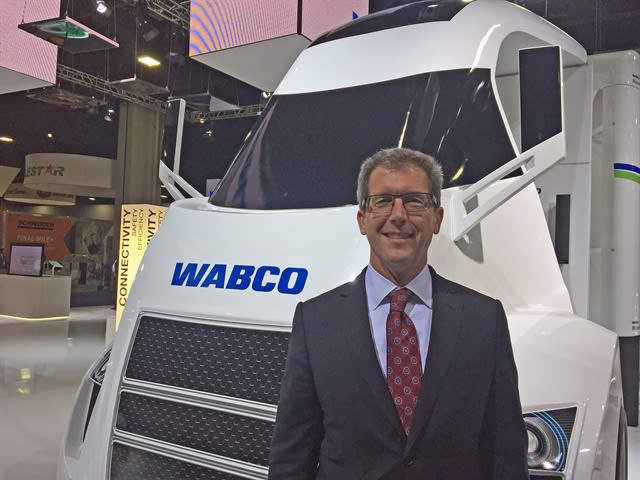
Jon Morrison, president of the Americas at Wabco.
Photo: Deborah Lockridge
HDT: What sort of redundancies might be required by regulators before trucks would be allowed to operate with autonomous steering?
Morrison: What makes Wabco’s MTO unique in the market is that it is not burdening the fleets and drivers with the costs associated with fully redundant systems. Wabco will have these systems available as they become required for fully autonomous trucks, but for now the Wabco Steering Gear with the Magnetic Torque Overlay system provides the right functionality for a better cost than our competitors.
HDT: How close are we to deploying self-steering mechanisms as part of an advanced driver assistance system (ADAS)?
Morrison: We already have units on the road and in fleets' hands as part of our testing procedures. Full-scale commercial launch will happen within 2019. When these systems launch, they will be able to provide active steering assist to lane departure and blind-spot systems.
HDT: On a more mundane front, can you tell me about any advances in basic power steering systems for heavy trucks?
Morrison: For hydraulic power steering, the technology continues to develop, with the main challenge being if you apply active steering to base hydraulic system, it will highlight any tolerance deficiencies in the system (gear/column). Where a driver may have accepted a certain amount of play in a system, an automated system will need much better precision to control. Wabco continues to evolve its HPS systems to maintain a focus on key customer attributes – performance, reliability, cost and weight – while evolving the technology to be compatible with electrical assist features.
More Safety & Compliance

FMCSA Pauses Biennial-Update Enforcement Amid Motus Transition
Carriers whose updates were due on or after June 1 have more time, while FMCSA works to stabilize its new registration system and warns of phishing sites impersonating its new carrier registration system, Motus.
Read More →
ZF Expands Commercial Vehicle Push in North America
ZF is expanding its North American commercial-vehicle presence with new transmission applications, electrification, trailer technology and autonomous-driving systems.
Read More →
Truck Drivers Need More Than Another Alert
Fleets have more visibility into truck health, safety events, and driver activity than ever. The next challenge is turning all that information into useful guidance for the person who has to decide what to do next.
Read More →
Tesla Wants a Self-Driving Semi. Are Cameras Enough?
Could Tesla’s camera-only autonomous driving technology work on an 80,000-pound Semi? In this commentary, HDT's Deborah Lockridge takes a look at Tesla, Cybercab, and how autonomous trucks see the road.
Read More →
What DOT’s Automated Vehicle Strategy Means for Trucking
The U.S. Department of Transportation issued a new automated-vehicle strategy that outlines plans for driverless-truck regulations, cross-state freight corridors, and federal safety standards.
Read More →
NYC Expands Speed, Pedestrian Safety Tech Across Fleet
New York City is expanding intelligent speed assistance and pedestrian-alert systems across its municipal fleet, moving the technologies from pilot programs into vehicle procurement and retrofit requirements.
Read More →
FMCSA Removes 110 Truck Driver Training Schools from Certified ELDT List
Federal regulators also are targeting more than 160 additional training providers and launching a nationwide audit of third-party CDL skills testers as part of a broader crackdown on trucking fraud.
Read More →
Beyond DOT Compliance: What Makes a Trucking Fleet Truly Safe?
A trucking fleet can follow every rule and still make unsafe decisions. The real test comes when safety conflicts with freight, productivity, or cost.
Read More →
Hours of Service Pilot Programs: FMCSA Readies for 2027 Rollout
Two pilot programs could eventually reshape hours-of-service rules, giving truck drivers options to pause their 14-hour clock or use longer split sleeper rest periods.
Read More →
New Guide Offers Pet Safety Tips for Truck Drivers
Hundreds of thousands of pets travel in truck cabs. A new safety guide from Volvo Trucks and the Center for Pet Safety offers practical advice for truck drivers who bring dogs and cats along for the ride.
Read More →