





What Did the Future of Self-Driving Trucks Look Like in 2014?
Q&A: Waabi’s Trucking Exec on Autonomous Technology
Dustin Koehl joined autonomous-truck startup Waabi after 16 years working at trucking fleets. He shares his thoughts on Waabi's self-driving truck vision and the future of autonomous trucks in this interview.
February 1, 2023
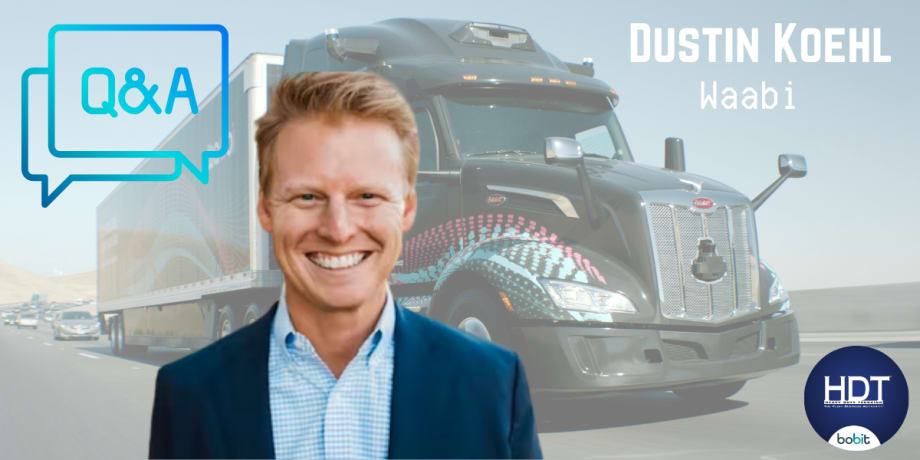
Dustin Koehl joined autonomous-truck startup Waabi last year.
HDT graphic from Waabi photos
7 min to read
Another autonomous-truck startup has entered the field, saying its “second-generation” approach will allow for faster commercialization — and one truck maker has already stepped up to invest and collaborate.
Waabi Innovations Inc. unveiled its Waabi Driver in November 2022. What sets it apart from other autonomous-tech companies, the company says, is the way it is using artificial intelligence to train the autonomous “driver” using an advanced driving simulator, Waabi World.
Volvo Group Venture Capital was impressed enough to announce an investment in Waabi in January. The announcement said the deal highlights the companies’ “shared commitment to redefine the way we move goods and to accelerate the deployment of future transport solutions.”
Another thing that was different was the 2022 hiring of an executive with real-world trucking experience, Dustin Koehl, as head of transportation. Shortly before the Volvo announcement, HDT Editor in Chief Deborah Lockridge talked to Koehl for the HDT Talks Trucking video/audio podcast.
The interview below has been edited for clarity and length. Catch the full interview on the HDT Talks Trucking podcast on Truckinginfo.com or your favorite podcast platform.
HDT: Waabi is coming onto the scene at a time where we're seeing articles in major national media outlets about how self-driving vehicles seem to be having a tougher and longer path to come to fruition than some developers and investors had expected. What are your thoughts on that?
Koehl: In my previous life, during my 16 years [at trucking fleets], I spent four of that actually building out the autonomous truck development program at U.S. Xpress. So I got to work with many of the developers and see the technology. And as you're saying, we've hit a wall to some degree in the industry. And I think that's why it’s really important to reference the artificial intelligence that's really needed in this autonomy stack — the software stack that aligns with the sensors — and then built in to the computers needed to launch.
And so what that means tangibly is [for previous autonomous-truck development efforts], you've needed billions of miles for on-road testing. And that costs billions and billions of dollars. That's just not scalable. And it's certainly not cost-efficient.
So that is one of our core key advantages at Waabi is this really dynamic simulation, an AI-first simulation that allows us to really re-create the common use cases, and also the really hard safety edge cases — like the ladder falling out of a truck, or this time of year, the deer that jumps in front of the truck. Imagine really two computers going against each other playing chess. And so you're building these situations through AI that you're not having to really capture in on-road testing, because you can do that in simulation.
HDT: So where is the company in the development process?
Koehl: So Waabi has been around for about a year and a half. And because of the technology that we're talking about, with artificial intelligence and simulation, it's allowing us to really grow much quicker than others that maybe have taken five and 10 years plus to create their fourth, fifth, generation tractors. So we have already created our first truck and you probably saw the product launch of the Waabi Driver that happened in November [2022.] It was because of this AI and simulation that allowed us to come out with this product much quicker, because when you think of this simulation, and what those learnings present, and how it's teaching the truck how to drive, it allows us to understand where our hardware and sensor placement needs to go. And if you really look at the Waabi Driver and the product that was launched, you'll notice some of the sensor placements. But you'll also notice that our truck looks a little bit more sleek and different than some of the competitors in this space today.
HDT: Most of the other companies out there seem to be focusing on [autonomous trucks] for interstate travel, they might go hub to hub. Where do you envision this being used?
Koehl: Waabi is focused on the hub-to-hub model… as a trucking guy at heart, I call that terminal to terminal. Hub to hub, as you think about workforce enablement, is a really great aspect. I think as we venture into autonomous trucking, I think that it’s going to really create these new business models, for local [pickup and delivery] for drivers to be at home more consistently in their communities. And it's going to be a lot of fun to see how the virtual driver and the human driver end up interacting together over the next couple of decades.
HDT: We started seeing a lot of hype about autonomous trucks a few years ago in the mainstream press, and predictions that it was going to put all these drivers out of work. Where do you see that, with your trucking background?
Koehl: I love this question because I spent 16 years in this space. And I think it's no secret, Bob Costello at the ATA loves to talk about the driver shortage, and that number continues to grow each year, and it's debatable where the number really falls. But what we know is that large fleets are spending tens of millions of dollars in driver recruiting and onboarding. Even small to medium size fleets, you're seeing turnover that bumps up at 100%; the larger fleets have 150%. And that tells us, and I know myself through experience, that this is a really challenging job.
One of my favorite things in the industry to do over my past 15 or 16 years is actually going on ride-alongs. The most recent ride along that I did was in April went three nights, four days for about 80-82 hours on the truck. And it doesn't take long to see that many over-the-road drivers are spending 22 out of 24 hours a day in the truck, a 70-hour clock that can be 80 to 100 hours.
I don't say that to throw shade at the industry; I just want us to call that out. Because I think that we can do better. As we talk about freight optimization and autonomous technologies, and you're going to see at Waabi that we're going to get really close to our great drivers in this country, because they sacrifice a lot. They sacrifice their time and away from their families or communities or hobbies, whatever it may be to make sure that we get our goods. And so I think that if anything, autonomous technologies can help drive the conversation with this ecosystem about freight optimization. And I think it's going to be so great to see how this world comes together over the next couple of decades.
HDT: What are we looking at as far as timing? What needs to happen before autonomous trucks become an everyday reality in logistics?
Koehl: I think if we look in the next, really, two to three year horizon, you're going to see this space evolve quickly. And where I'm encouraged, too, is not just the technology for commercialization, but the regulatory environment. While we necessarily don't have this federal framework, I can share with you that I was actually a part of a DOT expert working group this past year through the Volpe Center, preparing its recommendation for Congress.
But then also, you're starting to see the state by state frameworks, like Mississippi, starting to formalize their legislation and to connect these corridors across the country. And so all the pieces are starting to line up when you look at these major metros and where the weather and regulatory systems and all the very distinct things in each state that bring its own challenges and opportunities — they're starting to evolve and come together.
From my perspective, as a trucker, I think one of the really important things to do is to give fleets and drivers a larger seat at the table. How do we really engage the fleets — not just their executives, but then engage drivers and understand what I would call tribal knowledge and experience in the millions and millions of miles that they have driven and experiencing life on the road, and the safety experiences that they have had. And almost in terms of social acceptance as well…. How do you combine traditional trucking and these technologies? You've got to have everybody at the table to talk about it and deploy it.
Subscribe to Our Newsletter
More Equipment

How Volvo Updated Its D13 for EPA 2027 [Watch]
Volvo’s updated D13 promises lower emissions without sacrificing performance or fuel economy. Take a closer look at what changed inside the engine in this HDT Spotlight video.
Read More →
Michelin Tire Improves Efficiency and Durability for Regional Fleets
The Michelin X Multi Energy D2 is a regional haul drive tire engineered to help fleets improve fuel efficiency, durability and traction in demanding stop-and-go operations.
Read More →
ZF Expands Commercial Vehicle Push in North America
ZF is expanding its North American commercial-vehicle presence with new transmission applications, electrification, trailer technology and autonomous-driving systems.
Read More →
Tesla Wants a Self-Driving Semi. Are Cameras Enough?
Could Tesla’s camera-only autonomous driving technology work on an 80,000-pound Semi? In this commentary, HDT's Deborah Lockridge takes a look at Tesla, Cybercab, and how autonomous trucks see the road.
Read More →
Kodiak: Driverless Long-Haul Truck Launch on Track for 2026
Kodiak AI says its driverless long-haul safety case is 93% complete and it remains on track to begin commercial operations by year-end 2026.
Read More →
What DOT’s Automated Vehicle Strategy Means for Trucking
The U.S. Department of Transportation issued a new automated-vehicle strategy that outlines plans for driverless-truck regulations, cross-state freight corridors, and federal safety standards.
Read More →
East Coast Port Launches $45M Electric Truck Push
The Port Authority of New York and New Jersey announced millions in incentives for zero-emission drayage trucks, yard tractors, and new charging hubs near the port.
Read More →
PlusAI Going Public to Fund Autonomous Truck Launch
A SPAC deal could provide PlusAI with up to $300 million as it works toward a 2027 commercial launch of factory-built autonomous trucks.
Read More →
NHTSA Moves to Rewrite Truck Fuel-Economy Rules
The National Highway Traffic Safety Administration says it lacks authority to regulate medium- and heavy-duty truck engines separately from complete vehicles, but the existing standards have not yet been eliminated.
Read More →
Detroit Opens Orders for EPA 2027 Engines
Detroit isn’t starting from scratch to meet EPA 2027 diesel emissions standards. Its Gen 6 DD13 and DD15 engines keep much of today’s platform while updating the fuel and aftertreatment systems.
Read More →