





Dig Deeper— Loadsmith: Rethinking Logistics for the Autonomous Era
Q&A: The State of Autonomous Vehicle Development
Where is the autonomous/self-driving truck industry today? How much longer will we have to wait for Level 4 to mature? What's the holdup? HDT took these questions to autonomous-technology experts from Daimler Trucks and Torc Robotics.
September 18, 2023
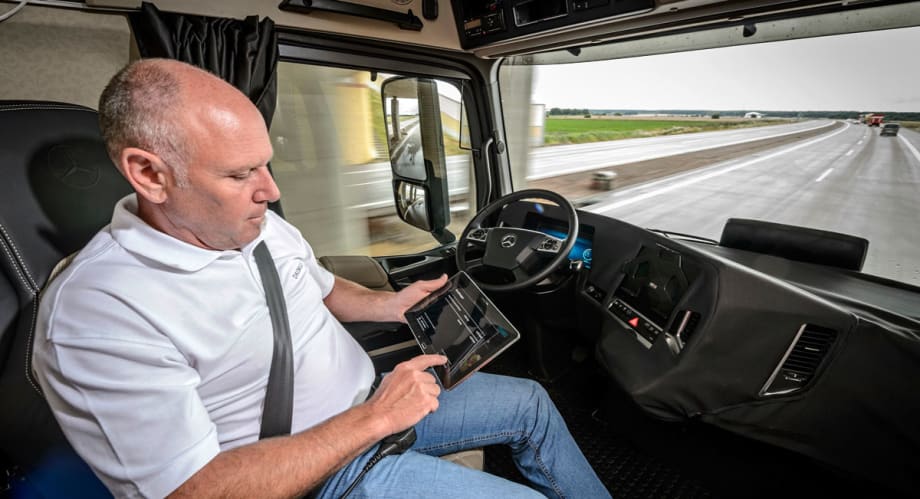
An early demonstration of automous truck technology showed a drver using a tablet as the truck drove itself.
Photo: Daimler Truck (HDT 2014 file photo)
7 min to read
Trucks with varying levels of autonomous or self-driving technology have been with us for more than a decade, yet no company has yet placed a full Level-4-autonomous truck into regular revenue service without a human driver aboard.
In the early days, few predicted it would take this long for self-driving technology to hit the road. Daimler Trucks in 2014 showed of its vision of the future with its Future Truck 2025. Where is the autonomous/self-driving truck industry today? How much longer will we have to wait for Level 4 to mature? What's the holdup?
To answer these questions and more, HDT invited Joanna Buttler, head of Daimler Trucks’ Global Autonomous Technology Group, and Peter Vaughan Schmidt, CEO of Torc Robotics, to discuss the current state of heavy duty self-driving trucks on HDT Talks Trucking
Read highlights of the interview with HDT Equipment Editor Jim Park here (edited for clarity and length) or watch the full interview above.
HDT: You have said that autonomous trucks can reduce accidents, and that you hope one day to get to zero crashes and zero fatalities. I don't know how realistic that is, but what kinds of crashes do you hope or expect autonomous trucks will be able to reduce or eliminate?
Schmidt: Crashes related to speeding, distraction and fatigue can be avoided just through technology, because computers never get aggressive or tired or distracted.
The second category where the system, in principle, can do better than humans is reaction time. For example, the trucks drive incredibly well in strong sidewinds, even with gusts, because the system can react within milliseconds.
In situations like really inclement weather, snowstorms, etc., the computer might do worse than a human. To be honest, that’s why we’re not deploying the technology in places like Montreal or Chicago.
HDT: If you looked at a statistic like the number of crashes per 100,000 miles, and you compare human performance to the computer, I have to believe the crash rate for humans would be considerably higher. If that’s the case, why aren't we ready to go 100% on Level Five? If you've already established that autonomous drivers are safer than human drivers, why are we still waiting to take the driver out of the truck?
Schmidt: There’s still a lot of polishing that needs to take place. It’s not so much the standard driving scenarios, but all the edge cases where humans are super great. We have to make sure all the edge cases are solved to a human-like level, because as good as an exemplary human driver must be the minimum threshold. And it's a really high bar.
On the other hand, there is still a lot of basic development to be done to make a supercomputer network and an automotive water-cooled computer last a million miles.
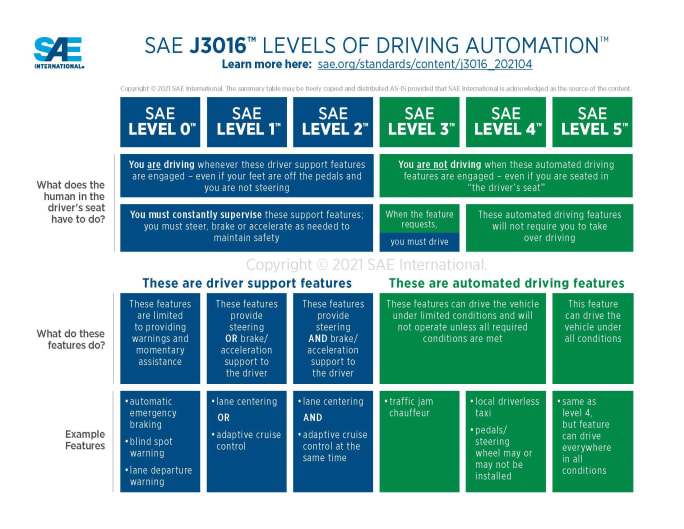
The Society of Autonotive Engineers developed definiitions for different levels of autonomous technology.
Source: SAE
HDT: Can you offer a 40,000-foot view of how autonomous driving technology has evolved from its earliest forms to where it is today?
Schmidt: The earliest forms go back to the famous DARPA (Defense Advanced Research Projects Agency) Urban Challenges of 2007.
Torc Robotics, now a 17-year-old company, came in third that year. Back then the technology consisted of some super expensive handmade sensors and a purely robotic approach. We were mainly driving off a map. We had some laser scanners as well to determine where we were and what people around the vehicle were doing.
Since then, Torc has worked in the mining and defense industries, developing and improving the technology. Today’s sensors are on a completely different level of performance, speed, density, and range. And the computing power that you get today at an affordable cost is also in a completely different range.
The AI machine learning back then was more or less classical algorithms, defining and learning uploaded shapes and objects. Now, we can identify an object even if we can only see 10% or 20% of it. The technology just leap-frogged, and I think we are now at a completely different stage. It has taken autonomous driving to a completely new level.
HDT: Let's talk about the fleets and your ultimate consumers and customers here. There are basically two different fleet business models for autonomous trucks. There’s the truck as a service model. And then there's the fleet that would actually own autonomous vehicles, their own fleet of driverless trucks. How does a fleet decide which way to go, or how to embrace this technology, whether to buy their own or contract another company as a service?
Buttler: I want to share [Daimler’s] core belief and also how we want to launch this technology.
It’s not our intention get into the business of our customers, so to speak, We have a clear agreement with Torc and also our other partner, [Waymo] that ultimately our vision is that the fleets who are today operating trucks, who are today providing logistics services, will also do that in the future. We want to provide a better means for them to do their job even more efficiently and safely. And that is, in this case, with an autonomous driving vehicle and the driver as a service.
Schmidt: First of all, logistics is much more than just driving. A lot of things need to happen to move goods safely from A to B, reliably, and at scale. And the fleets are just fantastic at that. Our goal is to enable them to do their business better, to deliver goods faster, safer, maybe cheaper. That should benefit the fleet and the end users. This is what we want to achieve, instead of competing with fleets and rebuilding what they’re already doing perfectly.
HDT: Is it a big step, do you think, for a fleet to take on an autonomous truck? How easy or difficult will it be to integrate this technology to fleet operations?
Schmidt: I think it will be a challenge, to be honest. That's why we are getting our customers involved early in the development process.
We have an advisory council consisting of key industry players from different segments of the industry, from parcel delivery to over-the-road fleets, to help us develop a product that is helpful for them.
As for the different aspects, it starts with simple operation and maintenance. You know, there's already a shortage of drivers, and also a shortage of technicians. That will have implications for both operations and maintenance in the future.
Then there’s the question of how to operate a mixed fleet. Let's be honest, it won't be all autonomous. So how do you operate a mixed fleet of manual-driven trucks and autonomous-driven trucks? It’s crucial that our trucks can seamlessly integrate into today’s mission controls. We are working hard to seamlessly integrate into customer processes and systems to make the switch and to use this technology and to make the first step an easy one.
HDT: The development cycle for autonomous trucks has gone on for longer than many people thought it would. We have seen a number of companies enter and exit the market already. Where do you think we're going to be in five years? Will we still dozens of autonomous vehicle companies out there, or just a few?
Buttler: We're all watching and observing what's happening in the market right now. We always believed that we would see some sort of consolidation in the market, and I think it’s starting to happen right now.
If we think five or 10 years ahead, we could see like three to four players surviving this game.
I think to be a player in the future, companies will need to have a couple of things in place.
One is a solid OEM partnership. I say that, very selfishly, being one of the providers, but we hear and see that in general, that this is definitely one of the success factors.
And the other success factor is to just stay focused from the autonomy side and be very, very good at the use case you decide to pursue.
HDT: A survey by the American Automobile Association say 68% pf those surveyed are afraid of driverless vehicles. And we know people are already afraid of trucks. How do you think motorists feel about autonomous trucks?
Buttler: It’s really important to build trust in the technology, by not just talking about how the industry is developing safety, but demonstrating it. The public will always see a driver behind the wheel and a safety engineer on the passenger seat when we test on public roads. This is to ensure that while we develop the technology, we have good oversight of the system. We will not take the driver out until we’re certain that the systems and the software can handle any driving situation safely without any human intervention.
Schmidt: Motorists will find our truck is really polite. It will never speed, it won’t cut you off, and it never gets aggressive. It has a really nice driving style, the kind you would like to see from all road users.
Subscribe to Our Newsletter
More Equipment

How Volvo Updated Its D13 for EPA 2027 [Watch]
Volvo’s updated D13 promises lower emissions without sacrificing performance or fuel economy. Take a closer look at what changed inside the engine in this HDT Spotlight video.
Read More →
Michelin Tire Improves Efficiency and Durability for Regional Fleets
The Michelin X Multi Energy D2 is a regional haul drive tire engineered to help fleets improve fuel efficiency, durability and traction in demanding stop-and-go operations.
Read More →
ZF Expands Commercial Vehicle Push in North America
ZF is expanding its North American commercial-vehicle presence with new transmission applications, electrification, trailer technology and autonomous-driving systems.
Read More →
Tesla Wants a Self-Driving Semi. Are Cameras Enough?
Could Tesla’s camera-only autonomous driving technology work on an 80,000-pound Semi? In this commentary, HDT's Deborah Lockridge takes a look at Tesla, Cybercab, and how autonomous trucks see the road.
Read More →
Kodiak: Driverless Long-Haul Truck Launch on Track for 2026
Kodiak AI says its driverless long-haul safety case is 93% complete and it remains on track to begin commercial operations by year-end 2026.
Read More →
What DOT’s Automated Vehicle Strategy Means for Trucking
The U.S. Department of Transportation issued a new automated-vehicle strategy that outlines plans for driverless-truck regulations, cross-state freight corridors, and federal safety standards.
Read More →
East Coast Port Launches $45M Electric Truck Push
The Port Authority of New York and New Jersey announced millions in incentives for zero-emission drayage trucks, yard tractors, and new charging hubs near the port.
Read More →
PlusAI Going Public to Fund Autonomous Truck Launch
A SPAC deal could provide PlusAI with up to $300 million as it works toward a 2027 commercial launch of factory-built autonomous trucks.
Read More →
NHTSA Moves to Rewrite Truck Fuel-Economy Rules
The National Highway Traffic Safety Administration says it lacks authority to regulate medium- and heavy-duty truck engines separately from complete vehicles, but the existing standards have not yet been eliminated.
Read More →
Detroit Opens Orders for EPA 2027 Engines
Detroit isn’t starting from scratch to meet EPA 2027 diesel emissions standards. Its Gen 6 DD13 and DD15 engines keep much of today’s platform while updating the fuel and aftertreatment systems.
Read More →