




Q&A: KeepTruckin Co-Founder Talks ELDs, Data and More
KeepTruckin is fast-growing company that specializes in providing electronic logging and fleet management solutions for owner-operators and small carriers. It recently announced a new round of capital to fund its expansion. We spoke to KeepTruckin Co-founder and CEO Shoaib Makani about where they came from and where they're going.

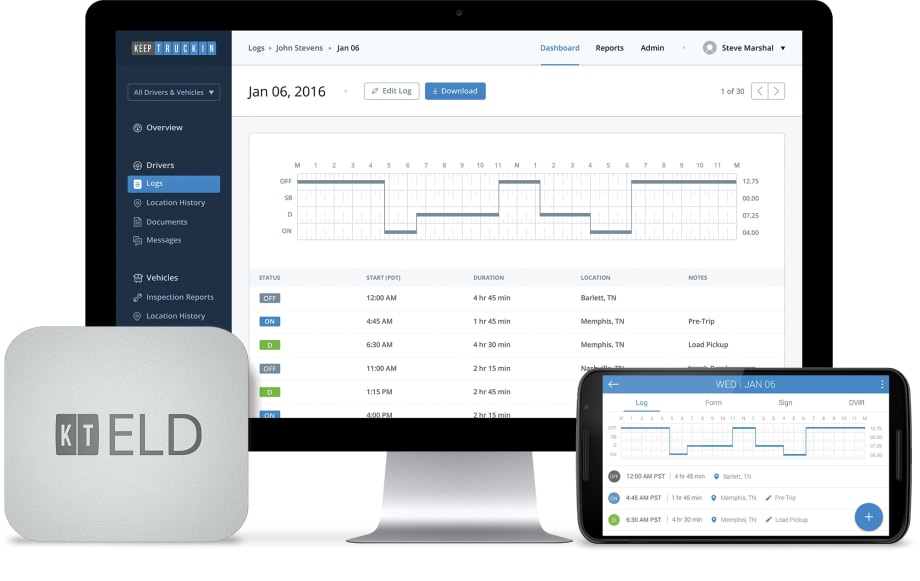
KeepTruckin is expanding from a free e-log app provider to a provider of telematics and safety management for fleets. Photo: KeepTruckin
KeepTruckin is fast-growing company that specializes in providing electronic logging and fleet management solutions for owner-operators and small carriers. It recently announced a new round of capital to fund its expansion, and the San Francisco Chronicle recently singled out the company as a Bay area startup to watch, noting it will expand staff in its San Francisco headquarters from about 120 people to more than 300 by year’s end.
We spoke to KeepTruckin Co-founder and CEO Shoaib Makani. The interview was lightly edited for length and clarity.
HDT: First of all, give our readers your quick elevator speech about what KeepTruckin is.
Makani: Really, what KeepTruckin is building is a modern electronic log to fleet management program for the trucking industry. We started with a core problem for drivers. We recognized that paper logs are inefficient and there could be a better way, so we created a free app for drivers to do logs on their phone. Once that was adopted by hundreds of thousands of drivers, we developed the ELD [to meet the recent mandate] and broader fleet management program based on mobile and smartphones. We now have a really comprehensive fleet management platform for trucking companies that spans compliance, telematics, and soon video monitoring.
HDT: What about the background of yourself and some of the team there?
Makani: I was at Google previously and focused on product management for e-commerce efforts. Co-founder Ryan Johns was VP of engineering at Tapjoy, a leading mobile advertising network. We believe by connecting drivers we can build a more efficient marketplace. We had seen the gains that come with connectivity in our previous jobs, and we believed that applied to trucking, it could result in greater efficiency and improve safety. So we set out to build modern tech products for drivers and fleet managers.
HDT: You didn’t come from a trucking background; what inspired you?
Makani: It really stemmed from interaction with drivers and fleet managers. We went to truck stops early on just to better understand the life of a driver on the road. We weren’t like, ‘We need to start a company;’ we wanted to see how other people live and appreciate the problems people faced outside of our Silicon Valley community. We wanted to solve a broader problem. Through that process we sort of uncovered some of the challenges they faced, and we believed we could help solve them. We felt we could solve a very specific problem around paper=based workflows. and that’s what compelled us to get into the business.
HDT: How did you come up with the name KeepTruckin?
Makani: Ha, yeah. It was the product of a late night brainstorming session. It’s partially inspired by the Grateful Dead song ‘Truckin’”. We wanted to be positive, something drivers can identify with – we are about the driver first. We think by creating great products for drivers, themselves an underserved audience, we can build a great business and improve connectivity.

Shoaib Makani, cofounder and CEO, KeepTruckin
HDT: Who are your main customers? I understand you’re also going after some larger fleets.
Makani: For the first really three years, the company was a free application for the driver replacing paper logs, a better paper log on your phone. Once the ELD mandate proposal was released, it was pretty clear we needed to build a telematics hardware device and sell to the fleet. The drivers were not the buyer; this was a fleet-wide decision. We set out to built a modern telematics platform, hired up a hardware engineering team, and invested not just in software but in hardware as well. Then we complemented that with tools for fleet managers to be able to better manage those drivers, and better manage the safety and efficiency of that operation. It’s really the mandate that broadened our focus and brought us into the fleets.
HDT: If you were offering a free app, how did you make any money?
Makani: We didn’t. We didn’t generate any revenue for the first three years. That was challenging, of course. There were just eight of us. But we did raise venture capital. Someone gives you money for a stake in your company, and that capital allows you to invest in product development and building up your operational capacity. So we raised a seed round from Google Ventures of about $2.2 million to build out the first stage of the company.
HDT: You must have had a plan to eventually generate revenue…
Makani: Yeah, we did… it was a pretty loose plan. We knew when we started the company, MAP-21 had essentially mandated that FMCSA create an electronic logging regulation. So we knew this was coming. We took the long view. We knew it might take a few years for this law to turn into regulations, but if we deliver value to drivers, we will create value for ourselves and be able to eventually generate revenue. So we stayed lean, we stayed really focused on drivers, and that paid off.
HDT: Tell me about your growth this past year – I understand it’s impressive.
Makani: It’s been tremendous. Going back, it really starts with that free electronic logbook app, which was adopted by hundreds of thousands of drivers over the last four and a half years. We earned the trust of drivers. We solved a problem in their life. And when the mandate kicked in, it became clear that if you want to operate a commercial motor vehicle interstate, you need an ELD. We became the preferred vendor for drivers that were using our free application. The trucking companies evaluated their options and recognized that we have … a high-quality product. We went from a few thousand ELDs this time last year to north of 200,000 this year. And that growth will continue well into next year as intrastate mandates kick in, as the Canadian mandate kicks in, and as trucking companies who had adopted substandard products switch to Keeptruckin. We believe we will have 400,000 deployed by the end of this year.
HDT: As we passed the April 1 ELD hard enforcement deadline, what were you hearing from your ELD users?
Makani: With the enforcement deadline kicking in we were seeing a sharp increase in demand, new customers coming to us and saying, ‘We need an ELD.’ We anticipated that, but we also have lots of folks who already purchased and are now activating. There is a real requirement and need to be able to educate those drivers and help them through that process.
Technology change is difficult. This is a new tool, we’re going from paper to electronic, and a lot of drivers need help. We have aggressively staffed up on the support side. We now have over 200 support reps that are available to answer driver questions over phone, email and chat. No matter how easy you make a product to use, you still have to support it and you still have to be there for drivers. You can’t let the driver down at the roadside. We’ve heard from drivers, ‘We need help in this transition.’ That’s where we put a lot of emphasis on creating content to help them understand how to use the product, we proactively give them the tools to train themselves and follow up with quality support.
HDT: Where do we go next with ELDs? How can that data be used to help truckers and the industry?
Makani: I think first and foremost the ELD data will make it really obvious in a data-driven way where changes to hours of service rules need to happen. And we’re already seeing this with our petition, which advocated for an extended detention exemption. The Owner-Operator Independent Drivers Association proposed a change that allows an extension of 14-hour clock to 16 hours, and Sen. Babin has also recently sponsored legislation that would change the rules.
Our view is the data being generated, both in terms of the safety of the current rule set, but also how significant is detention time and how much rest do drivers get during that time, will allow for a really informed conversation on how the rules need to be updated. And Keeptruckin will make our data available for regulators and legislators so that conversion can be really informed. That’s number one, an advocacy effort around HOS rules.
Two, the ELD mandate has essentially forced connectivity on this business. While some drivers are resistant to connectivity, in the end it will allow them to make more money. That is our fundamental belief. It is incredible what happens when a business goes from being offline to online. You operate more efficiently, you have data to make better decisions, and you can build a more efficient freight marketplace on the back of connectivity. We’re working with the leading 3PLs to help our drivers make more money.
HDT: How does that work?
Makani: We have an effort to essentially allow our customers to share their data with any third party directly through Keeptruckin. So instead of an intermediary or an aggregator, we’re allowing our carriers to say, ‘I want to share my data with Coyote [to get better loads]’, or ‘I want to share it with Progressive Insurance because I can get reduced insurance rates.’ … That data allows you to make more money and save more money and operate more efficiently if that data is made available to the right partners. But central to that is allowing our customers to own that data and decide who they want to share that with, and we're providing the tools that allow them to do so.
HDT: Now tell me about your latest round of funding.
Makani: We actually didn’t need to raise additional capital; we are profitable. But we wanted to be able to invest in technology and product development so we can keep on solving problems for our customers. And so we raised $50 million from a leading venture capital firm, IVP. Their whole focus is on helping companies that are growing rapidly scale even faster. So we took this capital and we are going to deploy it to build more product, to expand our hardware and software engineering teams so we can extend beyond compliance, our core focus today, into a broader fleet management platform. We need to build tools, we need to build features that help our customers operate more safely and efficiently.
HDT: You mentioned cameras earlier?
Makani: We really think about it as three legs – compliance, telematics, and video monitoring. On the telematics front we have basic driver performance monitoring, vehicle diagnostics, some fuel economy tracking, but we want to [work] aggressively in building out those features so the data is actionable. So it lets our customers make proactive decisions about how they can improve their operation and how they can take action to reduce waste and improve safety.
On video monitoring, this is a product we’re bringing to market soon, and the core focus is safety. It helps fleets defend themselves in the case of accidents and coach drivers to operate more safely and efficiently. We have designed our hardware platform to be fully modular and one that can be extended to deploy additional functionalities. It will be really easy for a fleet using our ELDs to add on. We want to bring the technology, video has been around, telematics has been around for some time, we learned to make it easer to use, easier to employ, and reduce the total cost of ownership.
HDT: You mentioned efficiency... Are you looking to get into the load-matching space?
Makani: No, we are not going to build any kind of load matching service. What we will do is allow our customers to share their data with existing load boards and directly with broker and shippers. We’re an open data platform. We partner with coyote, TQL, Truckstop.com and DAT. We’re focused on enabling our customers to take that data which they own and selectively make it available to their partners, to the folks that they leverage, for loads, so they can more efficiently access those loads.
HDT: What are your goals?
Makani: Our key goal for this year is to go from 200,000 trucks in our network to 400,000. We think that is achievable. And along with that is a move up market. Our bread and butter has been small fleets of less than 50 vehicles to date. And that is the majority of our network currently. But as we add more functionality we will go after larger fleets who are looking for a modern fleet management solution that spans compliance, telematics, and video.
More Fleet Management

Geotab Links Fleet Card to Vehicle Data
The new card combines fuel discounts with telematics-based purchase controls. Geotab’s analysis also points to potential savings from choosing lower-priced fuel stops.
Read More →
How MFA Helps Protect Trucking Fleets
Multi-factor authentication adds protection when passwords are stolen. Here’s how it works and where fleets should start.
Read More →
How Better Freight Data Helps Trucking Teams Get Ahead of Disruption
Trucking and logistics teams have plenty of data. The problem is getting the right information in front of the right people soon enough to act. Better-connected data can help teams spot trouble earlier and make smarter decisions before small problems become big ones.
Read More →
Trimble: Taking Artificial Intelligence in Trucking Beyond Faster Tasks
At Insight 2026, Trimble executives argued that fleets may need to redesign workflows to get more from AI as it introduced new products and enhancements. AI’s value will depend on how fleets combine automation with their people's knowledge.
Read More →
Build a bulletproof fleet: Uniting ELDs and dash cams for total compliance
An ELD can prove compliance, but it cannot always prove what happened on the road. Discover how uniting accurate ELD data with AI-powered dash cam video can help your fleet strengthen compliance, defend against liability, protect drivers and reduce operational costs.
Read More →
Nominations Open for HDT Emerging Leaders
Heavy Duty Trucking is looking for accomplished trucking fleet professionals under 40 who are making an impact and helping lead the industry forward.
Read More →
Why Private Fleets Are Taking More Freight
Private fleets are putting their own trucks on demanding customers and high-cost lanes as companies seek greater control over service, costs, and capacity.
Read More →
Color Match Smarter: Tools That Restore & Perform
For fleet managers and collision repair professionals keeping heavy-duty trucks on the road, getting the color right the first time isn't just about appearance — it's about efficiency, turnaround time, and bottom-line results. Discover how today's digital color tools are transforming the repair process from guesswork to precision.
Read More →
FMCSA Pauses Biennial-Update Enforcement Amid Motus Transition
Carriers whose updates were due on or after June 1 have more time, while FMCSA works to stabilize its new registration system and warns of phishing sites impersonating its new carrier registration system, Motus.
Read More →
2026 Blueprint for Countering Smarter Supply Chain Theft
Cargo theft is no longer just the cost of doing business. It's a multi-billion-dollar criminal enterprise exploiting vulnerabilities across your fleet, drivers, and supply chain.
Read More →