




Peckham Materials Runs Extra Heavy, Every Day
While debates over the productivity and safety of longer and heavier trucks wax and wane on Capitol Hill, some fleets have been quietly, legally and safely running such operations in various states under grandfathering rights granted years ago.


The Kenworth T800 waits quietly as hot liquid asphalt is pumped from the Etnyre tanker, and driver Jack Mirando climbs the ladder to peer into the manhole to check on offloading progress. Gross combination weight on this run was 102,000 pounds.
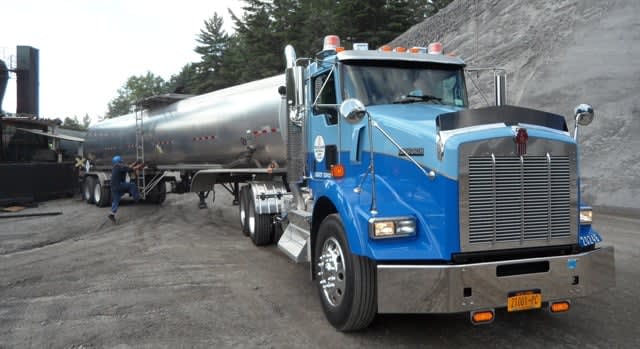
The Kenworth T800 waits quietly as hot liquid asphalt is pumped from the Etnyre tanker, and driver Jack Mirando climbs the ladder to peer into the manhole to check on offloading progress. Gross combination weight on this run was 102,000 pounds.
While debates over the productivity and safety of longer and heavier trucks wax and wane on Capitol Hill, some fleets have been quietly, legally and safely running such operations in various states under grandfathering rights granted years ago.
Peckham, a family-owned firm in its third generation, has about 35 operations up and down the valley and a fleet of trucks, tractors and trailers to keep them running.
“We're not a trucking company,” said the fleet's supervisor, Larry Fingar, who works out of the main terminal near Athens. “We run trucks to support our companies.”
For example, Peckham has contracts to spread calcium chloride for dust control on dirt roads and building sites, and supplies asphalt for paving of roads and parking lots. One ingredient in the paving material is hot liquid asphalt, which was loaded into a tank trailer for a demonstration run during our visit. The liquid asphalt was produced in the Midwest and shipped by rail car to a nearby yard, and was loaded into the tanker early that morning by driver Jack Mirando.
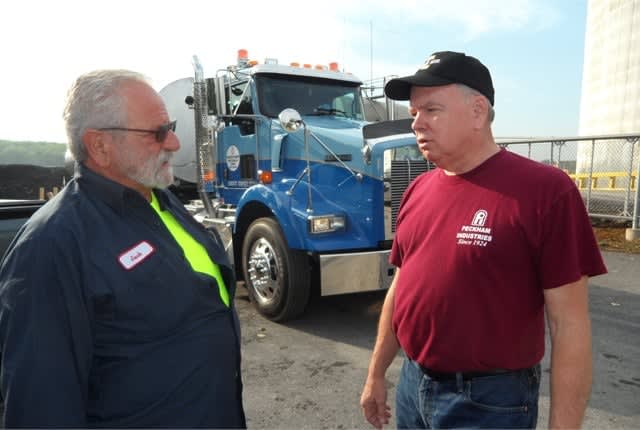
Veteran Driver Jack Mirando (left) and Fleet Supervisor Larry Fingar discuss the Kenworth-Etnyre rig and its planned run to a Peckham asphalt plant about 110 miles north.
New York's special permits
By special permit, New York state allows a five-axle tractor-trailer to gross as much as 102,000 pounds if its axle groups are spread far enough apart and its chassis components are strong enough, Fingar explained. That means beefy axles, suspensions, brakes, wheels and tires, as well as a strong powertrain.
The regulations governing “divisible load overweight permits” allow as much as 47,000 pounds on a tandem, 22,400 pounds on a steer axle and 25,000 on any other single axle. Fingar likes weight distribution to be 10,000 pounds on the steer axle and 46,000 on each of the tandems.
One or two extra axles allow more loading, and in the yard on the day of our visit there were a couple of brand-new three-axle tankers that allow a gross combination weight of 107,000 pounds. The extra 5,000 pounds are carried by a trailer’s liftable “pusher” axle ahead of its tandem.
The tridem formed by the tandem and pushers can gross up to 57,000 pounds under the regs. A seventh axle qualifies a rig to gross as much as 117,000 pounds. Permits affect tractor-trailers and straight trucks, some with multi axles, and they do cost some money.
“Each class of permit, whether it is for 102,000 pounds or 107,000, costs $750 for the tractor and first trailer,” Fingar explained. “Each additional trailer is $20. Most of our tractors have both Type 1A (102,000) and Type 7 (107,000). That's a total of $1,500 for the two permits plus $20 for each trailer after the first one. We have probably about 15 or 20 trailers for each Type 1A permit and 4 or 5 for each Type 7 permit. Total permit cost for each tractor would be about $2,000 per year.”
The money buys quite a bit of productivity, specifically 22,000 to 27,000 more pounds above the national 80,000-pound weight limit. With the five-axle rig, it's almost all additional payload. Loads vary, and not all go out at full permitted weight, he said. But conceivably, three such rigs can carry as much as four five-axle semis operating in most other states.
The equipment
The tanker trailers are an example of customer loyalty. Etnyre in Oregon, Ill., made this and most of the fleet's other tankers, and they are stout and durable — important because Peckham keeps its equipment a long time. There is no planned trade cycle, Fingar said, so they are maintained regularly and repaired as necessary and just keep working. The same is true of power equipment. In the yard were 1990s International 9900s with Detroit Diesel engines that still run every day. The oldest tractor dates to 1971 and it now shuttles trailers around the yard.
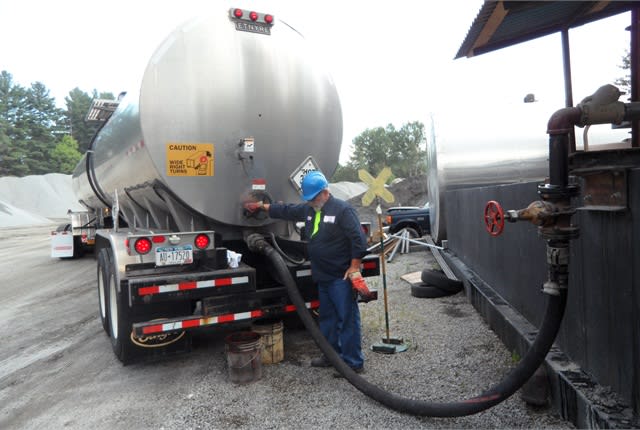
This tanker carried 8,800 gallons of hot liquid asphalt, about 40% more than what is normally allowed without an overweight permit.
Fingar put a lot of thought into choosing and spec'ing the latest additions, a pair of Kenworth T800 tractors ordered in late 2011. The fleet, which he joined as a shop mechanic in 1995 and became supervisor soon after, runs a variety of power units — Macks, Internationals, Peterbilts and so on — but had not owned KWs before. Fingar has been impressed with the dealer, Kenworth of Buffalo's Albany branch, as well as by engineering support from the factory.
Workers at KW’s plant in Chilli-cothe, Ohio, assembled the two tractors in January and Fingar had them by February, as the dealer had promised. Among other things, the tractors have 500-horsepower Cummins ISX15 diesels running through Allison 4500RDS (Rugged Duty Series) 6-speed double-overdrive automatic transmissions — something new for the fleet.
What's the drive like?
What's it like to drive a heavy rig like this? Mirando, a driving veteran in his 15th year with Peckham, helped me find out with one of the KWs hitched to an Etnyre tandem-axle tanker. He invited me to climb into the driver's seat for a run hauling hot liquid asphalt to a Peckham plant about 110 miles north.
I fired up the Cummins ISX15-500 engine, punched the Allison into D, released the brakes and moved out.
It was one of the easiest 220-mile round trips I've ever made in a big rig. More than ample power and no concerns about shifting gears meant I merely had to steer, control speed and watch traffic around us.
Mirando, who's been over these roads many times, coached me whenever we were about to enter a tight turn. The last thing either of us wanted was to roll over and spill hot, gooey liquid all over the place. I listened to him and backed off the throttle and applied the brakes lightly to slow whenever required. The rig didn't seem all that top heavy, but none does until a driver goes into a curve too fast and finds the trailer going over on him. And I maintained plenty of distance from any vehicle ahead.
Approaching a red light or stop sign is when our 51-ton weight showed itself, especially in the last 50 or so feet, where I pressed hard on the pedal. I didn't watch the application gauge, but it probably approached 30 or 40 psi.
Soon I began using the down arrow on the selector to downshift the tranny, which raised revs to 2,000 and 2,100 to increase retarding power from the Cummins-Jacobs Intebrake that continued steadily through the downshifts. I went as far down as third on one stop to shrug off road speed. Mirando said he often does this all the way to first, which brings the rig to a stop with very little use of the service brakes. This takes work and skill with a manual, but is easy to do with an automatic.
Even with double-overdrive top gears, engine speed at cruise is relatively high, 1,650 rpm at 65 mph. That's several hundred rpm higher than for an over-the-road tractor with a manual transmission, but close to what engine makers recommend for a vocational vehicle to keep power on tap with a heavy load.
Fingar chose a 4.78 axle ratio as a compromise between startability and cruiseability. The info display on the dash showed fuel economy on the loaded portion of this trip was 4.9 mpg, which seems reasonable given our weight and the many slow-downs, stops, starts and speed-ups as we passed through villages and trundled along two-lane highways. That mpg number slowly climbed during the empty return leg.
We pulled into the asphalt plant north of Lake George Village and I backed the tanker to the off-loading point. Mirando hooked up a hose and activated a pump that took about 40 minutes to suck out the hot liquid.
On the trip home, with the tanker now empty, acceleration was much more brisk and so was braking. To slow for the first village, I stabbed the pedal as before, causing Mirando's body to jerk toward the dash and him to laugh. “Makes a difference, doesn't it?” he said of the now-gone load.
Yet the ride quality was still good, showing that the suspensions worked as well now as when they were heavily loaded.
Those who oppose higher weight limits for trucks on safety grounds should see how securely these rigs can operate.
More Fleet Management

Kodiak Lines Up Fleets for Driverless Trucking
An agreement for 75 trucks, a new Texas freight lane, and progress on safety validation move Kodiak closer to its planned driverless highway launch.
Read More →
ITS Logistics Settles Religious Harassment Case
The Nevada-based logistics firm agreed to pay more than $396,000 to settle a religious harassment charge involving an employee's Jewish identity.
Read More →
Your Trucks Are Busy. That Doesn’t Mean They’re Winning.
High utilization doesn’t always mean strong margins. Looking beyond the current load can help fleets make better dispatch decisions and get more value from each truck’s time.
Read More →
Why This Trucking Recovery Is Different
Freight demand remains sluggish, but rising costs and tougher enforcement have taken enough capacity out of the market to change the outlook for motor carriers.
Read More →
Platform Science Adds Dispatch and Safety Tools
Four additions to PS Fleet help fleets monitor loads, manage driver coaching, share truck locations and adjust video system settings.
Read More →
PrePass Intelligence Mines Fleet Bypass, Toll and Safety Data
PrePass Intelligence helps fleets measure bypass savings, flag potential toll overcharges, and spot suspicious transactions by combining data from separate systems.
Read More →
Motive Adds AI Agents for Fleet Operations
New tools automate follow-up on fleet data, from maintenance work orders to driver alerts, with two-way voice conversations planned for later this year.
Read More →
Can You Beat Our Trucking Trivia Challenge?
Test your truck knowledge with 19 trivia questions from Heavy Duty Trucking Exchange. Can you keep up with the fleet pros?
Read More →
BeyondTrucks Adds Rules Checks to Dispatch
New Compatibility Engine checks driver qualifications, equipment requirements and fleet policies before loads are dispatched.
Read More →
Diesel Prices Hijack Trucking’s Worry List
ATRI’s annual survey finds cautious optimism about freight, but diesel costs, litigation, and insurance continue to squeeze fleets. Drivers have different priorities on several issues.
Read More →