




Ounces of Prevention Means Miles of Cure For Your Tires
Unlike their human counterparts, dead tires do tell tales. And aside from underinflation and road strikes, the tales most commonly told of tires robbing their owners of full value revolve around alignment. Scrubbing and scuffing and driving tires off in different directions, poor alignment kills tires faster than almost any other mechanical malady.

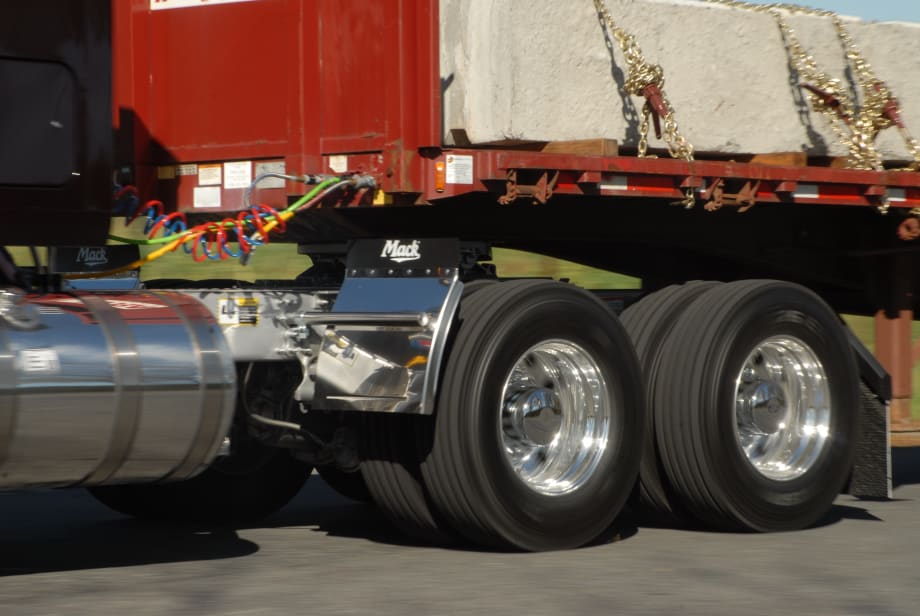
Alignment and balancing can keep your tires and your truck running straight and true.
Unlike their human counterparts, dead tires do tell tales. And aside from underinflation and road strikes, the tales most commonly told of tires robbing their owners of full value revolve around alignment. Scrubbing and scuffing and driving tires off in different directions, poor alignment kills tires faster than almost any other mechanical malady.
The sad part is the problem is almost entirely preventable.
Alignment and balancing can keep your tires and your truck running straight and true.
The same applies for balancing, though to a lesser degree. Tire damage resulting from an out-of-balance wheel assembly is easy to spot, but determining the cause is sometimes confusing. Like alignment wear, out-of-balance conditions are almost entirely preventable.
The best source for diagnostic information about these two conditions, and many others, remains the Radial Tire Conditions Analysis Guide from the American Trucking Associations’ Technology and Maintenance Council. The group just published an updated edition and it’s available for purchase on the ATA Business Solutions website. If you’re an active player in the war on premature tire wear, this might be the best weapon you ever have.
Alignment, however, is not a diagnostic tool, says Justin Gonzalez, heavy-duty marketing manager at Hunter Engineering. “The alignment process can solve problems, but first you have to decide that you have a problem.
“Driver complaints are often the first clue, and later you’ll see irregular wear on the surface of the tires,” he says. “The sooner you have the cause of the wear seen to, the less of the tire you’ll lose.”
Gonzalez notes that TMC’s Recommended Practice 642A suggests having an alignment done sometime between 80,000 and 100,000 miles or between 12 and 18 months – to which he adds, “or sooner if you notice irregular wear.”
Many fleets, it seems, don’t bother with regular or periodic alignments. And that often includes a pre-delivery inspection alignment. You expect that the OE will deliver the truck properly aligned, or the dealer might do a pre-delivery alignment check prior to handing over the keys to the customer – but that’s not always the case, says Doug Edwardsen, sales manager at Bee Line.
“Alignment should be checked when the truck is delivered,” he says. “Don’t wait until the first PM. If it’s not right the day it’s built, it’s not going to be right later on.”
Edwardsen says manufacturing tolerances can put preferred alignment out by the tiniest margin, but that can still have an effect on tire wear.
John Wenzel, president of Wenzel’s Car and Truck Repair in Spring City, Pa., and a former fleet manager, say in his fleet manager days he had dealers inspect all the trucks when they came from the factory.
“We’d also check the truck carefully after 2,000 miles or so for signs of irregular wear,” he says. “If there’s a problem, you’ll be able to see it on the tires after 2,000 miles. If you see a problem, act on it immediately and you’ll probably save the tire.
On in-service trucks, Gonzalez says, common alignment problems are toe-in on the steer axle and out-of-parallel drive axles.
“Our alignment systems can track this stuff pretty closely,” he says. “By scouring the data and the records from the machines, we can see trends in OEs, suspension types and so on, so we almost know what to expect when X truck with X suspension comes in.”
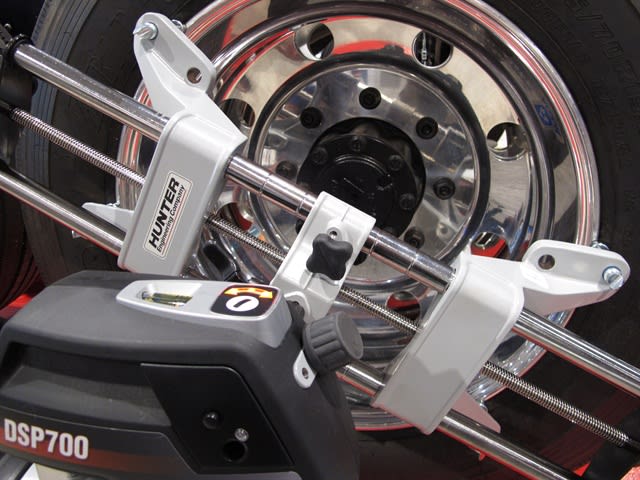
Laser alignment machines guide technicians to the right alignment solution for your truck and application.
At the other end of the spectrum we have services and tools available for fleets to perform their own alignments. Companies such as MD Alignment of Des Moines, Iowa, and the E-Z Line Laser Alignment system offer inexpensive and portable systems fleets can use in their own shops, or even in the yard on reasonably flat ground to set up a truck or trailer.
Dennis Smith, the inventor and patent holder of the E-Z line system, told HDT that his system uses magnetic self-centering lasers to provide measurement markers. The technician can refer to the manual for factory or recommended settings and, of course, experienced users can use their own settings where the operating environment demands something other than typical.
“We’ve got a one-person set-up and we can do truck empty or loaded, hooked to a trailer or bobtail,” Smith says. “It’s my experience that trucks are best aligned when they are in an as-driven state, that is, on the ground just as they sit when driving down the road.”
Trailers too
If few fleets have aggressive tractor alignment programs, fewer ever bother with their trailers. Trailers are often more in need of alignment than tractors because of the abuse the bogeys take, like cutting right turns short and running over curbs. Russ Brazeal, vice president of engineering at Hutchens Industries, thinks it’s usually a case of out of sight, out mind.
“Most of the trailers in drop yards around the country get less than their deserved share of routine maintenance to begin with,” he says. “Unless a driver complains of off-tracking, or dog-tracking as it often called, fleets just won’t bother.”
Verifying alignment on trailer suspensions can be done by simple triangulation with a tape measure. On mechanical suspensions, resetting alignment is as easy as turning the radius arm adjusting nut.
“Using a reference point on the wheel hub, get the diagonal distance from the kingpin to each reference point within an eighth of an inch of each other,” Brazeal says. “Then set the axle parallel distance to within 0.060” and tighten the radius arm. You’re done.
“There can be a bit more to it with some air suspensions, but it’s not complicated and it’s not an expensive job. It’s certainly less expensive than the price of the tires that are damaged by off-tracking.”
Balancing the equation
Balance is another hard sell for many fleets. It’s seen as an expense with few tangible benefits. Tire manufacturers will tell you there’s hardly any need to balance a modern tire thanks to manufacturing consistency. While that’s mostly true, the statement doesn’t account for the rest of the wheel-end assembly. The entire rotating mass, including the hub, brake drum or brake rotor, the wheel and of course the tires, rotate at about 500 rpm at 60 mph.
If there’s any irregularity in the assembly, it will affect your tires – and the drivers will have to endure the vibration.
Coley Wolkoff, national accounts manager at Counteract Balancing Beads, says there’s an acceptable tolerance for imperfections in any wheel assembly, but sometimes even acceptable can lead to an unpleasant driving experience and tire wear.
“Even the best tires in the world are still only one of a five-part system called a wheel assembly,” he says.
“Assuming you have mounted the tire properly and it’s concentrically mounted and the high and low spots are properly aligned, you can still have irregularities in the wheel or the drum or the hub on any wheel.”
One of the advantages of using a balancing compound is long-life service. The material stays in the tire as long as it’s on the wheel, notes John Tak, director of product marketing and development at IMI, the makers of Equal balancing compound.
“It provides a constantly changing state of balance even as the tire wears and subtly changes shape over its life,” he says. “You can remove the material and use it again in another tire as well.”
At the more sophisticated end of the spectrum, balancing machines help detect radial and lateral run-out as well as non-concentric mounting and even improper matching of the high and low spots on the tire and
the wheel.
“If you let the machine do its job, you’ll know you have a perfectly mounted and balanced tire and wheel when you’re done,” says Hunter Engineering’s Gonzalez.
Regardless of the approach you choose, properly balanced wheel/tire assemblies appear to have some fuel-saving benefit. Wolkoff says Counteract did some SAE Type II fuel economy testing recently with Auburn University in Alabama, and discovered a 2.2% improvement in fuel consumption. That not a huge savings, but it’s recordable, and it’s basically free for the price of balancing your tires.
“Another advantage of balancing all complete wheel assemblies, besides fuel economy improvement, is that the tires run cooler and last considerably longer,” Wolkoff says. “About 25% to 50% is regularly reported.”
For two processes that are often overlooked or even ignored by fleets, there are substantial savings to be had. Both alignment and balancing offer direct benefits in terms of tire wear reduction, but add fuel savings, reduced driver complaints and labor savings in tire repair, mount and dismount, etc. and there’s money there for the picking.

Check your scrap piles for clues to whether you need to align and balance.
Houston, do we have a problem?
Some fleets align their trucks and balance their wheels as part of a preventive maintenance program. Some do it only when there’s an obvious need or upon receiving a driver ride and handling complaint. Drivers will notice an alignment problem such as the truck pulling to the right or left, or drifting out of lane position. They’ll seldom report a balance issue, per se, but they will complain about vibrations.
Sources of vibration vary, but they offer clues you can follow.
Vibrations occurring at different speeds can point to different problems. Having a precise description of the symptoms from your drivers can help you isolate the problem. For example:
• If the vibration is felt in the steering wheel or the floor pan, it’s probably a steer axle problem. If it’s felt in the driver’s seat, it is probably a drive axle issue.
• Vibrations that start below 40 mph usually point to an out-of-round tire.
• Vibrations between 45 to 55 mph suggest the vehicle has a toe problem.
• Vibration over 60 mph is indicative of a balance problem.
When it comes to alignment, the tires themselves are usually the best indicator. The problem with that is, once the tires start showing signs of wear, the problem has already cost you money. With few exceptions, once a tire has begun to wear, it’s hard to stop. So, when a driver complains of handling problems, he or she could be saving you a lot of money.
The next step is to correct the problem. Alignment is not a hit-and-miss repair. The truck has to be set up properly to run true down the road, so you can’t just drop a shim into an axle support and hope it solves the problem.
Even an articulate driver’s description may not lead you to the exact cause.
Pulling in one direction or another, for example, could indicate a steering geometry problem, or a drive axle thrust angle issue. However, a few questions may help you isolate the cause, such as a pothole impact or damaged tire or wheel.
• Is the problem a recent phenomenon, or has it been getting progressively worse?
• Are there any unusual vehicle handling characteristics that accompany the vibration?
“A truck that sees regular alignments and wheel balancing will not be immune to the ravages of potholes, so don’t assume that because you do those service items regularly that a problem hasn’t occurred since its last service,” advises Mike Beckett of MD Alignment.
More Equipment

How Volvo Updated Its D13 for EPA 2027 [Watch]
Volvo’s updated D13 promises lower emissions without sacrificing performance or fuel economy. Take a closer look at what changed inside the engine in this HDT Spotlight video.
Read More →
Michelin Tire Improves Efficiency and Durability for Regional Fleets
The Michelin X Multi Energy D2 is a regional haul drive tire engineered to help fleets improve fuel efficiency, durability and traction in demanding stop-and-go operations.
Read More →
ZF Expands Commercial Vehicle Push in North America
ZF is expanding its North American commercial-vehicle presence with new transmission applications, electrification, trailer technology and autonomous-driving systems.
Read More →
Tesla Wants a Self-Driving Semi. Are Cameras Enough?
Could Tesla’s camera-only autonomous driving technology work on an 80,000-pound Semi? In this commentary, HDT's Deborah Lockridge takes a look at Tesla, Cybercab, and how autonomous trucks see the road.
Read More →
Kodiak: Driverless Long-Haul Truck Launch on Track for 2026
Kodiak AI says its driverless long-haul safety case is 93% complete and it remains on track to begin commercial operations by year-end 2026.
Read More →
What DOT’s Automated Vehicle Strategy Means for Trucking
The U.S. Department of Transportation issued a new automated-vehicle strategy that outlines plans for driverless-truck regulations, cross-state freight corridors, and federal safety standards.
Read More →
East Coast Port Launches $45M Electric Truck Push
The Port Authority of New York and New Jersey announced millions in incentives for zero-emission drayage trucks, yard tractors, and new charging hubs near the port.
Read More →
PlusAI Going Public to Fund Autonomous Truck Launch
A SPAC deal could provide PlusAI with up to $300 million as it works toward a 2027 commercial launch of factory-built autonomous trucks.
Read More →
NHTSA Moves to Rewrite Truck Fuel-Economy Rules
The National Highway Traffic Safety Administration says it lacks authority to regulate medium- and heavy-duty truck engines separately from complete vehicles, but the existing standards have not yet been eliminated.
Read More →
Detroit Opens Orders for EPA 2027 Engines
Detroit isn’t starting from scratch to meet EPA 2027 diesel emissions standards. Its Gen 6 DD13 and DD15 engines keep much of today’s platform while updating the fuel and aftertreatment systems.
Read More →