




Omnitracs Pursues a Software Focus with New Trucking Fleet Platform
Omnitracs’ new computing platform, Omnitracs One, is the latest reflection of the trend by technology providers to move from closed, proprietary systems – those in which their software runs on their proprietary hardware – to open systems.

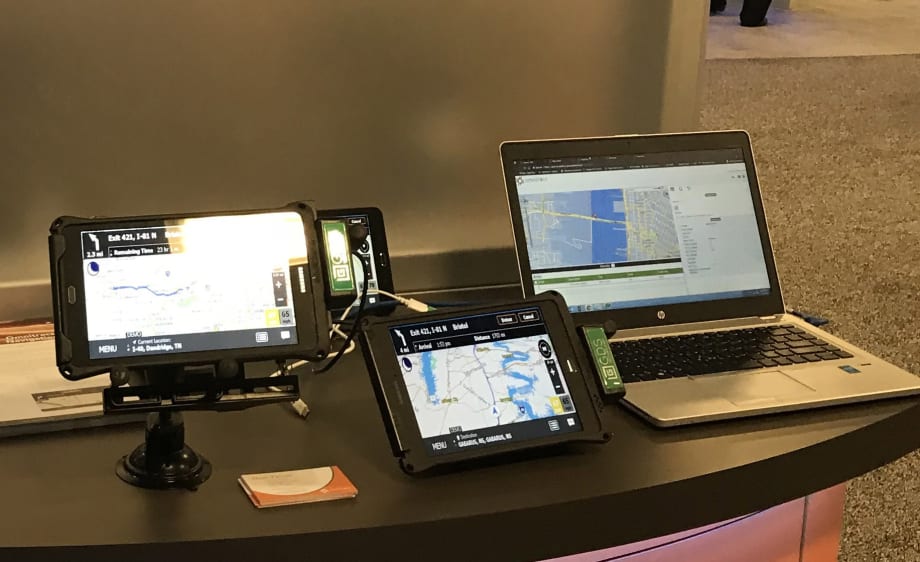
A key to Omnitracs new software platform is that it is “hardware agnostic.” Users can run the software on whichever kind of device best suits their needs. Photos: Jim Beach
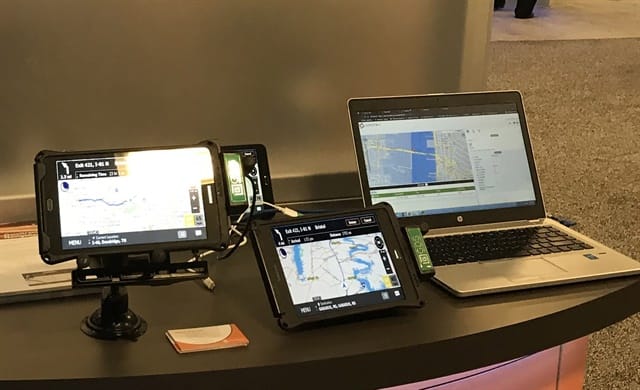
A key to Omnitracs new software platform is that it is “hardware agnostic.” Users can run the software on whichever kind of device best suits their needs. Photos: Jim Beach
The recent announcement of Omnitracs’ new computing platform, Omnitracs One, is the latest reflection of the trend by technology providers to move from closed, proprietary systems – those in which their software runs on their proprietary hardware – to open systems, in which hardware choices depend on the users’ needs and preferences.
Describing the systems as “hardware agnostic” in opening remarks at the Omnitracs Outlook 2018 user conference in Nashville on Feb. 26, Omnitracs CEO Ray Greer said the focus should be on the software, rather than the hardware, and the company’s new platform would focus on providing “software as a service.”
Such a platform “addresses what the industry has been moving toward,” he said, with greater integration of products. As the industry has changed, the segmentation of the market into distinct types has blurred. Where matching trucks and customers for irregular route long hauls had been the focus of much of Omnitracs’ original product, more fleets are interested in managing other segments as well.
Omnitracs' Evolving Fleet Software
In remarks to trucking journalists at the conference on Feb. 27, Greer said the new platform represents the “evolution of the company’s portfolio,” saying it allows their customers the flexibility to make use of the best capabilities of all the company’s products.
The new platform provides customers a unified source for fleet management, as opposed to a company needing to run several single-purpose solutions.
In a product review, Kevin Haugh, Omnitracs chief product and strategy officer, described Omnitracs One as “the next generation software platform” and that the company was in the process of bringing varied technologies under one umbrella. In a follow-up, he added, “At the most basic level, we want our technology stack, including the back-office part in the cloud, as well as the piece that runs on the device to be as generic as possible so we can take advantage of various devices.”
For long-haul fleets, the rugged, tethered devices, what Omnitracs calls IVGs, (Intelligent Vehicle Gateway), are most suitable, Haugh said. Other haulers that may need to use the device out of the cab will opt for a different option and then there are some fleets that want a device that is somewhat hidden and only tracks vehicle location and performance. “From that vantage point, it needs to be open,” he said.
But users need to understand that not all parts of their software will be supported on all devices. For example, a driver can’t interact with a device without a display for communication or hours-of-service operations.
Another part of moving toward an open platform is that the company wants to easily integrate with third-party devices and truck OEM devices. “Our customers often buy from multiple OEMs,” he said. Therefore, the company works with OEMs to provide pre-installed harnesses and IVG devices.
The new platform is built as a modular system. What that means, Haugh said is “we created a common underlying technology that the products sit on top of.” That allows customers, regardless of the segment they are in, to buy the pieces they need as they need them while knowing that each piece will easily integrate with the other pieces.
As an example, he noted that the hours-of-service back-office piece can integrate with their routing application. The HOS data provides information that can make the routing or optimization part more efficient. The modularity means customers don’t have to take everything offered from the software, but can buy what they need when they need it.
“The interesting thing we found when we looked across our product portfolio, is that there were some things where there was a common need across all of our customers, tracking the vehicle for instance.” But the level of tracking required can be different for different segments. For last mile operations, the tracking function needs to be more “fine grained,” he said. For long haul, not as much. The new platform allows fleets to configure this function based on their need.
The Same Platform for Different Users
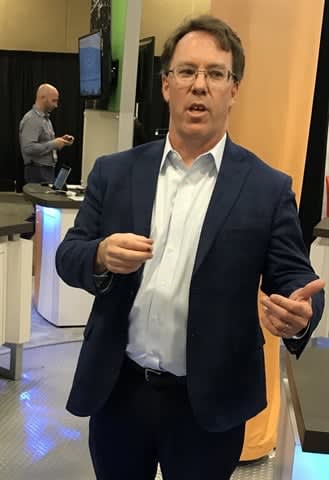
Kevin Haugh, chief product and strategy officer for Omnitracs, explains some of the functions of the new Omnitracs One computing platform.
As the new platform is rolled out, different customers will see different things. “If you think about our customer base, we have a wide array,” he said. Some are Omnitracs customers that use MCPs or IVGs – hard-wired devices. RoadNet customers are totally focused on the last mile and XRS customers tend to straddle both of those. “What it means for each segment is kind of different.”
For long-haul users, Haugh said they would see significant improvements from what they’ve seen in the past, including fleet management capabilities that allow them to see data in ways they haven’t before. Plus, they will have the ability to deploy a broader array of devices, which is important for the long-haul operations that are branching out into the last-mile segment where they will have different hardware needs (the ability to capture signatures out of the cab for instance).
For the XRS customer base, Omnitracs has offered telematics and compliance capabilities users can access on a tablet or smart phone. What they will see new is the opportunity to add more applications to enhance their systems.
Last-mile customers not only retain robust routing, dispatching, proof of delivery, and other functions, but they can also add an integrated compliance piece that will be seamless to the driver. “It is not just a new platform, there are a lot of new things that will be superior to what they have today,” Haugh said.
For software developers, one of the biggest challenges is understanding the markets being served and how to provide customers a competitive advantage and unique capabilities, he added. Instead of developing different products for specific markets, their goal was to provide one product that could work in all markets. “We saw the opportunity to think about it more holistically.”
He pointed to GPS as an example. “Up-to-the minute GPS is not really necessary for long-haul trucking.” Rather than having to incur the cost of up-to-the minute data transfers, customers can configure that based on the usage of the system. “That’s important because the more data you flow, the more it costs you.”
Omnitracs One will be available for customers beginning this year, the company said, with availability and timing dependent upon a fleets specific needs.
More Fleet Management

Color Match Smarter: Tools That Restore & Perform
For fleet managers and collision repair professionals keeping heavy-duty trucks on the road, getting the color right the first time isn't just about appearance — it's about efficiency, turnaround time, and bottom-line results. Discover how today's digital color tools are transforming the repair process from guesswork to precision.
Read More →
FMCSA Pauses Biennial-Update Enforcement Amid Motus Transition
Carriers whose updates were due on or after June 1 have more time, while FMCSA works to stabilize its new registration system and warns of phishing sites impersonating its new carrier registration system, Motus.
Read More →
2026 Blueprint for Countering Smarter Supply Chain Theft
Cargo theft is no longer just the cost of doing business. It's a multi-billion-dollar criminal enterprise exploiting vulnerabilities across your fleet, drivers, and supply chain.
Read More →


How Telematics Improves Visibility, Control, and Performance in Refrigerated Fleets
Explore how telematics help refrigerated fleets improve visibility, uptime, efficiency, compliance, and cargo protection across connected cold chain operations.
Read More →
What the U.S.-Canada Trade War Means for Trucking
Escalating U.S.-Canada tariffs could disrupt cross-border freight, reduce truck volumes, raise costs, and create new uncertainty for carriers on both sides of the border.
Read More →
What Are Trucking’s Top Concerns for 2026?
The American Transportation Research Institute wants to know what's worrying trucking fleet managers, drivers, and other stakeholders in its annual Industry Issues survey.
Read More →
American Trucking Associations Looks for a New Leader
ATA President and CEO Chris Spear abruptly left his job at the association on August 21, at a pivotal time for the trucking industry.
Read More →
Public Wi-Fi Cybersecurity Risks: How Truck Drivers and Fleets Can Protect Their Data
Public Wi-Fi can expose truck drivers and fleets to credential theft, malware, and other cyber threats. Here’s how to reduce the risk on the road.
Read More →
For Nicky Cupp, Fleet Innovation Starts With Frustration
HDT Truck Fleet Innovator Nicky Cupp turns everyday pain points at Fraley & Schilling into opportunities for better technology and smarter processes.
Read More →
Adam Buttgenbach’s Approach to Electric Trucks: Start With Where They Fit
HDT Truck Fleet Innovator Adam Buttgenbach helped PepsiCo build one of North America’s largest EV fleets by focusing on where electric trucks make operational sense.
Read More →