




NTSB Recommends Rollover/Stability Protection For Tank Trailers
The National Transportation Safety Board says more needs to be done to make tanker trailers less prone to rollovers, including mandatory stability control systems, following its investigation of a 2009 rollover accident involving a tractor and tanker trailer
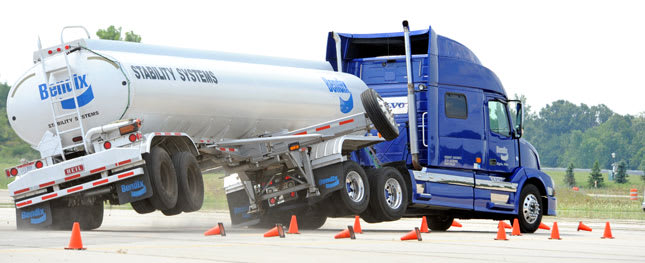
The National Transportation Safety Board says more needs to be done to make tanker trailers less prone to rollovers, including mandatory stability control systems, following its investigation of a 2009 rollover accident involving a tractor and tanker trailer.
On October 22, 2009, at about 10:38 a.m. EDT, a 2006 Navistar International tractor pulling a 1994 Mississippi Tank Company cargo tank semitrailer operated by AmeriGas Propane, L.P., rolled over about 10 miles northeast of downtown Indianapolis. The tanker was loaded with 9,001 gallons of liquefied petroleum gas, which escaped, formed a vapor cloud, and ignited. The rollover occurred on a connection ramp at the junction of I-69 south and I-465 south.
The investigation revealed that the truck driver, who was negotiating a left curve from the right lane of the connection ramp, began to encroach upon the left lane that was occupied by a passenger car. The truck driver responded to the car's presence by over steering his vehicle, which caused it to veer to the right and onto the paved right shoulder.
Moments later, the truck driver steered counterclockwise to redirect the truck from the right shoulder and back to the right lane. This series of driver inputs, steering hard to the right and then back to the left, led to the cargo tank rolling over, detaching from the truck, penetrating a steel guardrail, and colliding with and entirely displacing a bridge pier column that supported the I-465 overpass.
As a result of the accident and post-accident fire, the truck driver and the driver of the passenger car sustained serious injuries. Three occupants from other passenger vehicles traveling on I-465 received minor injuries from the post-accident fire.
The NTSB determined the cause of the crash was the driver's excessive and rapid evasive steering maneuver after he began to encroach upon the occupied left lane. Contributing to the rollover was the driver quickly steering the combination unit from the right shoulder to the right lane; the reduced cross slope of the paved right shoulder; and the susceptibility of the combination unit to rollover because of its high center of gravity.
The board noted that loaded cargo tank motor vehicles provide little tolerance for operator error, and the rollover training received by the truck driver was not effective in preventing this accident. Although a rollover prevention program will not eliminate all rollovers due to driver errors, it can be effective for identifying ways for cargo tank motor vehicle drivers and management to work collaboratively to prevent rollover accidents. In addition, the NTSB said, a stability control system on the combination unit may have prevented this accident.
"The NTSB has been concerned about the integrity of cargo tanks carrying hazardous materials for more than 40 years," said NTSB Chairman Deborah Hersman. "There are more than 1,300 rollovers a year involving cargo tank motor vehicles. These accidents pose a significant safety risk to both the vehicle driver and to the motoring public."
The NTSB has no regulatory power itself, but it issued 20 safety recommendations to other agencies, including several regarding mandatory stability control/anti-rollover systems.
The board recommended that the Federal Motor Carrier Safety Administration and the Pipeline and Hazardous Materials Safety Administration Implement a comprehensive rollover prevention program.
It recommended that the FMCSA to require all in-use cargo tank trailers with a gross vehicle weight rating greater than 10,000 pounds be retrofitted with a rollover stability control system.
The NTSB recommended that the National Highway Traffic Safety Administration develop stability control system performance standards for all commercial motor vehicles and buses with a GVWR over 10,000 pounds, and that it establish minimum performance standards for new cargo tanks and require the installation of stability control systems on all newly manufactured commercial vehicles.
It recommended that the Pipeline and Hazardous Materials Administration work to identify cargo tank designs that are susceptible to failure so it can develop accident performance standards for new cargo tanks.
A synopsis of the NTSB report, including the probable cause, findings, and a complete list of safety recommendations, is available at www.ntsb.gov/news/events/2011/indianapolis_in/synopsis.html.
More Equipment

ZF Expands Commercial Vehicle Push in North America
ZF is expanding its North American commercial-vehicle presence with new transmission applications, electrification, trailer technology and autonomous-driving systems.
Read More →
Tesla Wants a Self-Driving Semi. Are Cameras Enough?
Could Tesla’s camera-only autonomous driving technology work on an 80,000-pound Semi? In this commentary, HDT's Deborah Lockridge takes a look at Tesla, Cybercab, and how autonomous trucks see the road.
Read More →
Kodiak: Driverless Long-Haul Truck Launch on Track for 2026
Kodiak AI says its driverless long-haul safety case is 93% complete and it remains on track to begin commercial operations by year-end 2026.
Read More →
What DOT’s Automated Vehicle Strategy Means for Trucking
The U.S. Department of Transportation issued a new automated-vehicle strategy that outlines plans for driverless-truck regulations, cross-state freight corridors, and federal safety standards.
Read More →
East Coast Port Launches $45M Electric Truck Push
The Port Authority of New York and New Jersey announced millions in incentives for zero-emission drayage trucks, yard tractors, and new charging hubs near the port.
Read More →
PlusAI Going Public to Fund Autonomous Truck Launch
A SPAC deal could provide PlusAI with up to $300 million as it works toward a 2027 commercial launch of factory-built autonomous trucks.
Read More →
NHTSA Moves to Rewrite Truck Fuel-Economy Rules
The National Highway Traffic Safety Administration says it lacks authority to regulate medium- and heavy-duty truck engines separately from complete vehicles, but the existing standards have not yet been eliminated.
Read More →
Detroit Opens Orders for EPA 2027 Engines
Detroit isn’t starting from scratch to meet EPA 2027 diesel emissions standards. Its Gen 6 DD13 and DD15 engines keep much of today’s platform while updating the fuel and aftertreatment systems.
Read More →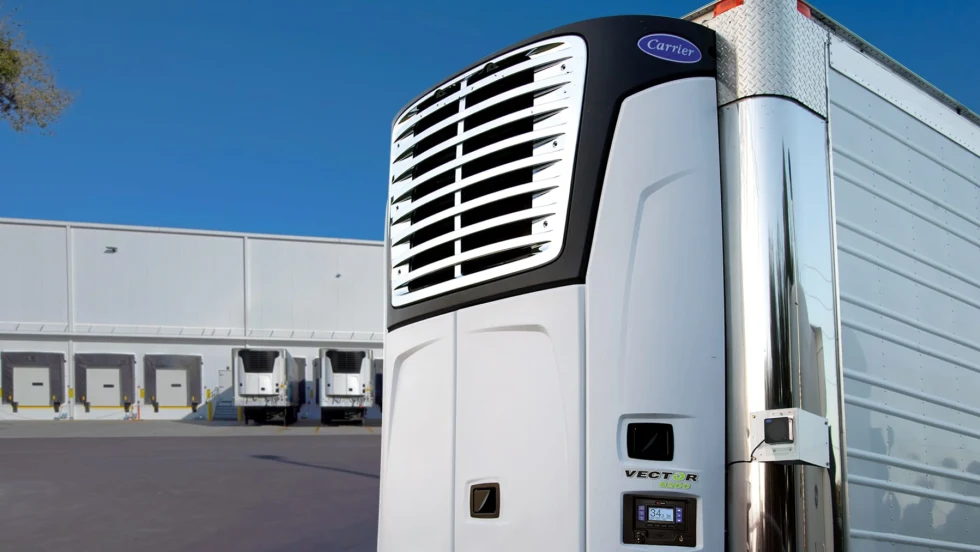
Carrier Transicold Adds All-Electric TRU for Stationary Cold Storage
Carrier Transicold’s new Vector 8200 all-electric transport refrigeration unit gives fleets a diesel-free option for temporary refrigerated and frozen trailer storage.
Read More →
A Closer Look at Kenworth’s Electric T880E Vocational Truck [Video]
Learn more about Kenworth's T880E battery-electric vocational truck at the Paccar Technical Center, including its range, applications, upfitting considerations, and PTO options, in this HDT Spotlight video.
Read More →