




Related: Nikola's Trevor Milton on Hydrogen Electric Trucks (Q&A)
Nikola Plans a Different Truck Ownership Model for its Hydrogen-Electric Trucks
There’s water, water everywhere, and little of it being transformed into fuel. Nikola Motor wants to change that – as well as the way fleets pay for trucks and their fuel – as it rolls out the new hydrogen-powered Nikola Two.
by John G. Smith, Today's Trucking
April 18, 2019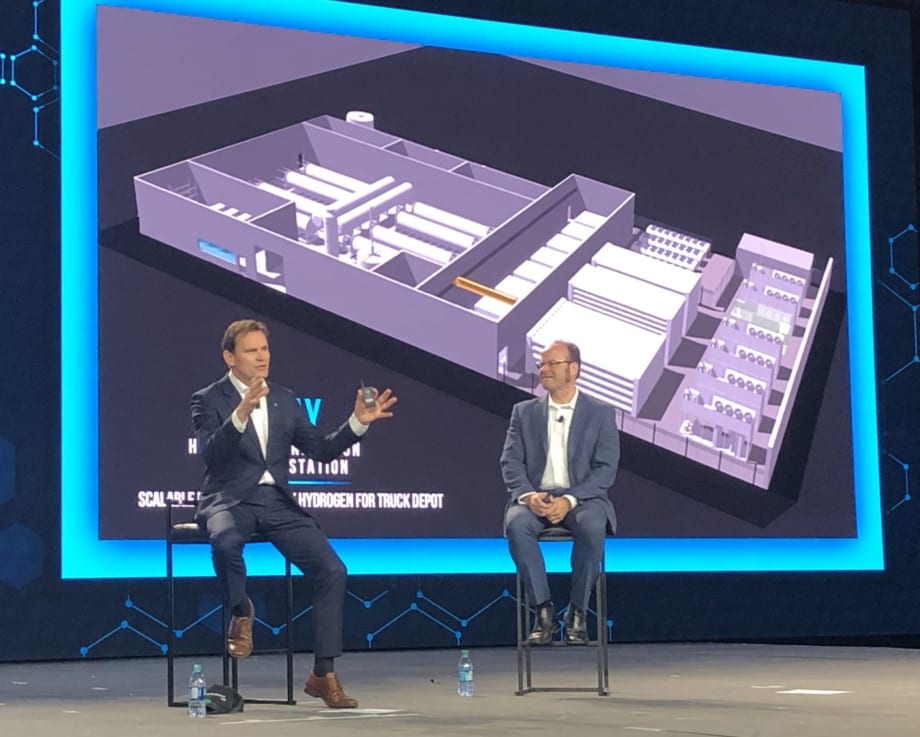
“This is really one of the most exciting projects that we’ve ever been involved with,” said Nel CEO Jon Andre Lokke. “It solves the chicken and the egg.”
Photo courtesy Today's Trucking
5 min to read
There’s water, water everywhere, and little of it being transformed into fuel. Nikola Motor wants to change that – as well as the way fleets pay for trucks and their fuel – as it rolls out the radically different Nikola Two.
As the company prepares to produce its hydrogen-electric Class 8 trucks by 2022, it’s also establishing plans for the related fueling network, as well as a leasing model that promises to roll truck payments, full-service maintenance, and the fuel cost itself into a single price.
Initial estimates from the company suggest that price will run between 90 and 95 cents per mile over the course of a truck’s seven-year lease – what Nikola personnel refer to as “parity” with the price of running diesel-powered equipment.
“We are talking about real disruption,” said Nikola Chief Financial Officer Kim Brady, referring to the pricing that would be available for those that run average miles of between 90 and 100K per year. “No one is willing to take risk from fuel.”
But doing this will mean delivering hydrogen “at scale” with the support of Norwegian-based Nel, establishing fueling infrastructure to support fleets that adopt the technology.
“We’re building our hydrogen infrastructure where the trucks are,” said Jesse Schneider, Nikola’s executive vice-president – hydrogen and fuel cell technology, during briefings at an event dubbed Nikola World in Scottsdale, Arizona, where the new Nikola Two was unveiled April 16. “If you want to build a new type of disruptive vehicle, you have to build the infrastructure.”
“This is really one of the most exciting projects that we’ve ever been involved with,” said Nel CEO Jon Andre Lokke. “It solves the chicken and the egg. Everything comes at the same time.”
The fueling stations
A standard Nikola fueling station can produce 8 tons of hydrogen per day – enough to support about 150 heavy-duty vehicles — although truck-focused depots could produce four times that much. “That’s where you see a lot of cost benefits to the hydrogen,” Schneider said. Public users would pay less than $6 per kilogram.
Nikola’s first 8-ton station is scheduled to be in place by 2021, while the ramp-up to a target of more than 700 stations in the U.S. is set to begin in 2022. Each station will cover a footprint similar to a truck stop covering a little more than 7 acres, and also be able to fill mobile trailers for fueling at other locations.
“The thing that worries me the most, the thing that would help us the most, is if [government regulators] would just get out of our way,” Nikola CEO Trevor Milton said during a press conference the night before.
“Just let us go build stations and pull these diesels off the road. Some of them have standards so stringent, like bureaucracy so deep, you take three to four years to permit an hydrogen station. That should be done in three weeks … We went from start to completion of a hydrogen station [in Arizona] within about four months.”
The goal is to be able to fuel a Class 8 Nikola truck with 80 kilograms of fuel within 10 to 20 minutes.
There will undeniably be fewer hydrogen stations than diesel islands, but Lokke stressed that planning will make a difference. The U.S. could get by with fewer fuel islands than exist today, he said. “You have the opportunity to plan.”
“We are trying to take the vehicle out of the carbon equation by removing carbon from the feedstock,” Schneider added. This means relying on renewable energy sources like solar panels and wind turbines to develop the hydrogen on site, perhaps supplemented by adjacent solar farms. An entire station will run on about 17.6 megawatts, and at least 30-40% of that is to come from renewable resources.
“It really drives down costs,” Lokke said of the business model, noting how it will make the hydrogen competitive with diesel in part because there is no need to transport the fuel.
“You will find smaller stations around the world, that will produce hydrogen on site, but never at this scale.”
Full-service leases
It will be up to Ryder to maintain the new Nikola trucks.
“We perform literally thousands of total cost of ownership studies each year,” said Dennis Cooke, Ryder president of fleet management solutions. The fuel simply “brings another dimension” to the equation.
Nikola’s proposed business model will follow the one already in place for Ryder customers in other respects, with leases involving full-service maintenance, predefined in-house maintenance service, or service on demand, said Karen Jones, Ryder’s executive vice-president and chief marketing officer. “What we’ve been perfecting in a diesel world, I think will be very transferrable.”
“This is the potential to simplify your business model down to hiring and training drivers and keeping them on the road,” said Nikola president Mark Russell. “We can fix all the other costs for you. That’s why we’re proposing lease as the base model. We know that we can generate hydrogen for a cost that is competitive with diesel, and if you buy our truck with a bundled lease, we’ll commit to selling it to you for the life of the truck.”
Fleet shops that want to service such equipment on their own will require some upgrades, but the changes would be similar to those associated with natural gas vehicles. Hydrogen is 14 times more buoyant than air, which will require some ventilation in the case of any spills.
“We’re making a giant step forward here in saving the planet, and we can save you money probably,” Russell said.
It isn’t the only differentiator when it comes to options like battery-electric vehicles.
“Every pro-forma we have does not depend on any government incentive,” Russell said. “Our bogey for everything is diesel parity and then try to beat it. We want to match it or beat it.”
John G. Smith is the editor of the award-winning Canadian publication Today's Trucking. This article was used under a cooperative editorial sharing agreement between HDT and its Canadian counterpart.
Subscribe to Our Newsletter
More Fuel Smarts

How Volvo Updated Its D13 for EPA 2027 [Watch]
Volvo’s updated D13 promises lower emissions without sacrificing performance or fuel economy. Take a closer look at what changed inside the engine in this HDT Spotlight video.
Read More →
Diesel Price Spike Shortens Payback for Natural Gas Trucks, Report Says
Energy Vision estimates fleets could recover the higher purchase price of an RNG-fueled Class 8 tractor in 1.3 to 2.8 years under current fuel-price scenarios.
Read More →
Calstart Becomes Catalyst Mobility, Reflecting Broader Focus
Calstart is now Catalyst Mobility, reflecting the nonprofit’s growing national role in clean transportation, including zero-emission trucks, infrastructure and incentive programs.
Read More →

Record Diesel Prices Squeeze Trucking Fleets
Average U.S. diesel prices have climbed to nearly $6 a gallon, surpassing the 2022 record as tight refinery capacity and Middle East disruptions keep fuel costs elevated.
Read More →
Sponsored•September 9, 2026
How Fuel Delivery Shapes Engine Performance
Fuel delivery depends on more than what happens at the injector. For fleet, maintenance and technical professionals, looking at the full path from pump to injector can provide useful context for understanding engine performance.
Read More →
East Coast Port Launches $45M Electric Truck Push
The Port Authority of New York and New Jersey announced millions in incentives for zero-emission drayage trucks, yard tractors, and new charging hubs near the port.
Read More →
California Bill Could Shed Light on Electric Truck Prices
Why do battery-electric Class 8 trucks remain so expensive? A California bill headed to Gov. Gavin Newsom would give fleets and state agencies more visibility into what manufacturers charge.
Read More →
Detroit Opens Orders for EPA 2027 Engines
Detroit isn’t starting from scratch to meet EPA 2027 diesel emissions standards. Its Gen 6 DD13 and DD15 engines keep much of today’s platform while updating the fuel and aftertreatment systems.
Read More →
Zero-Emission Truck Corridor Planned for West Coast
California, Oregon, Washington, British Columbia and Baja California are coordinating plans for truck charging and hydrogen fueling from Canada to Mexico.
Read More →
A Closer Look at Kenworth’s Electric T880E Vocational Truck [Video]
Learn more about Kenworth's T880E battery-electric vocational truck at the Paccar Technical Center, including its range, applications, upfitting considerations, and PTO options, in this HDT Spotlight video.
Read More →