




Q&A: Nikola's Trevor Milton on Hydrogen Electric Trucks
We sat down with Nikola Motor Co. CEO Trevor Milton at the Nikola World event in Scottsdale, Arizona, where the evening before he had introduced the Nikola Two hydrogen-electric truck to the world, to get his thoughts on the fueling infrastructure, the competition, hydrogen vs. electric trucks, and why he thinks truck drivers will be eager to switch from diesel.

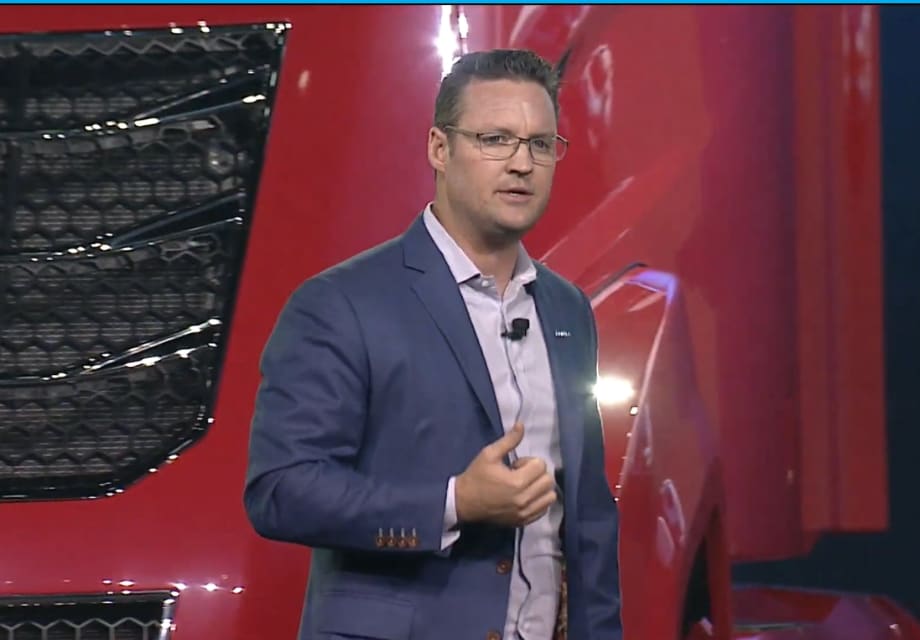
Nikola Motor Co. CEO Trevor Milton talks about the Nikola Two during the unveiling event.
We sat down with Nikola Motor Co. CEO Trevor Milton at the Nikola World event in Scottsdale, Arizona, where the evening before he had introduced the Nikola Two hydrogen-electric truck to the world, to get his thoughts on the fueling infrastructure, the competition, hydrogen vs. electric trucks, and why he thinks truck drivers will be eager to switch from diesel.
The following interview has been lightly edited for clarity and length.
HDT: You are talking about a network of hundreds of service stations all over the country to fuel trucks with hydrogen extracted from water. You’ve committed to using electricity produced by wind, solar and other renewable sources. You obviously can’t have huge solar farms at every truck stop. How are you going to execute that?
Milton: We have a saying here at Nikola, we like to move protons, not fuel. So what we do is we produce all the hydrogen on site, but we don’t have the solar farms on site usually, because there’s usually not enough space. You can imagine, you’re going to need a lot of acres of solar. So we usually put those solar farms out in the middle of the desert. We transmit [the electricity] through the main transmission lines and then pull them out wherever our facility is around the country. We use the grid, you have to; we put it in and pull it out. We’re specifically putting in energy that is zero emission and pulling the same amount out at the other end, so we’re not using any dirty fuel for our hydrogen. What we know is whatever we’re using is produced by zero emissions, and that’s what’s important.
HDT: So what do you need to make and store hydrogen at a fuel station?
Milton: That’s usually a whole bunch of equipment. There’s very large electrolyzers, and then hydrogen tanks and then compressors. Those are the main three components. There’s a whole bunch more than that, but those are the easy ones to know.
We start out with an 8-ton station. That’s the minimum; that’ handles 160 trucks. That would be 16,000 pounds, or about 8,000 kilograms. We can scale it up to 24,000 kilograms without major issues using the same facility. So you could go up to 24,000 kilograms, which could handle about 500 trucks on that one spot fueling every day at full capacity. Which is a good amount of trucks [laughs]; that’s a lot of trucks.
HDT: Let’s discuss range. You talk about a kilogram of hydrogen; can you convert that to miles per gallon?
Milton: 6 to 10 miles per kilogram, and that’s fully loaded in a real environment. And that totally depends on where you’re at in the country. So it’s very equivalent to a gallon of diesel. Very similar. There’s 80 kilograms capacity, so you’ll see that would [be] equivalent [to] up to 500-800 miles of range.
HDT: There are some other companies working on hydrogen-electric trucks. How is Nikola different?
Milton: The truck that we built is the most advanced truck that’s ever been built in history. It literally is; it’s a billion dollar program. These other guys have no clue what they’re doing when it comes to hydrogen. [Other OEMs will] have to build a truck from the ground up. It’s going to take them seven years to do it, and they’re going to have to figure out how to do it without using our patents. And without that it’s going to be pretty hard. The idea is, we’re the only truck with, we have patented integrated tanks into the frame. The only way to get that kind of capacity is to have the tanks integrated into the frame, and that’s some of our patents. What that does is it allows us to have an enormous amount of hydrogen on board, with a truck that is specifically built from the ground up for hydrogen. So if you retrofit a diesel, you’re going to end up with something that does 100 to 150 miles; it’ll never compete.
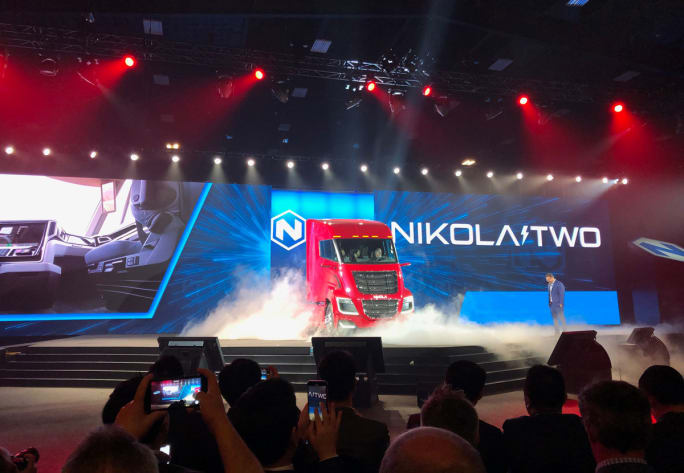
The Nikola Two was unveiled to an enthusiastic crowd at Nikola World.
You won’t be able to do it unless you build an entirely new truck around the entire frame and you’re willing to commit a billion dollars to the program, which they ‘re not willing to do. Why, when they’ve got six months of diesel [back]orders? Until they see their entire market evaporate, they will not get it.
By the way, also, the power and torque of the other trucks? You couldn’t even go up a big hill. This is a real truck. This will outperform the diesels. The idea is to make diesel look like the old steam engine. Everyone’s always said truckers love diesels because of their power. Now that trucker’s going up the hill at 15 mph in a diesel blowing black smoke, and he sees his friend go by him at 65 mph, getting more miles every day, making more money, having more power and more torque. There’ll be nothing that makes that driver more mad than seeing his friend blow by him up a hill in a truck that is silent and zero emissions, and incredibly fun to drive, while making more money.
HDT: Duty cycles? Is there any difference to the fuel cell or the powertrain for different applications?
Milton: No; ultimately they’re all the same, it just depends how much fuel you have. We’ll keep really only one version of the hydrogen truck for a while. But we’ll also have the battery electric versions for people that don’t need the range. If they’re driving inner city and weight’s not an issue, let them have a battery truck, happy to help them. But it’s just a totally different duty cycle. It’s going to be short range, long charge times. Imagine this, imagine you’ve got 20 trucks, if you were to think about the Tesla trucks or anyone else. Each truck is 1 megawatt hour of energy. In order to charge them at the speed that Tesla’s talking about, you would need twice the energy going in, so that means you would need 40 megawatts to be able to pull to charge those 20 trucks. There’s not a grid out there right now that can allow 40 megawatts to get sucked off it right away. It would take the whole grid down. So what we’ve tried to tell people is look, battery electric’s going to be a good thing for where people are running 50 miles runs, they plug in for 30 minutes, run another 50 miles, plug in for 30 minutes. That’s what they’re going to be doing. With hydrogen it’s all about, we’re going to put mass energy into a truck.
HDT: Does a transient duty cycle like city delivery work for hydrogen too?
Milton: Yeah, you could use either one. It’s just a little more expensive when you talk about the cost per mile on a hydrogen truck than an electric truck within a city. But not on a highway. On a highway it’s cheaper hydrogen, but in a city it can be on par or slightly less with electric. We always tell people it makes sense to have a battery electric option. That’s why we’re offering both, because we’re the only company out there now that can be honest about it. We’ll tell you the benefits of both because we can sell you both. Everyone else has an agenda. We have no agenda. We will work with you on either one. It does not matter. You want battery? We’ll help you, and we’ll tell you when it’s better. If you want hydrogen, we’ll help you and we’ll tell you when it’s better. So we’re the only group that I feel like will actually be honest with people about the advantages of both. One size does not fit all.
HDT: As far as getting these trucks on the road is concerned, have you got schedules for reliability testing, durability testing, road testing, those sorts of things? When are we going to see one of these delivered to a customer?
Milton: Sometime around 2020 and 2021 you’ll see these trucks with customers being driven, in limited numbers. Testing’s going on in the background too with our team during that time. We’ll put probably 10 to 20 million man-hours into it over the next two years. So there will be our teams, other teams, thousands of engineers around the world doing testing on their individual components, and also the real life testing from both the customers and us. So we’ll be doing rollover testing, stability testing; we’ve already done a lot of it on this truck. We did our antilock brake testing, rollover stability, we did a lot of that to make sure it was safe to drive. And now we get into the really bad stuff, like winterization, stability, we get into crash testing where we actually run them into walls at 40 mph.
HDT: What about a windshield wiper that’ll last a million miles? Not very sexy, but that’s what people expect from Class 8 trucks nowadays. Not the rubber part, but the motors, the controller, all that.
Milton: We hope. The nice thing about our model is it won’t matter to the driver anymore, because it’s all covered by us. If it goes out at half a million, it’s on us, we pay for it. And because we’re buying in such scale, and this is the crazy thing, this is what I don’t understand. The cost of doing something as an OEM is so cheap. When you think of the cost of a window motor or a windshield wiper, it’s very, very cheap. What they retail for is like three, four, five, 10 times more than we pay for it at the factory. So it costs us a few bucks to swap something out, why cause a driver to lose his pay over it. Our idea is to make money moving miles, not making money off of windshield wiper motors. And the other OEMs don’t feel that way. Their whole entire market is on hey, we need to take money everywhere we can get it, parts, parts, parts. No. I don’t like that. My idea is miles, miles, miles. I want my money made on miles, and the drivers never worry about their parts.
More Fuel Smarts

How Volvo Updated Its D13 for EPA 2027 [Watch]
Volvo’s updated D13 promises lower emissions without sacrificing performance or fuel economy. Take a closer look at what changed inside the engine in this HDT Spotlight video.
Read More →
Diesel Price Spike Shortens Payback for Natural Gas Trucks, Report Says
Energy Vision estimates fleets could recover the higher purchase price of an RNG-fueled Class 8 tractor in 1.3 to 2.8 years under current fuel-price scenarios.
Read More →
Calstart Becomes Catalyst Mobility, Reflecting Broader Focus
Calstart is now Catalyst Mobility, reflecting the nonprofit’s growing national role in clean transportation, including zero-emission trucks, infrastructure and incentive programs.
Read More →

Record Diesel Prices Squeeze Trucking Fleets
Average U.S. diesel prices have climbed to nearly $6 a gallon, surpassing the 2022 record as tight refinery capacity and Middle East disruptions keep fuel costs elevated.
Read More →
How Fuel Delivery Shapes Engine Performance
Fuel delivery depends on more than what happens at the injector. For fleet, maintenance and technical professionals, looking at the full path from pump to injector can provide useful context for understanding engine performance.
Read More →
East Coast Port Launches $45M Electric Truck Push
The Port Authority of New York and New Jersey announced millions in incentives for zero-emission drayage trucks, yard tractors, and new charging hubs near the port.
Read More →
California Bill Could Shed Light on Electric Truck Prices
Why do battery-electric Class 8 trucks remain so expensive? A California bill headed to Gov. Gavin Newsom would give fleets and state agencies more visibility into what manufacturers charge.
Read More →
Detroit Opens Orders for EPA 2027 Engines
Detroit isn’t starting from scratch to meet EPA 2027 diesel emissions standards. Its Gen 6 DD13 and DD15 engines keep much of today’s platform while updating the fuel and aftertreatment systems.
Read More →
Zero-Emission Truck Corridor Planned for West Coast
California, Oregon, Washington, British Columbia and Baja California are coordinating plans for truck charging and hydrogen fueling from Canada to Mexico.
Read More →
A Closer Look at Kenworth’s Electric T880E Vocational Truck [Video]
Learn more about Kenworth's T880E battery-electric vocational truck at the Paccar Technical Center, including its range, applications, upfitting considerations, and PTO options, in this HDT Spotlight video.
Read More →