




Navigation's Not Another Toy
Before adopting Maptuit's navigation system, drivers for expedited truckload carrier Armellini Express Lines had three choices if they got lost: wait for dispatch to jump onto Google Maps to get them back on trac
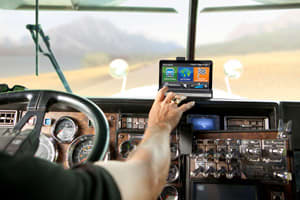
Navigation solutions have evolved beyond just the consumer market; trucking-specific units are bigger and easier to use for truck drivers. (Photo by Rand McNally)
Before adopting Maptuit's navigation system, drivers for expedited truckload carrier Armellini Express Lines had three choices if they got lost: wait for dispatch to jump onto Google Maps to get them back on track
; find a cop or a fire department to point them in the right direction; or call the customer for directions. And most people don't know how to give directions to a 53-foot tractor-trailer, says Jeff Jackson, vice president of operations at Armellini.
Palm City, Fla.-based Armellini runs the same routes every week, with about 10 to 15 stops per load. The company delivers perishables, such as floral products, so time is everything. "Once you get lost, things just go to hell very quickly," Jackson says. "The consequence of one wrong turn could cost 30 minutes of lateness."
Now, dispatch is virtually out of the picture, as drivers deal directly with the Maptuit navigation system. The company has reduced its out-of-route miles, largely because drivers are no longer getting lost. "If we do get lost, we only get lost for a minute."
The navigation system stays current to the driver's location, even if he's off route, so it can direct the driver back to where he needs to be.
Until the last few years, in-cab navigation devices were mostly viewed as a high-tech toy for consumers. But today, there's a rapidly expanding number of devices and systems designed specifically for trucking.
"Navigation is not just a toy; it should be used as a business tool," says Luke Wachtel, executive vice president of sales and marketing for Maptuit.
Truck-specific navigation
"Commercial-grade navigation is designed specifically for truckers, with features like truck-friendly and hazmat routes; up-to-date directions that don't require right-hand turns; and the ability to be customized for specific vehicle types and dimensions," explains Christian Schenk, vice president of product marketing at Xata Corp.
The trucking industry has much more discerning users, with greater expectations than a consumer, Maptuit's Wachtel says. That's because there's not as much room for error in trucking. An 80,000-pound mistake can be an expensive one, he says. A device that understands the industry and knows where a truck can and cannot go can save a fleet a lot of money.
"You don't see cars and airplanes using a truck GPS system," says Dave Marsh, head of product development at Rand McNally.
This year, Rand McNally rolled out its IntelliRoute TND 700, a new truck GPS device with a 7-inch high-definition screen and enhanced software features. Marsh says the company didn't just take a consumer unit and add truck stuff. Like the TND 500 introduced last year, the new device was developed from the ground up for professional truck drivers.
Marsh points out that truck drivers need to know the distance to exit earlier than passenger cars, because it's harder for them to change lanes. They also have a different eye level than passenger car drivers. The TND 700 was designed with those things in mind. It features a large screen that displays a yellow arrow and picture of the exit screen when trucks need to exit. "More is going on, so you want to make sure that distraction is not there."
In addition, the unit provides directions to the dock, rather than the front of the store or place of delivery, says Amy Krouse, spokeswoman for Rand McNally.
When TeleType was designing its truck-specific portable GPS, which was released in 2008, the company also looked closely at the specific needs of the trucking industry. For one, drivers need to know where they can go with some assurance, says Marleen Winer, vice president of business development at TeleType. There are some roads and bridges where trucks cannot go, size- and weight-wise.
TeleType's mapping system routes the driver based on the specifications of the vehicle, and the map changes color based on those specs, Winer says. This highlights the restriction area for the driver and provides the reason. The driver then has the flexibility to make a decision about whether to proceed. "They want more information, not less," Winer says.
Cobra Electronics launched its truck GPS system last year. It features map data from TeleAtlas, truck-specific routing from ProMiles, and truck points of interest from TruckDown Info International. The 7700 Pro plans routes after taking into consideration vehicle specs, including height, width and weight. The device also features Cobra's Aura Camera and Driving Hazard Database, which alerts drivers to the locations of fixed speed and red-light cameras, dangerous intersections and known speed traps.
Paccar this year rolled out a proprietary, in-dash navigation and infotainment technology system for Peterbilt and Kenworth trucks. Aside from vehicle diagnostics, hands-free phone capabilities, and other features, the system includes truck-optimized navigation from Garmin. It will route a truck based on the vehicle's type, load, height, weight, length and hazardous load restrictions information. The navigation system will alert the driver if he's going where the truck's not supposed to, even if the vehicle is off route. This includes sharp turns, low overpasses and high wind gust zones.
"It won't let that truck go where that truck's not supposed to go," says Tony McQuary, senior director of marketing and strategic business planning for Peterbilt.
The company is also working on a new feature with Garmin that would provide for eco-friendly routing. This would involve monitoring the vehicle's engine, transmission and fuel consumption. Garmin would also look at high traffic areas, elevation and road condition, and an eco-friendly route would be developed based on that, McQuary says. While it might take the driver five to 10 miles out of the way, it will put the truck on a more fuel-efficient route.
Staying connected
Unlike consumer systems, many of today's truck navigation systems are integrated with the back office.
"The dynamics of the market seem to be changing, in particular for private fleets, which previously were operating static routes," says Craig Fiander, vice president of marketing for ALK Technologies' PC*Miler solutions. "These fleets are having to become much more nimble to address the dynamic needs of the marketplace and to operate much more like for-hire fleets, hence the need for integrated navigation."
ALK offers truck-specific navigation through its CoPilot Truck offering, powered by PC*Miler routing, maps and miles.
Integration can provide route and driver flexibility, increased efficiency, greater journey predictability and better customer satisfaction, due to real-time customer feedback, ALK says.
ALK's CoPilot software and PC*Miler routing power CarrierWeb's new NavManager system. NavManager provides truck-specific, dock-to-dock, spoken turn-by-turn directions, according to Keith O'Brien, product marketing manager. The system is integrated with CarrierWeb's Web portal, where the dispatcher can build the trip step by step for the driver. Dispatch can then send the route directly to the device, where the driver clicks a "Navigate Me" button.
O'Brien says the technology saves time in the back office, as dispatchers don't have to help when the driver gets lost.
You also don't want the driver typing in the address to get directions while he's driving. With this integration with the back office, he doesn't have to, says Chris Silver, senior product marketing manager at Qualcomm Enterprise Services. Qualcomm runs Maptuit's NaviGo system on its mobile computing platform.
Silver says this connection with the back office provides flexibility on truck routing, putting the control within the fleet, rather than the driver. This feature is important when it comes to things like congestion, as the system offers tools for dispatch to reroute the driver.
According to TeleType's Winer, integration helps avoid double entry
More Fleet Management

Color Match Smarter: Tools That Restore & Perform
For fleet managers and collision repair professionals keeping heavy-duty trucks on the road, getting the color right the first time isn't just about appearance — it's about efficiency, turnaround time, and bottom-line results. Discover how today's digital color tools are transforming the repair process from guesswork to precision.
Read More →
FMCSA Pauses Biennial-Update Enforcement Amid Motus Transition
Carriers whose updates were due on or after June 1 have more time, while FMCSA works to stabilize its new registration system and warns of phishing sites impersonating its new carrier registration system, Motus.
Read More →
2026 Blueprint for Countering Smarter Supply Chain Theft
Cargo theft is no longer just the cost of doing business. It's a multi-billion-dollar criminal enterprise exploiting vulnerabilities across your fleet, drivers, and supply chain.
Read More →


How Telematics Improves Visibility, Control, and Performance in Refrigerated Fleets
Explore how telematics help refrigerated fleets improve visibility, uptime, efficiency, compliance, and cargo protection across connected cold chain operations.
Read More →
What the U.S.-Canada Trade War Means for Trucking
Escalating U.S.-Canada tariffs could disrupt cross-border freight, reduce truck volumes, raise costs, and create new uncertainty for carriers on both sides of the border.
Read More →
What Are Trucking’s Top Concerns for 2026?
The American Transportation Research Institute wants to know what's worrying trucking fleet managers, drivers, and other stakeholders in its annual Industry Issues survey.
Read More →
American Trucking Associations Looks for a New Leader
ATA President and CEO Chris Spear abruptly left his job at the association on August 21, at a pivotal time for the trucking industry.
Read More →
Public Wi-Fi Cybersecurity Risks: How Truck Drivers and Fleets Can Protect Their Data
Public Wi-Fi can expose truck drivers and fleets to credential theft, malware, and other cyber threats. Here’s how to reduce the risk on the road.
Read More →
For Nicky Cupp, Fleet Innovation Starts With Frustration
HDT Truck Fleet Innovator Nicky Cupp turns everyday pain points at Fraley & Schilling into opportunities for better technology and smarter processes.
Read More →
Adam Buttgenbach’s Approach to Electric Trucks: Start With Where They Fit
HDT Truck Fleet Innovator Adam Buttgenbach helped PepsiCo build one of North America’s largest EV fleets by focusing on where electric trucks make operational sense.
Read More →