




More about methane
Just over a week ago I 'penned' a brief column on the European launch of Volvo's new 'MethaneDiesel' FM tractor. It needs a little expansion
Just over a week ago I 'penned' a brief column on the European launch of Volvo's new 'MethaneDiesel' FM tractor. It needs a little expansion.
The company is set to market a long-haul tractor that's powered by up to 75% methane gas, the rest diesel, in a variable mix. In a standard configuration with a gross weight of 48 tons, the methane tank is good for a range of up to 300 miles in normal driving and then a switchover to diesel is automatic.
It'll be a European first -- making it a production item, that is -- but I wondered aloud if the Swedes might also bring their technology here.
Yeah, well, turns out it's not their good idea at all, rather it belongs to Clean Air Power of Lancashire, U.K. It's also the technology used in the International ProStar+ prototype powered by a 13-liter MaxxForce dual-fuel engine that Navistar showed off at this year's Mid-America show. Not only that, but it didn't have to travel far to get here because it originated at the Clean Air Power R&D facility in San Diego.<!break>
In case you didn't read about it at the time, that ProStar's 430-horse engine uses diesel pilot injection for combustion on the compression stroke and then mixes air and LNG on the intake stroke. In this case it runs on a mixture of 15% diesel and 85% natural gas, not 25/75 like the Volvo. The tractor's 119-gallon LNG tank provides a 400-mile range.
Navistar is currently working with the Environmental Protection Agency to define the regulatory requirements of an EPA-compliant dual-fuel engine.
Last time out I also wondered -- fearing I'd sound mighty dumb in the process -- if methane is the same as natural gas and biogas. I went on to define the three as best I could, saying I'd surely get a letter calling me an idiot.
Well, I did get a letter, from the kindly Brett Jarman, executive director of
NGV Global. That's the New Zealand-based International Association for Natural Gas Vehicles. I might as well just quote him here:
"Thought I'd help out on the methane/natural gas/biogas quandary," Brett wrote in an e-mail. "Firstly, no you aren't an idiot. The truth is that the terminology is being made up as we go along so there's no right or wrong in this whole deal (yet). We've actually initiated some efforts to define some of this within ISO processes but in the meantime, here's how we interpret this stuff.
"You are correct about methane being a major component of natural gas. As it's the 'active ingredient' of natural gas as far as natural gas vehicles are concerned, natural gas will sometimes be referred to just as methane. Biogas is a 'new' gas (i.e. not fossil) produced from some sort of organic source. It usually contains a whole bunch of impurities so for pipeline or vehicular use, it goes through an additional process to clean it up. The end result of this is commonly called biomethane and that's the biofuel that you'll find used in a natural gas vehicle, either on its own or blended with fossil natural gas."
I'll thank Brett publicly here, not just for my own sake but -- I'd guess -- for the many thousands of truck operators who are beginning to explore these 'new' fuels but get lost in the terminology. Yet I must admit that questions remain.
Navistar's dual-fuel International, for example, is fired up by both diesel and liquefied natural gas (LNG). Not diesel and methane. Should I care about that LNG-vs-methane difference? Is it just terminology?
As I understand things, LNG is cooled natural gas that condenses to a liquid occupying a volume that's just 1/600th the volume of the original gas. Volvo describes its dual-fuel FM tractor using cooled, liquefied methane in what sounds like an LNG tank, so I'm going to conclude that we're talking about the same fuel under different names.
But another question occurs as I write, and I'll be asking about this one: LNG can be 90% methane and all the way up to 100%. That's not a small spread so is there a difference in power density or bang for your buck? If we're buying such a fuel, and assuming this difference matters, will we know what we're getting?
It's clear that I could ask 413 questions about our collective launch into natural gas and still have many more besides, so I'll pick 'em off one by one. Stay tuned.
More Equipment

ZF Expands Commercial Vehicle Push in North America
ZF is expanding its North American commercial-vehicle presence with new transmission applications, electrification, trailer technology and autonomous-driving systems.
Read More →
Tesla Wants a Self-Driving Semi. Are Cameras Enough?
Could Tesla’s camera-only autonomous driving technology work on an 80,000-pound Semi? In this commentary, HDT's Deborah Lockridge takes a look at Tesla, Cybercab, and how autonomous trucks see the road.
Read More →
Kodiak: Driverless Long-Haul Truck Launch on Track for 2026
Kodiak AI says its driverless long-haul safety case is 93% complete and it remains on track to begin commercial operations by year-end 2026.
Read More →
What DOT’s Automated Vehicle Strategy Means for Trucking
The U.S. Department of Transportation issued a new automated-vehicle strategy that outlines plans for driverless-truck regulations, cross-state freight corridors, and federal safety standards.
Read More →
East Coast Port Launches $45M Electric Truck Push
The Port Authority of New York and New Jersey announced millions in incentives for zero-emission drayage trucks, yard tractors, and new charging hubs near the port.
Read More →
PlusAI Going Public to Fund Autonomous Truck Launch
A SPAC deal could provide PlusAI with up to $300 million as it works toward a 2027 commercial launch of factory-built autonomous trucks.
Read More →
NHTSA Moves to Rewrite Truck Fuel-Economy Rules
The National Highway Traffic Safety Administration says it lacks authority to regulate medium- and heavy-duty truck engines separately from complete vehicles, but the existing standards have not yet been eliminated.
Read More →
Detroit Opens Orders for EPA 2027 Engines
Detroit isn’t starting from scratch to meet EPA 2027 diesel emissions standards. Its Gen 6 DD13 and DD15 engines keep much of today’s platform while updating the fuel and aftertreatment systems.
Read More →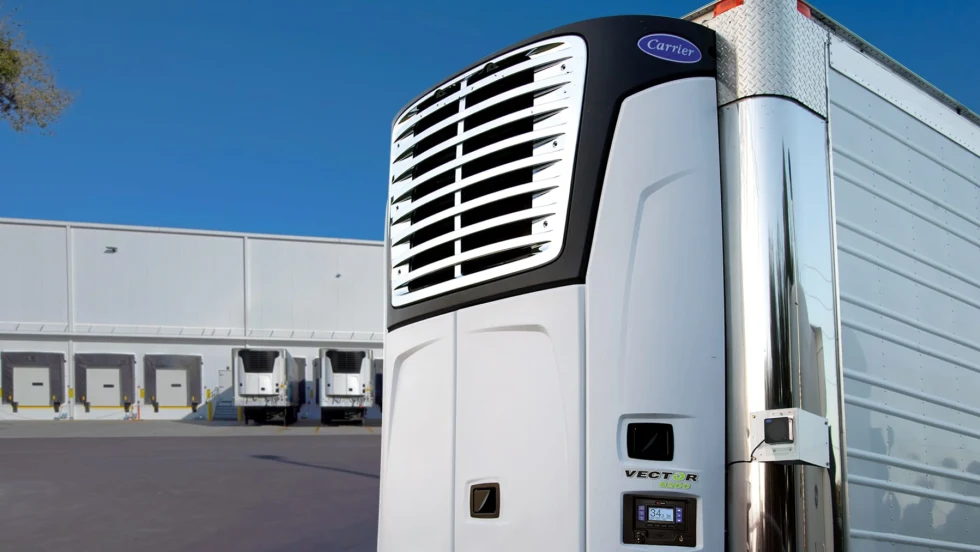
Carrier Transicold Adds All-Electric TRU for Stationary Cold Storage
Carrier Transicold’s new Vector 8200 all-electric transport refrigeration unit gives fleets a diesel-free option for temporary refrigerated and frozen trailer storage.
Read More →
A Closer Look at Kenworth’s Electric T880E Vocational Truck [Video]
Learn more about Kenworth's T880E battery-electric vocational truck at the Paccar Technical Center, including its range, applications, upfitting considerations, and PTO options, in this HDT Spotlight video.
Read More →