




More on the historic convoy: Motor Trucks in the Wild West
The Interstate Highway System at 50
A look back at the rough and tumble history of America's remarkable Interstate System.
by Steve Mitchell, Managing Editor
August 1, 2006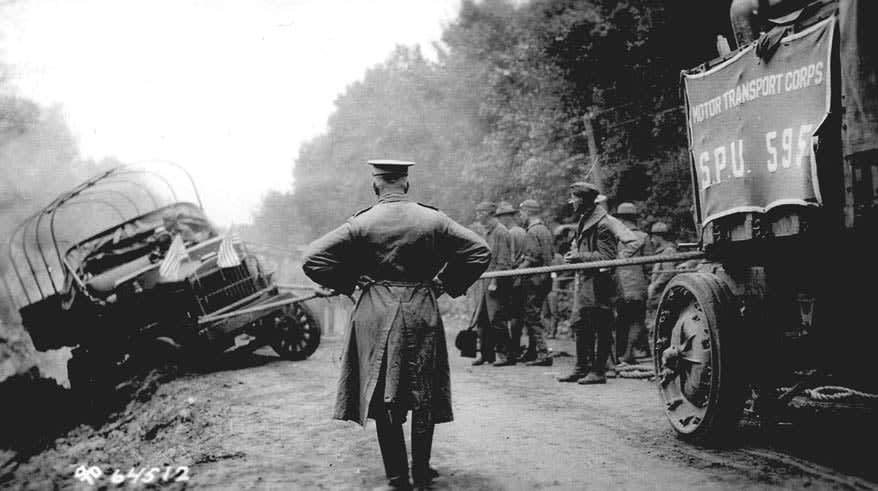
During the 1919 transcontinental convoy, soldiers use a winch to pull a truck out of a ditch.
Photo: Eisenhower Library
9 min to read
When the Pilgrims arrived at Plymouth Rock, they didn't just drop anchor, row ashore and hop onto Interstate 93 on their way to settle the New World.
Yet most folks figure the nation's interstates have been here forever, says John Horsley, executive director for the American Association of State Highway and Transportation Officials.
While these remarkable roadways have been around longer than most of the truckers and travelers who drive on them, they're actually quite young. In fact, the interstates turned 50 this summer.
Horsley thinks it's a shame so many motorists take this 46,837-mile cobweb of concrete for granted. Personally, he ranks the U.S. Interstate Highway System right up there with the Pyramids of Giza and the Great Wall of China as a true man-made wonder of the world.
HIGHWAY ACT SIGNED
When President Dwight D. Eisenhower signed the Federal-Aid Highway Act on June 29, 1956, he put into motion a massive engineering undertaking – the construction of nearly 50,000 miles of mostly straight roadways crisscrossing the nation with nary a stoplight in sight.
To commemorate the 50th anniversary of the signing, Horsley and his crew at AASHTO put their heads together to come up with a plan to properly celebrate the occasion.
Somebody said road trip.
So AASHTO – which represents all of the state transportation departments that built, own and continue to operate the interstate system – organized a caravan of 20 or so big rigs, RVs, buses and antique cars to cross the country in a convoy.
The two-week trip began June 16 in San Francisco's Lincoln Park and ended July 29 at the Zero Milestone marker just south of the White House in Washington, D.C. It was termed a great success; a joyous hallelujah to the highways.
The caravan served two purposes: to promote the highway system and ensure its future, and to pay homage to the original journey in 1919 that set in motion the idea of a highway system that would traverse states from coast to coast.
FIRST CONVOY IN 1919
A young Army lieutenant colonel named Dwight Eisenhower joined that first convoy, which departed the nation's capital by way of the Lincoln Highway for San Francisco in July 1919.
Like this summer's caravan, the First Transcontinental Motor Train had a two-fold purpose. The Army wanted to gauge the feasibility of moving military troops and equipment quickly across the country. In addition, government officials were along to promote improved roadways.
Worthwhile goals, considering the 1919 trip took 62 days and was fraught with mishaps, mud and mayhem.
In his book, American Road, Pete Davies said the original convoy was made up of 81 vehicles carrying 37 officers and 258 enlisted men. There were 46 trucks ranging from three-quarter-ton Dodge vans to huge Mack trucks. There were Whites, Garfords, Packards and Rikers, along with a number of cargo trucks.
In addition, there were 11 passenger cars for the officers and nine Indian and Harley-Davidson motorcycles for the scouts.
Then there was the Militor. Davies described this vehicle as a custom-built wrecker winch "that looked like an iron box bolted on to the back of a huge scarab beetle." The monster tractor was constantly being called up to pull or push vehicles out of the mud or deep ditches. At $40,000, it turned out to be the convoy's most valuable asset.
FRIED CHICKEN DINNER
Along the way the convoy stopped at a farm in Columbiana, Ohio, belonging to tire builder Harvey Firestone. Firestone fed the troops a fried chicken dinner, and he talked with great passion to Eisenhower and other officers about his "Ship by Truck" campaign, which encouraged manufacturers to use trucks to move their merchandise from coast to coast.
Firestone sent two of his own trucks equipped with his inflatable, pneumatic tires to join the Army motorcade, where most vehicles rode on bone-jolting solid rubber tires.
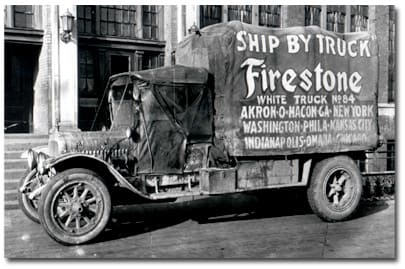
Along the way the convoy stopped at a farm in Columbiana, Ohio, belonging to tire builder Harvey Firestone. Firestone fed the troops a fried chicken dinner, and he talked with great passion to Eisenhower and other officers about his "Ship by Truck" campaign, which encouraged manufacturers to use trucks to move their merchandise from coast to coast.
Photo: Firestone
Driving cross country back then was a sort of connect-the-dots proposition, with portions of the existing Lincoln Highway offering paved roadways, long stretches of gravel and equally long portions of nothing. Army officers were constantly sending out scouts on motorcycles to find missing gaps in the highway or to come back with alternatives.
Mechanical problems were commonplace and there were more than 200 accidents, according to one account. Vehicles were routinely being pulled out of the mud by soldiers or out of deep ditches by the Militor.
Richard F. Wingroff wrote a 2003 article in Public Roads magazine that detailed an event-filled day west of North Platte, Neb., in which 25 vehicles skidded into roadside ditches.
There were hundreds of wood bridges to cross, many of them dilapidated and few of them able to carry the weight of Army trucks, tractors and personnel. One day in Wyoming, the convoy had to stop 14 times so engineers could strengthen a dozen bridges and completely rebuild two others.
WIND, DUST, LONG SPEECHES
Log entries also mention blasting winds, blinding dust, rain, hail, snow, slush and even quicksand as impediments to progress.
Also greatly hindering any semblance of a time schedule were the speeches. All along the route, people would gather at every stop on the Lincoln Highway to get a close-up look at these mud-caked trucks and weary soldiers. Politicians would pontificate about the need for new roads – especially the need for new highways through their own neighborhoods.
Towns and cities bickered fiercely for the privilege of feeding and housing the troops. City fathers staged dances, cookouts and parades at nearly every stop, offering up everything from lodging for the officers to ice cream and lemonade for the enlisted men. Several of these events sparked romances, with at least two soldiers marrying local women, according to news reports of the day.
By the time the convoy reached San Francisco, some 3 million Americans had cheered on the troops at some point along the 3,251 miles of mostly unpaved Lincoln Highway.
As a result of these frequent distractions – not to mention driving disasters – the convoy crawled along at an average 6 mph. Today, a motorist can cover in an hour the distance the convoy traveled in a full day.
IKE SUPPORTS "GOOD ROADS"
In his six-page report summarizing the two-month transcontinental trip, Eisenhower described to his superiors the poor condition of the Lincoln Highway, strongly suggesting that efforts be made "to get our people interested in producing better roads."
While the 1919 convoy planted the seeds of a national highway system in the future president's mind, what really sold him on the "Good Roads" concept was his first-hand look at the innovative autobahn roadways in Germany during World War II.
Boasting several thousand miles of paved highway across Germany, the high-speed autobahns enabled Hitler to quickly move ground forces from one end of the country to the other. Hence the term "blitzkrieg," which means "lightning war." By the time the Allied forces reached Germany, they found the autobahn invaluable for their own supply trucks and troop movements.
Wingroff's article in Public Roads quotes Eisenhower as writing: "After seeing the autobahns of modern Germany and knowing the asset those highways were to the Germans, I decided, as President, to put an emphasis on this kind of road building. The old [1919] convoy had started me thinking about good, two-lane highways, but Germany had made me see the wisdom of broader ribbons across the land."
Under the Federal-Aid Highway Act signed by Eisenhower in 1956, the federal government agreed to finance 90 percent of the construction costs of the interstate system – largely paid for by gas taxes. States were responsible for the remaining 10 percent of the cost, as well as upkeep.
Construction of the Interstate Highway System was officially regarded as complete in 1991, although work on some new roads continues. The initial cost estimate for the system was $25 billion over a dozen years. But it ended up costing $114 billion and took 35 years to complete.
When the first bucket of concrete was poured, there were only 120,000 tractor-trailers operating on U.S. highways, compared with the nearly 3 million rigs that ply the interstates today.
Thus, "Celebrate the Interstates" is a year-long recognition of a project that forever changed the way people and freight are transported across the country. It put motorists within days of everyone else in the country, and it turned trucks into rolling warehouses. The distribution of virtually all goods and services involve interstate highways at some point or another.
ROAD TRIP: THE SEQUEL
This summer's two-week re-creation of the 1919 road trip was a big part of the celebration. Making the journey in reverse – from San Francisco to Washington, D.C., this time around – the convoy crossed 13 states, with 18 major stops in a period of 14 days.
The colorful convoy of big rigs, tour buses and RVs changed shape daily as participants alternately joined up or dropped out at various points throughout the 3,000-mile trek across Interstate 80, which generally follows the route of the original Lincoln Highway.
Participants included Merrill Eisenhower Atwater, a great-grandson of President Eisenhower, and Andrew Firestone, great-grandson of Harvey Firestone, founder of Firestone Tire & Rubber Co., and a leader in the industrial revolution.
From the Golden Gate Bridge, stops included Reno, Nev., where convoy participants toured the National Automobile Museum. Then it was on to Salt Lake City for a huge barbecue dinner and speeches by local transportation leaders.
The next morning, Utah's leather-clad governor led the convoy to the state's border on his Harley-Davidson, inadvertently taking a wrong turn and moving the entire procession due north until state troopers could manage a mile-long U-turn.
Two overnight stops in Wyoming included speeches at a 8,640-foot-high rest area – one of the highest points of the interstates – and a transportation symposium the next day in Cheyenne.
Participants were greeted by bands and a farm-style picnic in Urbandale, Iowa, followed by a huge welcome at Walcott's Iowa 80 truckstop, where host Delia Moon Meier laid out fresh pies and sandwiches to accompany speeches by AASHTO and Iowa officials.
Other stops along the way included the National Test Road site in Ottawa, Ill., and the Studebaker Museum in South Bend, Ind.
ANOTHER CHICKEN DINNER
Firestone Tire and Rubber Co. hosted a fried chicken dinner in Akron, Ohio, replicating the meal served soldiers 87 years earlier by Harvey Firestone.
Following a tour of the Eisenhower National Historic Site in Gettysburg, Pa., the convoy arrived in Washington, D.C., on June 29 – 50 years to the day that President Eisenhower signed the highway legislation that would change the way America got around.
WHAT DID THE CONVOY ACCOMPLISH?
"We retraced the route of the 1919 convoy to mark the contrast from the hardships of 1919 to the freedom we enjoy today to travel where and when we want," said AASHTO's John Horsley at the D.C. ceremonies. "That mobility did not come about by accident – it's a legacy from President Eisenhower and the men and women who built this transportation system."
"The trip wasn't just about celebrating past achievements," said AASHTO President Harold Linnenkohl, commissioner of the Georgia Department of Transportation. "It's also about opening our eyes to look ahead to the next 50 years of the Interstate System. That's going to take the same kind of vision and commitment that Eisenhower brought to the job. But inaction really isn't an option."
Subscribe to Our Newsletter
More Fleet Management

Sponsored•September 16, 2026
Color Match Smarter: Tools That Restore & Perform
For fleet managers and collision repair professionals keeping heavy-duty trucks on the road, getting the color right the first time isn't just about appearance — it's about efficiency, turnaround time, and bottom-line results. Discover how today's digital color tools are transforming the repair process from guesswork to precision.
Read More →
FMCSA Pauses Biennial-Update Enforcement Amid Motus Transition
Carriers whose updates were due on or after June 1 have more time, while FMCSA works to stabilize its new registration system and warns of phishing sites impersonating its new carrier registration system, Motus.
Read More →
Sponsored•September 14, 2026
2026 Blueprint for Countering Smarter Supply Chain Theft
Cargo theft is no longer just the cost of doing business. It's a multi-billion-dollar criminal enterprise exploiting vulnerabilities across your fleet, drivers, and supply chain.
Read More →


Sponsored•September 1, 2026
How Telematics Improves Visibility, Control, and Performance in Refrigerated Fleets
Explore how telematics help refrigerated fleets improve visibility, uptime, efficiency, compliance, and cargo protection across connected cold chain operations.
Read More →
What the U.S.-Canada Trade War Means for Trucking
Escalating U.S.-Canada tariffs could disrupt cross-border freight, reduce truck volumes, raise costs, and create new uncertainty for carriers on both sides of the border.
Read More →
What Are Trucking’s Top Concerns for 2026?
The American Transportation Research Institute wants to know what's worrying trucking fleet managers, drivers, and other stakeholders in its annual Industry Issues survey.
Read More →
American Trucking Associations Looks for a New Leader
ATA President and CEO Chris Spear abruptly left his job at the association on August 21, at a pivotal time for the trucking industry.
Read More →
Public Wi-Fi Cybersecurity Risks: How Truck Drivers and Fleets Can Protect Their Data
Public Wi-Fi can expose truck drivers and fleets to credential theft, malware, and other cyber threats. Here’s how to reduce the risk on the road.
Read More →
For Nicky Cupp, Fleet Innovation Starts With Frustration
HDT Truck Fleet Innovator Nicky Cupp turns everyday pain points at Fraley & Schilling into opportunities for better technology and smarter processes.
Read More →
Adam Buttgenbach’s Approach to Electric Trucks: Start With Where They Fit
HDT Truck Fleet Innovator Adam Buttgenbach helped PepsiCo build one of North America’s largest EV fleets by focusing on where electric trucks make operational sense.
Read More →