




Match Dual Tires for Optimal Miles
Mismatched duals on truck drive axles and trailers can chew up tires and a fleet’s bottom line. Luckily, the fix is fairly simple.
September 10, 2019

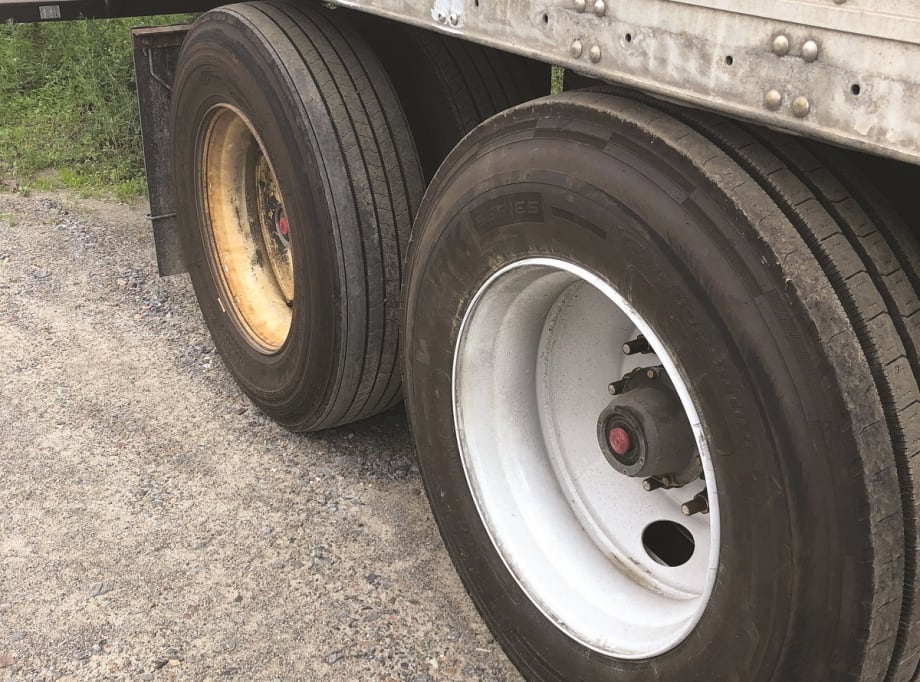
Sometimes spotting a mismatched older tire with a newer tire on a dual axle is simple.
Photos: Darry Stuart
6 min to read
At the dawn of long-haul trucking in North America, fleet managers quickly learned that single radial tires simply could not withstand heavy loads. To better distribute weight over tires and axles — and provide a sort of built-in “limp mode” should a single tire fail — the concept of dual drive and trailer tires was adopted, placing two tires side by side on both single- and double-axle configurations.
It’s still an approach widely used, even with the recent advancements in wide-based single tires. It provides a logical life-path for tires purchased new to be used time and again as they are retreaded and moved further and further back on the tractor-trailer until their casings are spent.
However, it is this unique “recycling” ability that can cause headaches, because matching tires with similar amounts of tread wear is critical on dual-tire axles. And it traditionally is one of the most overlooked maintenance issues.
When Dual Tires Are Mismatched
There are two ways dual tires can be mismatched — significant air pressure differences and tire height imbalances.
“There are still dual assemblies being mismatched, but overall, fleets and service technicians have become more aware of the tire performance consequences and are taking strides to eliminate the problem,” says Phil Mosier, Cooper Tire’s manager of commercial tire development.
Drivers are generally unable to recognize mismatched duals through feel or vehicle performance. Visual inspections, by both drivers and technicians, are the best way to catch mismatched tires before serious damage is inflicted on tires.
The strongest visual clues that there’s a problem are typically found in the smaller and/or under-inflated tire. The most common sign is irregular or uneven tread wear. The types of irregular wear include alternate lug wear, diagonal wear, multiple flat spotting, and erratic or inner rib depression wear.
That’s because whether you’re dealing with a pressure differential or a height problem, it’s the smaller tire in the set that bears the brunt of the damage. Two tires paired together on a dual assembly must have the same circumference (or height, or diameter) in order to cover the same distance as they roll along.
If the diameter or circumference of the two tires are even slightly different, the smaller of the two tires will scrub along the pavement trying to make up the distance traveled by the larger tire. It’s that scrubbing that kills tread life.
But the larger (often newer) tire doesn’t get off scot-free, either. Because of the smaller tire’s limited footprint, the larger tire has to carry a greater share of weight. This causes additional wear to the tread face of that tire and greater stress on its sidewalls.
So the smaller tire in a mismatched set of duals is being scrubbed to death, while the larger tire’s lifespan is being shortened because of overloading the sidewall.
How to Prevent Mismatched Dual Tires
For those reasons, fleet consultant Darry Stuart, owner of DWS Fleet Services, says the American Trucking Associations' Technology & Maintenance Council recommends keeping dual tires within ¼ of an inch in height in order to minimize scrubbing and ensure the tires work together on the road.
“I’m not as stringent on that spec as most people,” he admits. “Most people like a closer spec on the tire height. But I’m being honest about the labor costs required to match those tires up away from home. Are you willing to pay $150 to swap a tire out over an extra quarter of an inch when that truck is away from your shop?”
When looking at pressure differences, Cooper’s Mosier notes it is not uncommon to find dual tires with different inflation pressures — but it is far less common in fleets using automatic tire inflation systems. More and more fleets are investing in such systems because they realize the importance of maintaining proper inflation pressures, he says.
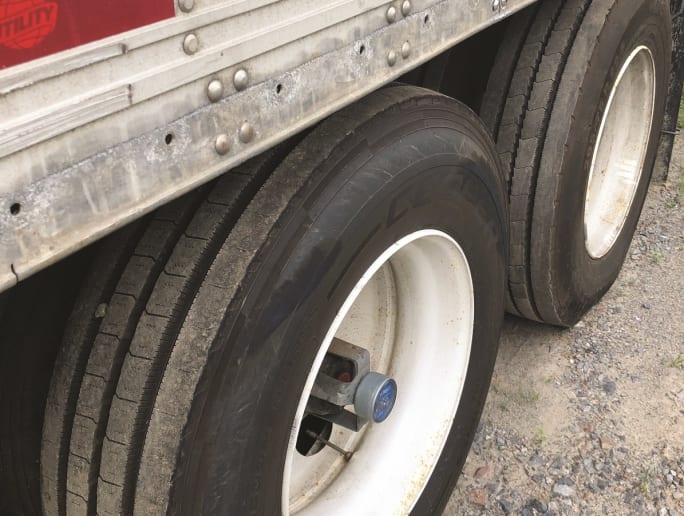
In many cases, spotting a mismatched tire means visually inspecting the tires for signs of scrubbing and other irregular wear.
Industry-wide, Mosier says, it is acceptable for dual assembly inflation pressures to be within 5 psi of each other.
A recent study at three different trucking companies revealed 79% of the dual assemblies fell in the zero- to 5-psi range; 16% were between 6 and 10 psi difference, and the remaining 5% measured at a 11 psi or greater difference.
"To put the 5 psi difference in tire pressure into perspective, the lowest inflation tire will have a circumference that is 5/16-inches smaller. During every rotation cycle, the smaller-circumference tire must scuff ahead to keep up with the tire with more inflation, just like two tires with mismatched diameters will do.”
Bryan Golden, vice president of fleet maintenance for Southeast Logistics in Tuscaloosa, Alabama, says mismatched-diameter tires are the bigger problem for his vehicles.
Golden has a reputation as something of a perfectionist, and says he prefers to keep his duals within 4/32 of each other in terms of height. But, he notes, his best efforts in the shop can vanish in a puff of rubber-scented smoke as soon as a truck is out of his sight.
Dealing With Emergency Tire Replacements
“We had a truck come in the other day, and when I looked at the trailer tires, one dual tire was a half inch off the ground,” Golden says.
“The problem is if there’s a blowout on the road and a tire has to be replaced. We specify 4/32 as our spec for dual tire height in all our vendor profiles. But usually a technician just grabs whatever tire is handy and puts it on the truck or trailer. And we won’t know about it until that truck gets back to the shop and we can take a look at it.”
Stuart agrees that most issues occur when a truck is away from its home base, noting that in all his years as a fleet manager, he can only recall a couple times when someone actually pulled a caliper out to measure tire heights.
“The real issue with duals is a new tire next to a worn tire,” he says.
Stuart recommends fleets take extra steps to match tires together and keep problems to a minimum.
“If you’ve got one bad tire on a double axle, you can get by with matching it up to the tire next to it, height-wise,” he says.
“But if you have four tires bad on a double axle, you’re better off replacing all eight tires on the double axles, then taking the four good tires you have left and match those up with any incoming truck that needs a single dual tire replaced.”
Keeping duals matched correctly can be a headache for fleets, but Golden has no doubt the effort is worth it.
“If you have mismatched duals, you’re just rolling money right out the door,” he says. “It’s a problem you have to train your people for, and stay on top of. But if you manage it correctly, the money you save goes right to your bottom line.”
Subscribe to Our Newsletter
More Equipment

How Volvo Updated Its D13 for EPA 2027 [Watch]
Volvo’s updated D13 promises lower emissions without sacrificing performance or fuel economy. Take a closer look at what changed inside the engine in this HDT Spotlight video.
Read More →
Michelin Tire Improves Efficiency and Durability for Regional Fleets
The Michelin X Multi Energy D2 is a regional haul drive tire engineered to help fleets improve fuel efficiency, durability and traction in demanding stop-and-go operations.
Read More →
ZF Expands Commercial Vehicle Push in North America
ZF is expanding its North American commercial-vehicle presence with new transmission applications, electrification, trailer technology and autonomous-driving systems.
Read More →
Tesla Wants a Self-Driving Semi. Are Cameras Enough?
Could Tesla’s camera-only autonomous driving technology work on an 80,000-pound Semi? In this commentary, HDT's Deborah Lockridge takes a look at Tesla, Cybercab, and how autonomous trucks see the road.
Read More →
Kodiak: Driverless Long-Haul Truck Launch on Track for 2026
Kodiak AI says its driverless long-haul safety case is 93% complete and it remains on track to begin commercial operations by year-end 2026.
Read More →
What DOT’s Automated Vehicle Strategy Means for Trucking
The U.S. Department of Transportation issued a new automated-vehicle strategy that outlines plans for driverless-truck regulations, cross-state freight corridors, and federal safety standards.
Read More →
East Coast Port Launches $45M Electric Truck Push
The Port Authority of New York and New Jersey announced millions in incentives for zero-emission drayage trucks, yard tractors, and new charging hubs near the port.
Read More →
PlusAI Going Public to Fund Autonomous Truck Launch
A SPAC deal could provide PlusAI with up to $300 million as it works toward a 2027 commercial launch of factory-built autonomous trucks.
Read More →
NHTSA Moves to Rewrite Truck Fuel-Economy Rules
The National Highway Traffic Safety Administration says it lacks authority to regulate medium- and heavy-duty truck engines separately from complete vehicles, but the existing standards have not yet been eliminated.
Read More →
Detroit Opens Orders for EPA 2027 Engines
Detroit isn’t starting from scratch to meet EPA 2027 diesel emissions standards. Its Gen 6 DD13 and DD15 engines keep much of today’s platform while updating the fuel and aftertreatment systems.
Read More →