




Making the Case for Low-Rolling-Resistance Tires
How do you explain to the boss that the tires you want to buy are going to cost more up front but run fewer miles? You can explain they will save money on fuel, but then she's going to want numbers.

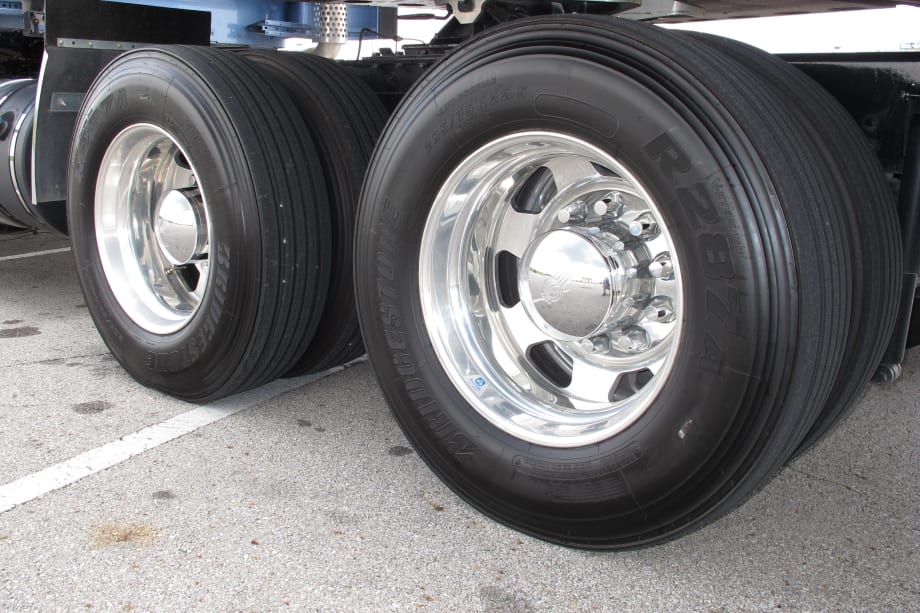
Premium all-position tires offer reduced rolling resistance through ribbed tread patterns and shallow grooves.
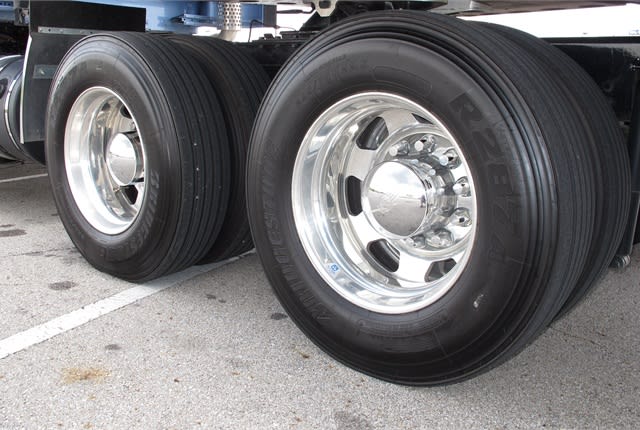
Premium all-position tires offer reduced rolling resistance through ribbed tread patterns and shallow grooves.
How do you explain to the boss that the tires you want to buy are going to cost more up front but run fewer miles? You can explain they will save money on fuel, but then she's going to want numbers.
If you do the research or run a fuel test, it's almost impossible to conclude that low rolling-resistance tires won't save you money. The toughest hurdle to get over is the mileage shortfall.
Many of the LRR tires on the Environmental Protection Agency's SmartWay list will run fewer miles to take-off, because most of those tires have less tread to start with. You'll probably get the same mileage per 32nd of an inch of rubber as any comparable tire (longhaul, regional, etc.), but starting with fewer thirty-seconds will inevitably take you a shorter distance.
Sorry, that's the way it is. It would be nice to drive as far on three-quarters of a gallon of fuel as you can on a gallon, but ...
There are a few inalienable truths when it comes to tires.
The tread – the pattern, the compound or the depth – produces much of a tire's rolling resistance.
Compromise in tire design is a delicate balance. If we push too far in one direction or another, traction, wear, or rolling resistance could suffer.
Fuel economy improves as tires wear.
Thus, today's low-rolling-resistance tires are a compromise between traction, reasonable tread life, and importantly, a tread pattern and compounds that roll more easily than other tires. Not surprisingly, some LRR tires handle these three criteria better than others. As well, some fleets may want tires with a combination of reasonable traction and fuel economy, or tread life and fuel economy. These are available, and you can arrive at the right tire for your application by asking your sales reps lots of questions.
Donn Kramer, director of product innovation, Goodyear Commercial Tire Systems, says the task of spec'ing the right tires has become much more challenging.
"Fleets should engage a trained tire sales person to help in calculating the differences in cost-per-mile for new tires and retreads versus fuel savings," he says. "There are so many variables now, and many different inputs are required to accurately calculate fuel economy savings."
Shallower is better
So what's wrong with deep treads? Nothing, if you're after a high-mileage tire and aren't worried about fuel efficiency.
Rick Phillips, the senior director of sales, commercial & OTR Products, Yokohama Tire Corp., points out that deeper tread has more "give" or "elasticity" in the individual tread blocks than the same tire with a shallower tread. That hurts fuel economy.
"The deeper tread causes increased rolling resistance, as the leading edge actually deforms when it rolls through the footprint," he explains. "This deforming of the tread increases rolling resistance, which has to be overcome with increased horsepower from the engine, which burns more fuel."
It's worth noting as well that some deep-tread tires may be more susceptible to irregular wear.
"Again, it has to do with the elasticity of the tread blocks," Phillips explains. "There is more 'squirm' or movement in a deeper tread block as it rolls down the highway, making it more susceptible to scuffing and scrubbing. This causes tiny flat spots on the tread, which will develop into larger spots as the tire turns over multiple times under load."
That's not to say shallower, low-rolling-resistance tires are immune to irregular wear, only that the thinner tread makes them less likely to wiggle their way an untimely end.
How much am I giving up?
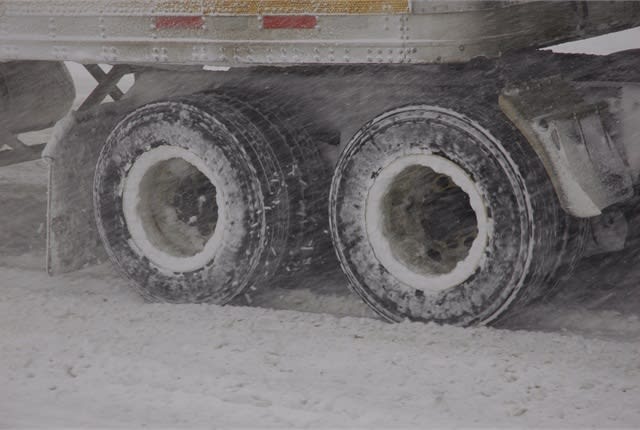
Perception or reality, drivers worry about traction. Don't dismiss their concerns.
Where no external factors are chewing up your tires, calculating mileage to take-off is easy once miles-per-32nd of an inch of rubber is established. Comparing a deep tire with 32/32 of tread to a low-rolling-resistance tire with 26/32 of tread, you subtract the tread depth of a typical pull point like 6/32.
"You could make the assumption that since the deeper tire has 18% more usable rubber that it should last 18% longer," says Yokohama's Rick Phillips. "In a perfect world that might be the case, but there are too many variables in play to make that assumption."
In a high scrub or heavy-haul fleet that experiences rapid wear, the calculation is more linear and, all things being equal, a deeper tread will typically prove to be more cost effective. However, Phillips says, "in a lighter load, higher speed fleet the results will be all over the board depending on maintenance, load, road surface etc. Air pressure, alignment and balance will also play a major role in how the tires will perform. And then there are modified tread compounds from shallow to deeper treads that will also affect performance."
You could drive yourself crazy worrying about the difference. According to Continental's Curtis Decker, "Take the loss in tire mileage and stack it against the fuel savings and the savings will trump the forfeited mileage every time."
How much can I save?
Tire manufacturers all make their own claims related to the efficiency of their tires. It's worth remembering that the figures you're likely to hear came from a lab or a carefully controlled test, not the highway of broken dreams.
"In our case, it's a perfectly clean number," says Guy Walenga, director of engineering, commercial products and technologies at Bridgestone Commercial Solutions Group. "But it's not necessarily a real-world number a fleet could take to the bank."
To arrive at a rolling resistance figure that can be translated into a fuel efficiency number, Bridgestone calculates the number of BTUs required to overcome a load of 1,000 pounds.
"We look at BTUs of energy, which we can translate into gallons of diesel," Walenga explains. "We ignore factors like aerodynamics, powertrain inefficiencies, type of pavement, etc. This is purely and simply a measurement of the tire's efficiency relative to the amount of energy required to overcome its rolling resistance."
Bridgestone and other companies also road-test and track-test tire designs and can arrive at some pretty accurate numbers. Whether it's a real-world number, a track number, or a lab number is up to the customer to determine.
What will a fleet see from a tire that claims, say, a 10% improvement in efficiency?
"This is where people start getting confused," says Curtis Decker, manager of product development at Continental Tire North America. "If you improve a tire's rolling resistance by 10%, that doesn't equate to 10% for the truck. Continental's calculations in Europe and North America indicate there's about ratio of about 3 to 1 in tire efficiency to truck fuel efficiency. It's reasonable to assume that with tires that are 10% more efficient, you'll see a 3% improvement in fuel economy for the truck."
What does 3% mean in the real world? There are just too many variables to open that discussion here. Tire manufacturers can take fleets through the exercise, but remember, it involves balancing upfront cost, lifetime mileage, application, traction needs or preferences, vehicle maintenance capabilities, operating climate ... and, of course, projected fuel savings. It's not an exercise for the faint of heart.
The most difficult part, perhaps, is waiting on the payback. With low-rolling-resistance tires, you'll pay more today, but the benefits will trickle in over two or three years.
"It's far easier to notice a shortage in tire life than to measure the improvement in fuel efficiency," says Decker. "It's also painfully easy to see a front-loaded cost than feel a rear-loaded benefit."
Making the case for LRR Tires
If you're the tire guy trying to explain to the accounting department why you're spending more money than usual for new tires that won't last as long as your old ones, you have your work cut out for you.
The biggest problem is a lack of communication, according to Walenga. The people who buy fuel and the people who buy tires don't talk to each other.
"Tire managers live and die by cost per mile, which is how much they pay for the tires and how many miles the tires last," he says. "Fuel managers, on the other hand, know how much fuel costs, but don't know what the fuel economy of the vehicle is, and they have no idea what tire rolling resistance does."
Walenga advises opening up the lines of communication and using data to build the case for the more fuel-efficient, low-rolling-resistance tires. Any good tire sales rep can demonstrate how their fuel-efficient tires compare with their longer-lasting but less efficient deep-tread tires, but in-service fleet fuel economy comparisons are the best way to prove the case in the real world.
"You'll need to run five or 10 trucks in similar service for a period of three to six months to get really accurate results," he says. "The longer the comparison period, and the more trucks that are involved, the better the data will be."
He recommends starting with new tires and measuring tread depth regularly through the study. That will provide an accurate estimate of how far the tires will run until reaching their established tread depth at removal. Of course, accurate fuel and mileage records are essential to the evaluation.
Rolling resistance – and fuel economy – improves as tires wear, and tread wear isn't always a linear calculation, but the results will provide a good estimate of lifetime results.
The Technology and Maintenance Council of the American Trucking Associations is nearly finished with an update to its Recommended Practice RP 208C (to be titled RP 208D), Tire Cost Determination. It will include calculations for fuel savings when evaluating the lifetime costs of low rolling-resistance tires, which is a pretty significant part of the reason for making the investment in that type of tire.
"You have to help the accounting people understand that there will be just a tiny bit of pain on the way to a serious long-term gain," Walenga says.
More Fuel Smarts

Trucking’s Diesel Squeeze Isn’t Letting Up
With diesel topping $6 a gallon nationally, ATA's Bob Costello explains why fleets should prepare for continued pressure at the pump.
Read More →
FlowBelow Redesigns Trailer AeroSlider to Cut Fuel Use
The lighter trailer aerodynamic system installs in less than 45 minutes, according to the company, with potential payback in under a year depending on fuel prices and trailer mileage.
Read More →
Why Diesel Price Relief Efforts May Fall Short
Diesel prices have eased from September’s record high, but doubts about additional Russian supply and limits on dyed-diesel tax relief mean trucking fleets still face expensive fuel. And prices could go higher.
Read More →
Why Small Fuel Savings Matter in Trucking
Can better fuel economy help pay for driver raises? In this podcast, GP Transco explains how small efficiency gains create room to reinvest in its people.
Read More →
How GP Transco Cuts Trucking Fuel Costs, a Tenth of a Gallon at a Time
What’s another tenth of a mile per gallon worth? GP Transco shares how equipment upgrades and driver coaching turn small gains into meaningful fuel savings.
Read More →
Electric Yard Tractors Move Beyond Pilots
Operating-cost savings have overtaken sustainability goals as the leading reason surveyed fleets are adopting battery-electric terminal tractors, according to new NACFE research.
Read More →
Geotab Links Fleet Card to Vehicle Data
The new card combines fuel discounts with telematics-based purchase controls. Geotab’s analysis also points to potential savings from choosing lower-priced fuel stops.
Read More →
Fleet Economics Shape Electric Truck Outlook
ACT Research expects costs, charging infrastructure, and technology improvements to drive zero-emission commercial vehicle adoption as federal regulations and incentives retreat.
Read More →
Wex Adds Cardless Fuel Payments for Over-the-Road Customers
A new fuel card feature for Wex customers offers convenience and security.
Read More →
New California Law Could Shed Light on Electric Truck Prices
Why do battery-electric Class 8 trucks remain so expensive? A California bill signed by Gov. Gavin Newsom would give fleets and state agencies more visibility into what manufacturers charge.
Read More →